Really a very enjoyable book from Randall Munroe, which takes the graphical style of his brilliant going-15-years-and-still-funny xkcd web comic series, adds to it the self-imposed restriction of only using the thousand most common words in English, and pits it against various everyday “things” and attempts to explain them.
You get cross-section views of things like a datacentre (“computer buildings”), dishwashers (“box that cleans food holders”), and laptops (“bending computers”), as well as more abstract things like the US Constitution (“laws of the land”) and the periodic table (“the pieces everything is made of”). Munroe clearly had a lot of fun not just picking the things to explain, but coming up with cute names for them (“sky boat with turning wings” for helicopter, and so on). It’s perhaps a bit more fun if you actually know what he’s talking about, so you can work out what the actual concept he’s getting at is, but it’s fun even when I couldn’t quite get it!
Is this a book you could give to (say) a child, and expect them to learn about microwave ovens, or the Mars Rover? Perhaps not without additional guidance, but for grown-up kids (like me) it’s a delight. It’s charmingly done, and makes a much more entertaining coffee table book than many (physically it’s quite big – 23x34cm, although not super thick at about 1cm).
Four stars for flair and execution, and a bunch of fun.
A second excellent book The Invisible Library series, this picks up the story from the first book as Irene becomes Librarian in Residence in the slightly magical, slightly steam-punk, Victorian England, together with Vale, the great detective (think Sherlock Holmes, thinly veiled, as it were), and Kai, her apprentice. Kai – who we discovered in Book 1 is in fact a dragon, a creature of Lawfulness, working in human form – goes missing, taken by the Fae, who represent the side of Chaos.
As a Librarian, Irene is in theory neutral in this Lawful/Chaos struggle that spans many thousands of worlds in many times, but as Kai’s mentor, she feels a responsibility to find out what’s happening. From this, the plot is spun. And it’s a cracker, moving things into a Venice that’s much closer to the Chaotic side of things, where it’s always Carnival, and masks are de riguer. For me it slowed a little in the middle perhaps, as we started in Venice, but that was a momentary pause lasting only a few dozen pages, before things cranked up to full volume for the sparkling finale.
You perhaps don’t have to have read book 1, The Invisible Library first, but honestly I don’t see why you wouldn’t, as that’s a great book, too. Four and a third stars, for me.
On Playboy Bunnies, Princesses, Trainwrecks and Other Man-Made Women
For me this was an insightful and interesting exploration of the role women have played in (largely American) culture since the mid 1800s, seen through the lens of their portrayal in popular media. The author was a TV and then a film critic, and she looks at the roles women have been given to play, from The Philadelphia Story (1940) through The Stepford Wives (1975) to Frozen and beyond. Her take on things is always insightful and witty, and she made her points very well. I’m a late middle-aged, cis-gendered white man, and I was thoroughly enraged by the way in which women have been expected to politely play nicely as either background or suitable companions for the hero throughout the ages.
This sort of segregated role for women seems to be a creation of a post-industrial age. Hunter-gatherer societies will often have had men and women in broadly separate roles, but this didn’t imply any kind of power hierarchy – women in such societies would have openly laughed at the idea that men were “in charge” of anything (see Margaret Mead’s writings, for example). Such a hierarchy was present in the upper echelons of medieval society in the West, however, as women were often seen as useful pawns in the political wars of the time. I think some of the responsibility for this is the view clearly expressed by the Abrahamic religions that women need to be kept separate from men, and increasingly subordinate to them.
Quite how we get out of this, I’m no clearer than the author, but it’s clear that for the sake of everyone involved, we really need to find a better way to be in the world. This book reveals the “patriarchy” as alive and kicking back, and it’s not good for anyone involved.
Another fun romp into a different version of the present day from Neal Stephenson. This one is about exploring different kinds of “present day”, as well as different possible histories! Our hero is Melisande (Mel) Stokes, a linguist of languages both ancient and modern, who is recruited by Tristan Loyd to translate a number of ancient documents. But first she has to sign the NDA, promising not to tell anyone about any of this, ever. Since she hates her current boss and her job as an overworked, underpaid, untenured lecturer at Harvard, she accepts the offer, and finds she has joined the mysteriously named DODO.
In due course, she finds that DODO are trying to build a machine in which people can once again perform magic – even though magic seems to have disappeared from the world in 1851. Magic, we in due course discover, is done by people who can access other “threads” of the present moment – alternative versions of the world that have split off but are still intertwined with ours. It’s all based on the Many Worlds interpretation of quantum mechanics, which holds that such world-splittings happen literally at every moment. People who can do magic – witches – can manipulate these threads in some way.
So Mel’s job evolves into recruiting a witch, keeping the witch on-side with the programme (witches turn out to be incredibly high maintenance), and working with the expanding crew in DODO to achieve their ultimate aim – using magic to “tweak” the past to the geo-political benefit of the current United States.
The characters are well drawn, perhaps with a little too heavy a hand in one or two places but not bad. And the plot is spun with the characteristic humour and wit of Neal Stephenson. I loved in particular the clashing of the two cultures – one represented by Mel and Tristan and their start-up style organisation, the other the full-press acronym-loaded bureaucracy and hierarchy of the US government, who we soon find out are funding the whole DODO thing. Delightful!
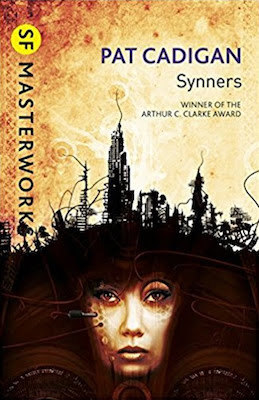
This is another early cyberpunk work – I seem to be having a couple of months where classics like this are appearing in my to-read queue! Pat Cadigan writes beautifully, and she brings more to the individual characters than many of the other early cyberpunk authors. See this insight into the mind of one of the lead characters:
She had the guilts over the coffee even as she couldn’t wait to drink half of it at one gulp. Modern life was making her sick by trying not to make her sick.
The underlying theme is our interactions with our technology – how much do we change for it, as opposed to changing it to work better for us. Gabe, the protagonist, is a “synner” – a synthesizer, who can take images from the brains of artists and spin them into a media package suitable for mass consumption. Here he is, spinning off down this thread when he’s standing in front of a vending machine, and someone says he looked like he might need a few coins for it:
‘Ah. I thought you looked like you needed, um, change for the machines.’ Gabe shrugged self-consciously; he could feel the entire common room watching. The man’s smile was unexpectedly broad and sunny. ‘That’s a good way to put it. How did you know?’ Gabe had the sensation of going over a mental speed bump. ‘Excuse me?’ ‘My whole life has been, “Okay, change for the machines.” Every time they bring in a new machine, more change.’
In this future, a new technology – called sockets – is emerging, which allows people to plug themselves directly into the “dataline” – what we might call the Web. Synners who can do this become vastly more capable, and more commercially valuable. But is it dangerous? – what if there are monsters out there?
Neurons start firing in patterns over and over, and if they’re bad patterns, well, that’s too bad. You people got no shields. You put in sockets, but you forgot about the watchdogs and the alarm systems and the antivirals and the vaccines.
Reality isn’t out there, it turns out, it’s in our heads. The line for Gabe and his friends becomes increasingly blurred, and the action increasingly frenetic. Great stuff, from one of the founders of cyberpunk.
A Brief Guide to the Fundamental Mystery of the Mind
by Annaka Harris
This is a brief introduction to the mysteries of consciousness, with much to commend it. It starts a conventional definition, after Thomas Nagel: “An organism is conscious if there is something that it is like to be that organism”. From this starting point, Annaka Harris takes us via an interesting series of viewpoints to a view of consciousness that she acknowledges isn’t really the mainstream view – that of “pan-psychism”, which is that consciousness may be an inherent quality of matter even down to the smallest levels – electrons may be, in some tiny atomic way, conscious. From these small components, consciousness as we know and experience it as humans is produced.
The route to this conclusion covers some ground that may be familiar to many readers, such as David Chalmers’ “philosophical zombies” – people who look and act exactly like you or I, but who (by definition) do not have conscious experiences. It also covers some territory that was new to me, such as the discussion about trees and how they seem to communicate via their roots tapping into underground mycorrhizal networks. This was fascinating to me, and lead me off to all sorts of interesting searches – this was a nice summary I found.
The argument is overall well put, but I felt there were difficulties that had either been skipped for simplicity, or simply weren’t acknowledged. For example, Harris says that “as far as consciousness is concerned, there is nothing, then suddenly, magically, at just the right moment …. something!”. It’s not clear to me that this has to be the case. Introspectively, I am conscious at some moments to a greater degree than others. When I fall into a deep sleep, does my consciousness finally switch off at a defined point, or is it more like sunset on a cloudy day: it gets darker and darker, and eventually it’s definitely completely dark, but there was no one moment when the last light was extinguished. It seems to me consciousness is more like this – continuous, not discrete. And if the claim is that it’s discrete, I’d hope for a discussion of the point.
As another example, one of the traditional arguments against panpsychism is discussed in the book – the “combination problem”:
The problem is that this is very difficult to make sense of: “little” conscious subjects of experience with their micro-experiences coming together to form a “big” conscious subject with its own experiences
Harris argues that this problem isn’t present in versions of panpsychism in which consciousness is a fundamental feature of the universe, as consciousness is not interacting with “itself”, as it would be if it were combining. Think of gravity: individual atoms have a tiny amount of mass, and thus of gravitational attraction, and they can combine perfectly happily to produce a large planet with its own gravity.
This argument, it seems to me, can apply just as well to the “emergent” view of consciousness, where consciousness emerges as the appropriate kinds of information processing capabilities combine in an appropriate way. But Harris has already dismissed the possible emergence of consciousness by saying that it doesn’t really explain it at all:
…when scientists assume they have bypassed the hard problem by describing consciousness as an emergent property – that is, a complex phenomenon not predicted by the constituent parts – they are changing the subject …. If some matter has experience and some doesn’t (and some emergent phenomena entail experience and some don’t), the concept of emergence as it is traditionally used in science simply doesn’t explain consciousness.
But simply defining consciousness as something that all matter has, it seems to me, isn’t a good way out of this problem. Announcing that everything has consciousness, down to electrons and protons, and therefore some things get to be what we call conscious, is either a way of hiding from the hard problem (“everything is conscious, so no wonder we are”), or just causes the emergence problem to emerge in a different place (how does what we historically cause consciousness appear from combining a lot of this subatomic consciousness – and you can’t use emergence as you’ve already dismissed this!).
In the end, there was a lot to like about this book, and I found it hard to pick a final star rating. This is a three-and-a-half star book for me. Lots to like, some interesting new ideas, really nice to see a readable book on such a complex issue, although it was too short to do enough justice to all of its subject matter, even for a self-confessed “brief guide”. In the end, I have gone with four stars, to encourage Ms Harris to write more on this, and to guide readers to an interesting book.
Very nice little book of mathematics, as applied to various Christmas problems.
Although this is in the long tradition of seasonal stocking-fillers, the execution was great: the maths was non-trivial, but not so hard as to require a degree in the subject (although there were extra-hard sums in the footnotes, where appropriate), and the whole subject was treated with the appropriate degree of tongue in cheek sillyness:
Maybe that’s how we should see Santa. An undecidable being. You can’t prove his existence one way or the other, you just have to close your eyes and decide for yourself.
In the meantime, everything from simple geometry to Markov chains was used to solve various seasonal sillynesses. Excellent!
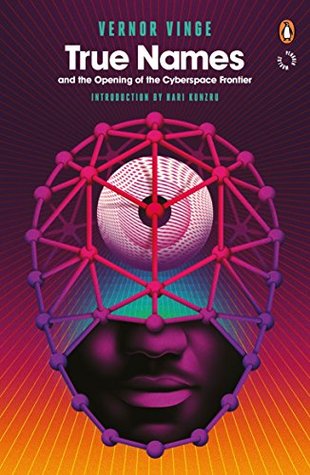
A classic story from the early days of Cyberpunk, when the internet was a thing known only to a few academics and scientists, from 1987 and the dawn of the World Wide Web.
We meet hackers – Mr Slippery is the main protagonist – and we meet them as they fight their way across the global networks, or the Other Plane as it’s known. The fight each other, they fight cyber criminals, and they fight the government. But Mr Slippery finds himself arrested – or threatened with arrest – unless he helps the government (the NSA?) fight back against the Mailman, an international dark hacker, or Warlock, who is recruiting other Warlocks to his side.
The title comes from the believe that you need to keep your true name secret, for it will give others power over you. Mr Slippery’s true name becomes known to the government, giving them a hold over him. Now he must find the Mailman’s name, and protect his own.
The book is one of the defining works of “cyberpunk”, perhaps with less “punk” than William Gibson, but a full dose of “cyber”. It hasn’t lost its power, either way.
Another excellent showing here, with Mercy Thompson getting caught up with the local vampire seethe, whilst trying not to get her friendly neighbourhood werewolves too entangled in the resulting mess. The tone was sometimes much darker than the first of the Mercy Thompson books, as getting involved with the vampires seemed to involve getting a whole lot of blood over many things. If you don’t like your urban fantasy too gritty, this might be a problem, but I felt it was all in keeping with the plot, and none of it was gratuitous or merely put in to shock.
Four stars this time instead of five, as I was a little alarmed with the way an increasing number of the other main characters seem to be falling romantically for Mercy herself. I also wasn’t totally convinced by Mercy’s motivations to go out hunting alone again in the final 30 or so pages of the book. Still, very enjoyable, and I’ll be reading more!
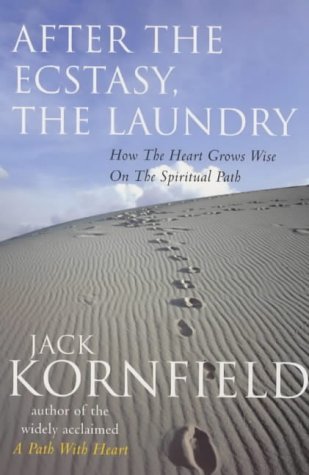
This classic book explores the experience of meditation and spirituality through quotes and stories from nearly a hundred very experienced practitioners, ranging from nuns and priests to Zen masters and Tibetan Buddhist lamas. They’re all anonymous, so that they could speak freely, and they talk about the highs and lows of their journey. The title tells the story: we might spend hours, days, or even months at the highest spiritual plane, but in the end we still need to clean our teeth and wash our smalls. Even though this may feel like we’ve fallen, in fact we are just living, right here right now in the moment, and that’s the highest achievement we can hope for.
There are so many beautiful quotes and passages in here. Even though in the end I couldn’t quite give it five stars because sometimes I just plain lost the thread through the chapter, there are some lines that are just heartbreakingly beautiful, and capture the human condition to a tee:
Underneath all the wanting and grasping, underneath the need to understand is what we have called “the body of fear”. At the root of suffering is a small heart, frightened to be here, afraid to trust in the river of change, to let go in this changing world. This small unopened heart grasps and needs and struggles to control what is unpredictable and unpossessable. But we can never know what will happen.
Just so. Four and a half stars, and a massive hug to you all.