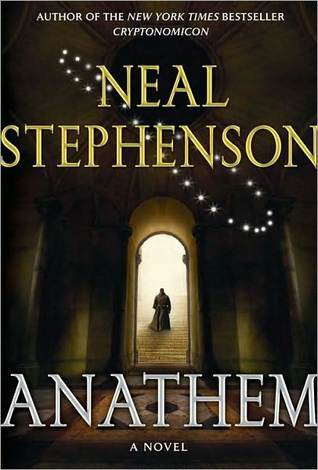
Not many authors can start off in the “mystery world” genre, tour through hard science fiction, and end up being about what it is to be a conscious being, all while keeping your attention. It’s a tribute to Neal Stephenson that he can steer this path with Anathem, and make it thoroughly entertaining with it.
We start off in a world occupied by “fraas” and “surs”, who we soon work out are the friars and nuns of some kind of secluded community. Once every few years – 10, 100, and 1000 years, it turns out – the gates of these communities are opened, and for ten days the inhabitants can go out and mix with the “extramuros”, that is, those who live in the secular society outside the walls. Turns out this has been going on for nearly four thousand years. Only this time, events start to happen which turn that regular, ordered, world almost literally inside out… We get to follow along, narrated by one of the fraas, through all sorts of adventures – which I won’t mention because, spoilers. And once I’d made it through the first 100 pages or so, and was beginning to get to grips with the odd vocabulary and all the new words, this was a great adventure, excellently told.
One thing I will say is that this isn’t a book about monks and nuns, so don’t let that first 100 pages put you off. It’s a book about many things, but perhaps most of all it’s about the human consciousness – what it might mean to have one, why and how we might have one in the first place, and what the outer limits of having one might be. It’s set on a world very similar to Earth in many ways, and contains all sorts of entertaining indirect references to science curiosities we might know on Earth – from Roger Penrose’s non-periodic tiles to Kurt Godel’s theory of time travel. All done with Mr Stephenson’s usual flair and wit.
In the end, this was almost a totally brilliant book for me, and just missed it by not quite exploring some of those possibilities far enough. So four stars, not five, but definitely worth a read.
The Poppy War is a fantasy novel with a difference. Most such novels are set in a sort-of Lord of The Rings lineage of countries, which all look a lot like medieval England (with greater or lesser degrees of grittiness, but with wizards, and of course lots of men with mighty thews and huge swords.
Instead, here we are in a country like medieval China, with shamans who are linked to sixty-four fantastical god-like creatures, and women with wicked martial arts skills – oh, plus a few mighty-thew’d warriors to round out the numbers. This does give the whole thing a very different flavour, which I have to say I enjoyed. The exploration of this culture, and the way the empires have grown (and are falling), was well done throughout, and definitely deserving of praise.
Better still for me was the main character, Ren, and the portrayal of her inner conflict between duty and vengeance, as she grows from fighting to survive, to fighting for her country, to fighting for her friends. It’s a great piece of character development. We see her start as a young war orphan in a shop in a rural village, then through sheer force of will and determination, we watch her pass the tough exams to attend the prestigious war college – her only way out of this life other than through an arranged marriage to a man 20+ years her senior. From there, we follow her through the college, and into the real war that breaks out before she’s had time to even graduate. It’s then, in many ways, that the really interesting action starts. I did feel a times though that this was a longer book than it might have needed to be, and perhaps some of the build up to this might have been judiciously edited down.
It’s worth warning that some of the writing in the battle scenes in the final third of the book is very dark. One of the themes of the book is about how when we cease to see the “other side” in a war has human, that (a) makes the war easier to fight for the soldiers, and (b) produces extraordinary brutality. You are treated to this in full. I think of myself as mentally quite robust, and am entirely used to high levels of gore in movies, etc, but this gave me some quite unpleasant dreams. Enough said.
So, overall I’m giving this 3-1/2 stars, rounded up to 4 stars. The novelty of the setting and the characters, plus the higher-level themes, elevated this above your normal fantasy novel. Just not for the faint of heart!
I genuinely didn’t know what to expect here – I’d previously read one of David Mitchell’s books and greatly enjoyed it, and was a little uncertain what I’d got myself into as I read the first section, a series of diary entries written by someone in 19th century New Zealand.
Then I was even more confused, when just as I was beginning to get the hang of things, and literally in the middle of a sentence, we jumped to the next section, to another continent and perhaps a hundred years later.
And so it continued. In the end, there were half a dozen sections, each lightly connected to the previous one and separated by some number of years. We see different narrative voices, many years apart, threaded cleverly together into a beautiful braid. The plot winds firstly forward through them, and then backwards.
The effect is beautifully done – the writing is entrancing, with great world-building and beautiful scenes created for you, all tangled through with intriguing plotlines. I didn’t engage with some of the characters as successfully as with others, but that’s perhaps always the nature of these things. And perhaps if I were picky, one or two of the plot lines were a bit forced. But overall, I greatly enjoyed it, despite my (snobby) uncertainly created by the “Selected by Richard and Judy book club” on the cover. Shame on me, and four stars for David Mitchell!
I very much enjoyed this version of the Bhagavad Gita, I have to say. It was, above all, readable, written as it is in modern English, This meant that (in contrast with some other translations of classics of world literature) I wanted to come back each time and read more. So bonus points to Jack Hawley, PhD, for accessibility.
The Bhagavad Gita is framed as a conversation between Arjuna, a warrior prince, and his charioteer, Krishna, who is the divine made into human form. It is described as
a universal love song sung by God to His friend, man. It can’t be confined by any creed. It is a statement of the truths at the core of what we all already believe
. I’m a secular person, with some experience of Buddhism, plus the benefits of an English school education on the bible, and I could clearly see the parallels with Buddhism, although those with Christianity as it’s usually currently interpreted were less clear. Perhaps with Bishop Berkeley and his more pan-psychism moments. I could take or leave the more Divine moments myself, but it’s entirely possible to read this as about the larger Self, rather than requiring an external divinity. It has a lot to say about how life should be lived, regardless of your beliefts. Clearly, for example, it’s a foundation text for Hinduism, and one can see how it inspired M.K.Gandhi throughout his life.
Although I’ve of course never read the original, Mr Hawley was clearly trying very hard to convey the nuances of the different meanings of the words of the original. He did this in prose which was always clear, and at times also quite beautiful. At a text that’s at least 2,000 years old, perhaps much older, it’s also astonishingly relevant to our modern world. Consider the following:
The downward spiral to one’s ruin consists of the following process: Brooding on worldly attractions develops attachments to them. From attachments to sense objects come selfish desires. Thwarted desires cause anger to erupt. From anger arises delusion. This causes confusion of the mind and makes one forget the lessons of experience.
. That’s more or less stock advice from many self-help books today.
I enjoyed reading this, I’ve highlighted lots of sections, and I’ll dip into it again. A good four stars.
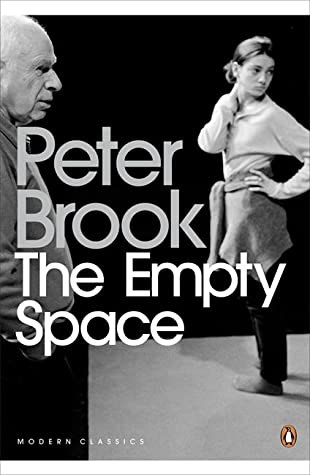
This slim book sets out to be an analysis of theatre, from one of the most significant directors of the second half of the 20th century. Actually, it’s not about that: it’s about life. Peter Brook analyses theatre performances into four categories, while acknowledging that any performance can flip from one to another category in a few words. It’s completely timeless, by the way – it was written 50 years ago, but could have been written last year.
The first is Deadly Theatre. Theatre as “tradition” and “heritage” and “because that’s just how it’s done”. This was brilliantly caricatured in the third series of the wonderful Blackadder, where two actors try each the befuddled Prince Regent (Hugh Laurie) to improve his public speaking, explaining to him how you need to thrust your groin forward, throw out your arms, and start every declamation with a loud “Aaaaaahhh!!!”. It means theatre as a caricature of itself, acting with an arch view of how acting “ought” to be. In life, I see this all the time: meetings held “because this is when we have this meeting”, corporate decisions guided only by the dead hand of expectation, dismal social conventions because that’s how it was done 20, 30, 50 years ago.
Then there is Holy Theatre. This is when, as Mr Brook puts it:
it could be called The Theatre of the Invisible-Made-Visible: the notion that the stage is a place where the invisible can appear has a deep hold on our thoughts.
It’s when we see theatre performed with beauty and with love (which) fires the spirit and gives them a reminder that daily drabness is not necessarily all. Life as it out to be lived, for the moment, or for the value we bring to others.
Next comes Rough Theatre. Theatre not necessarily performed in traditional venues, but less formal, truer perhaps to the original spirit, more energised by improvisation. It is contrasted with Holy Theatre in that the former tries to look at hidden motives, while the Rough looks at real events and actions that directly affect the viewer.
Finally comes Immediate Theatre. He describes this as theatre that “asserts itself in the present”, which I think means theatre that connects and reflects directly to what’s in our hearts at the moment. He certainly talks more of the interaction with the audience in this chapter, and how much they bring to the experience. Contemporary satirical comedy, with an emphasis on the current political and social climate, and heckling from the audience turning into part of the act, seems to fit in here. More formally, Mr Brooks talks about working with actors to see how the pacing of a speech from Shakespeare might sound in modern prose, and to use that phrasing to connect and convey feeling to the audience. It’s very much about directly engaging with the audience.
Although the boundary between these four isn’t always clear, it does seem to me that if you think of them as four overlapping circles*, rather than four squares with a clear division between them, then it does make a deal of sense. And, I think, this is a very interesting perspective to bring to the world of work, and of our lives. Experiences where advertising seeks to create false “deadly” aspirations, moments in nature that are “holy”, or when we find flow in a “rough” DIY task, or when our interactions with a child are “immediate”.
Four stars for powerful stuff.
(*OK, technically to get each one of four things to overlap with the other three, you need to think of it as four overlapping spheres in a pyramid, but people look at me oddly when I say things like that, and I think you all knew what I meant anyway)
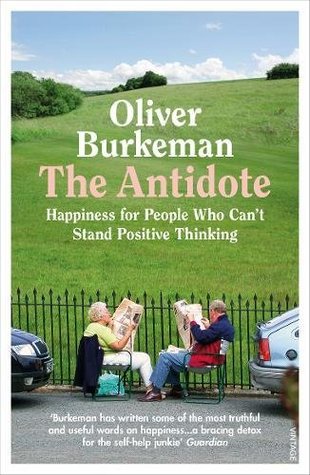
I bought this book as a present for my wife, who would have no shame in admitting that she can’t stand all the “positive thinking” malarkey. She read it, and didn’t really enjoy it, finding that it had many of the same messages for how to be happy but without the “positive” sticker on the front. So I was curious as to what lay within…
And once I’d read it, I could see her point. Many of the conclusions that Mr Burkeman comes to are, indeed, those that you might read elsewhere, but without the same spin: you would read elsewhere of the benefits of mindfulness, of Stoicism, of self-awareness in many websites and books.
The spin here, if there is one, is that you don’t have to do these things with any view that they are designed to be positive affirmations. You can just do them because they seem to work. Plus, you get to poke fun at the wilder elements of the “positivity” crowd, which Mr Burkeman does very effectively in is re-telling tales of huge conference centres with crowds chanting empty slogans about “winning” or whatever it happens to be.
So in the end I rather liked this book. From my personal point of view, I’m becoming increasingly wary of the whole move to Stoicism, as I think it may entrench particular points of view that I don’t subscribe to (in particular I fear it pushes people into accepting a bad status quo, rather than in pushing back against it).
On the other hand, I’m all-in on Mindfulness: there is clearly a bunch going on in our brains that isn’t directly accessible to us, and the identification of ourselves with our stream-of-consciousness self-talk seems like a great candidate for why so many of us are so upset, so much of the time. My cats don’t do that (or at least I don’t think they do…), and they are pretty content.
So anything that tries to break us out of this is a good thing. Plus, the book got me watching Youtube videos of Eckhart Tolle, and the guy is like Yoda, if Yoda were wearing clothes that escaped from the 1970s that his mother had knitted him, sitting and smiling and blinking and not saying much, but when he does saying wise things. How much do I love him!
Three and a half stars, rounded up to four because of the Tolle bits.
A moving short story about an ugly old man, a young girl, a snow goose, and the evacuation of the British Expeditionary Forces from Dunkirk in 1939. How does that even fit together in a novel, let alone in a short story?? Well, read it, and you’ll see. It’s a brilliant example of the power of the short story, masterfully painted, emotionally moving without being sentimental.
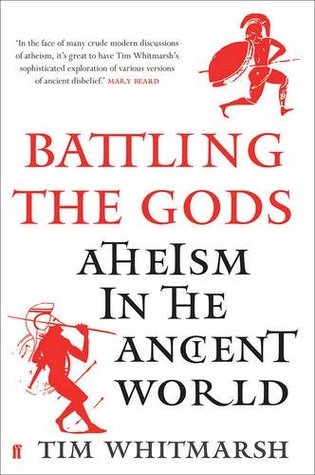
I learned three main things reading this very readable account: first, that there have always been atheists, with writers expressing various philosophical positions and arguments about atheism for all of Greek and Roman ancient history (even early Christianity having a place for it). Atheism was only ever one point on the spectrum of beliefs, but it was always around, and often attracted some high profile proponents.
Second, I found an eminently clear account of the major lines of philosophy running all the way through the ancient world. I hadn’t really seen this laid out like this before, and seeing it set against the historical political background was very helpful.
And finally, I found an interesting slant on the Stoics, which made me rather uncomfortable with the modern geek (not Greek!) revival of Stoicism as a philosophy for living your life today.
The first and the last of these are worth a bit more unpacking. The first is, of course, the main purpose of the book. Tim Whitmarsh gives us a scholarly and yet very readable account of the various threads of (non)belief in the ancient world, and how these were received by their contemporaries. He starts in about the seventh century BC, where the ancient Greek city states were enormously diverse, but didn’t seem to view organised religion in political terms, but rather “for personal communion with the divine”. It provided a vehicle for collective involvement in the community, but differences in belief were personal matters, so long as they didn’t impact the cohesion of the community. This view seems to have continued for hundreds of years – even the trial of Socrates in 399BC for (among other things) “failing to acknowledge the gods the city acknowledges” was about this risk to social cohesion, rather than any atheistic leanings per se.
As we transition into the Roman era, after the Punic Wars and the final sacking of Carthage in 146BC, we still see religion and the gods viewed in the same way: the Roman emperors after Augustus (who died in 14AD) were viewed as gods, but just one amongst many. The ensuing two centuries of Pax Romana didn’t change this: not believing in the gods was acceptable, especially if you were prepared to keep the peace by making the odd minor contribution to the community in other ways. It was only with the emperor Constantine’s conversion to Christianity on his deathbed in 312AD that we would have seen a move towards a much sharper division into “true religio” versus “false superstitio”. With this came the assumption that “all humans are born with a natural sense of the divine but that some people have been led into misunderstanding by false teaching”.
For me, this Christian belief is reflected in Christianity’s much more prosyletizing approach to religion. The Greeks and Romans didn’t really do this, because their polytheism allowed them to incorporate the gods of peoples that they conquered. Indeed, the often produced tables of equivalences, and as long as you knew which of your gods mapped to which of theirs, you could continue to worship whichever you chose (or none at all), and everyone was happy. Not so with Christianity, which was much more all-or-nothing. It’s not until the arrival of the Enlightenment that atheism became a philosophical position that could be held in the Western world (and even then, you were wise to keep quiet about it in many cases!).
All of this is the main thrust of the book, and Mr Whitmarsh provides an excellent and readable account of all of this. Definitely worth the wear on your eyeballs of reading it all.
My other learning, as I said, was a realisation that the modern revival of Stoicism has a rather unpleasant (for me) set of philosophical beliefs embedded within it. I certainly agree that many of the main thrusts of Stoicism are helpful views to hold: be resilient against the slings and arrows of outrageous fortune by anticipating the worst, act according to your beliefs, and confine your actions and your judgement to your own sphere of influence, rather than wasting too much time judging others. All good and helpful, and much lauded today by everyone from Navy SEALs to Tim Ferriss.
But in Mr Whitmarsh’s contrast of Stoicism against the other philosophies that were around at the time I saw a different side: the side that says don’t fight against conventions and the prevailing political system, don’t push back against the hierarchy, just stay in your own small world. All very well if you are already at the top of the hierarchy (as Marcus Aurelius of “Meditations” fame of course was – extraordinarily wealthy, and in due course emperor himself). But not so good for anyone in, say, the bottom half. So I need to do more personal reading here, but for the moment, whilst I will read quotations from modern fans of Stoicism with a more jaundiced eye…