Categories
Book review

The Daily Stoic

366 Meditations for Clarity, Effectiveness, and Serenity

by Ryan Holiday

The Daily Stoic by Ryan Holiday

There’s been a huge revival in the Greek and Roman philosophy of Stoicism in the past few years, and this book is a good example of what it yields. It’s a series of daily quotations from the great Stoic philosophers such as Marcus Aurelius, Seneca, and Epictetus. Each quotation is accompanied by a paragraph or two of discussion, underlining the key points. It’s well done, with readable and un-stuffy new translations of the originals, and the presentation is good.

I read this book at the average pace of the one meditation a day for which it was written, although I must admit I would sometimes loose track for a week or ten days, and then do some catching up. If one can hold a thought in one’s head, and follow through on it for the day, it’s hard to see the day not being the better for it. There’s a reason why these observations have lasted nearly two thousand years.

My qualms, such as I have them, are I suppose based on an underlying niggle of disquiet. Look at the philosophers quoted: Marcus Aurelius – very successful general, somewhat reluctant but well-regarded emperor; or Seneca – senator, playwright, adviser to the emperor Nero. These are powerful men, at the top of whatever power hierarchy was going. Is this a philosophy for the rich and powerful, enabling them to keep what they have with a clear conscious, thinking they could give it all up if they had to (although, mostly, they don’t…)? And all the while lecturing us that we, too, should be content with what we have? Sometimes it seems that way: on June 23rd we have Marcus Aurelius telling us:

You could enjoy this very moment all the things you are praying to reach by taking the long way around – if you’d stop depriving yourself of them

Epictetus, to be fair, was born a slave, and grew up crippled (and Seneca was exiled, and eventually forced to take his own life when accused of plotting against Nero). Although none of Epictetus’ writings survive directly, we do have several volumes of his discourses from his pupil, including a “best of…” compilation known as the Enchiridion. It is this work that perhaps is most responsible for the modern revival of Stoicism: James Stockdale, the vice presidential candidate of Ross Perot, was shot down in the Vietnam War and spent seven and a half years in captivity, which included torture and four years of solitary confinement. He had read the Enchiridion at college, and credits it with enabling him to survive this horrific ordeal in his book Courage Under Fire: Testing Epictetus’s Doctrines in a Laboratory of Human Behavior. There are a good few Epictetus quotes in The Daily Stoic; for January 19th, for example, we have Epictetus saying:

A podium and a prison is each a place, one high and the other low, but in either place your freedom of choice can be maintained if you so wish

Focus on what is in your control, as opposed to what is not. Good advice, however and wherever you are living.

In the end, it is to Epictetus’ quotations that I was perhaps most drawn. And he won’t care that I rounded my 3 1/2 star view of this book down to 3 stars, for the disquiet. “Not things, but opinions about things, trouble men”, he once wrote. Enough said.

Categories
Book review

Conscious

A Brief Guide to the Fundamental Mystery of the Mind

by Annaka Harris

Conscious by Annaka Harris

This is a brief introduction to the mysteries of consciousness, with much to commend it. It starts a conventional definition, after Thomas Nagel: “An organism is conscious if there is something that it is like to be that organism”. From this starting point, Annaka Harris takes us via an interesting series of viewpoints to a view of consciousness that she acknowledges isn’t really the mainstream view – that of “pan-psychism”, which is that consciousness may be an inherent quality of matter even down to the smallest levels – electrons may be, in some tiny atomic way, conscious. From these small components, consciousness as we know and experience it as humans is produced.

The route to this conclusion covers some ground that may be familiar to many readers, such as David Chalmers’ “philosophical zombies” – people who look and act exactly like you or I, but who (by definition) do not have conscious experiences. It also covers some territory that was new to me, such as the discussion about trees and how they seem to communicate via their roots tapping into underground mycorrhizal networks. This was fascinating to me, and lead me off to all sorts of interesting searches – this was a nice summary I found.

The argument is overall well put, but I felt there were difficulties that had either been skipped for simplicity, or simply weren’t acknowledged. For example, Harris says that “as far as consciousness is concerned, there is nothing, then suddenly, magically, at just the right moment …. something!”. It’s not clear to me that this has to be the case. Introspectively, I am conscious at some moments to a greater degree than others. When I fall into a deep sleep, does my consciousness finally switch off at a defined point, or is it more like sunset on a cloudy day: it gets darker and darker, and eventually it’s definitely completely dark, but there was no one moment when the last light was extinguished. It seems to me consciousness is more like this – continuous, not discrete. And if the claim is that it’s discrete, I’d hope for a discussion of the point.

As another example, one of the traditional arguments against panpsychism is discussed in the book – the “combination problem”:

The problem is that this is very difficult to make sense of: “little” conscious subjects of experience with their micro-experiences coming together to form a “big” conscious subject with its own experiences

Harris argues that this problem isn’t present in versions of panpsychism in which consciousness is a fundamental feature of the universe, as consciousness is not interacting with “itself”, as it would be if it were combining. Think of gravity: individual atoms have a tiny amount of mass, and thus of gravitational attraction, and they can combine perfectly happily to produce a large planet with its own gravity.

This argument, it seems to me, can apply just as well to the “emergent” view of consciousness, where consciousness emerges as the appropriate kinds of information processing capabilities combine in an appropriate way. But Harris has already dismissed the possible emergence of consciousness by saying that it doesn’t really explain it at all:

…when scientists assume they have bypassed the hard problem by describing consciousness as an emergent property – that is, a complex phenomenon not predicted by the constituent parts – they are changing the subject …. If some matter has experience and some doesn’t (and some emergent phenomena entail experience and some don’t), the concept of emergence as it is traditionally used in science simply doesn’t explain consciousness.

But simply defining consciousness as something that all matter has, it seems to me, isn’t a good way out of this problem. Announcing that everything has consciousness, down to electrons and protons, and therefore some things get to be what we call conscious, is either a way of hiding from the hard problem (“everything is conscious, so no wonder we are”), or just causes the emergence problem to emerge in a different place (how does what we historically cause consciousness appear from combining a lot of this subatomic consciousness – and you can’t use emergence as you’ve already dismissed this!).

In the end, there was a lot to like about this book, and I found it hard to pick a final star rating. This is a three-and-a-half star book for me. Lots to like, some interesting new ideas, really nice to see a readable book on such a complex issue, although it was too short to do enough justice to all of its subject matter, even for a self-confessed “brief guide”. In the end, I have gone with four stars, to encourage Ms Harris to write more on this, and to guide readers to an interesting book.

Categories
Book review

The Indisputable Existence of Santa Claus

The Mathematics of Christmas

by Hannah Fry

The Indisputable Existence of Santa Claus by Hannah Fry

Very nice little book of mathematics, as applied to various Christmas problems.

Although this is in the long tradition of seasonal stocking-fillers, the execution was great: the maths was non-trivial, but not so hard as to require a degree in the subject (although there were extra-hard sums in the footnotes, where appropriate), and the whole subject was treated with the appropriate degree of tongue in cheek sillyness:

Maybe that’s how we should see Santa. An undecidable being. You can’t prove his existence one way or the other, you just have to close your eyes and decide for yourself.

In the meantime, everything from simple geometry to Markov chains was used to solve various seasonal sillynesses. Excellent!

Categories
Book review

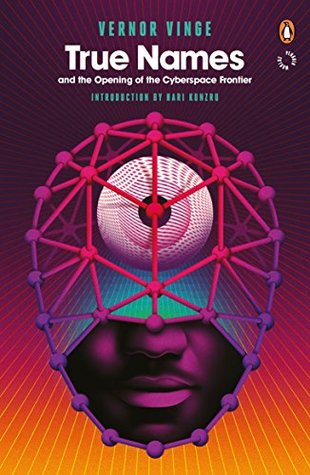
True Names

by Vernor Vinge

True Names by Vernor Vinge

A classic story from the early days of Cyberpunk, when the internet was a thing known only to a few academics and scientists, from 1987 and the dawn of the World Wide Web.

We meet hackers – Mr Slippery is the main protagonist – and we meet them as they fight their way across the global networks, or the Other Plane as it’s known. The fight each other, they fight cyber criminals, and they fight the government. But Mr Slippery finds himself arrested – or threatened with arrest – unless he helps the government (the NSA?) fight back against the Mailman, an international dark hacker, or Warlock, who is recruiting other Warlocks to his side.

The title comes from the believe that you need to keep your true name secret, for it will give others power over you. Mr Slippery’s true name becomes known to the government, giving them a hold over him. Now he must find the Mailman’s name, and protect his own.

The book is one of the defining works of “cyberpunk”, perhaps with less “punk” than William Gibson, but a full dose of “cyber”. It hasn’t lost its power, either way.

Categories
Book review

A Christmas Carol

by Charles Dickens

A Christmas Carol by Charles Dickens

From the famous opening line – “Marley was dead, to begin with” – Dickens announces that this isn’t your everyday ho hum Christmas tale; indeed the full title stakes its claim: “A Christmas Carol: Being a Ghost Story of Christmas”.

But it’s more than that, of course. It’s a story that kicked into life the Victorian version of Christmas (apparently turkey sales rocketed at Christmas, while sales of the traditional goose dived correspondingly). It’s another chance for Dickens to talk about the appalling poverty and deprivation which lived on the doorsteps of his middle class readers: the ghost of Christmas yet to come takes the reader to this scene –

The ways were fouls and narrow; the shops and houses wretched; the people half naked, drunken, slipshod, ugly. Alleyways and archways, like so many cesspools, disgorged their offences of smell, and dirt, and life upon the straggling streets; and the whole quarter reeked with crime, with filth and misery.

Dickens was a marvelous writer, and A Christmas Carol contains many great lines, from Scrooge’s “Bah, humbug”, through Marley’s Ghost’s “I wear the chain I forged in life”, to Tiny Tim and somewhat saccharine “A Merry Christmas to us all, my dears! God bless us every one!”. You can read the scenes even now without our modern detachment hiding their power from us. Even the two children clinging to the second Ghost “yellow, meagre, ragged, scowling, wolfish; but prostrate, too, in their humility” still just about land this side of my irony detector.

Ultimately, though, it sets the template for the Christmas tales of redemption. This appears in all our favourite Christmas stories and movies, from “The Grinch” to “Elf” to to “Die Hard”. Like many of these tales the story hangs on the credibility of the transformation of the hero (well, perhaps not with “Die Hard”…). On this re-read, I found Scrooge’s transformation entirely credible. Although only one night has passed in the real world, in the ghostly world Scrooge visits, he spends at least twelve nights in the company of the Ghost of Christmas Present, where the moral is pounded repeatedly into his head:

Much they saw, and far they went, and many homes they visited, but always with a happy end. The Spirit stood beside sick-beds, and they were cheerful; on foreign lands, and they were close at home; by struggling me, and they were patient in their greater hope; by poverty, and it was rich. In almshouse, hospital, and gaol, in misery’s every refuge, where vain man in his little brief authority had not made fast the door, and barred the Spirit out, he left his blessing, and taught Scrooge his precepts.

Perhaps a little over the top to modern ears, but in the renowned psychiatrist Stephen Grosz’s book The Examined Life: How We Lose and Find Ourselves he talked of using A Christmas Carol to show how we really can change – but the motivation needs to be strong enough. By the end of the second ghost’s visit, Scrooge is ready to change, and by the end of the third, he knows he must. He sees what his death may be otherwise, how his cooling body is picked over for change, how the shirt is literally taken from his corpse’s back in exchange for a few pennies from a rag and bone merchant. Buddhists will spend days meditating in charnel grounds to come to terms with their own death and motivate their change in life. One can but hope that humankind in general does not need the lesson so brutally told.

Categories
Uncategorised

Blood Bound

Mercy Thompson book #2

by Patricia Briggs

Blood Bound by Patricia Briggs

Another excellent showing here, with Mercy Thompson getting caught up with the local vampire seethe, whilst trying not to get her friendly neighbourhood werewolves too entangled in the resulting mess. The tone was sometimes much darker than the first of the Mercy Thompson books, as getting involved with the vampires seemed to involve getting a whole lot of blood over many things. If you don’t like your urban fantasy too gritty, this might be a problem, but I felt it was all in keeping with the plot, and none of it was gratuitous or merely put in to shock.

Four stars this time instead of five, as I was a little alarmed with the way an increasing number of the other main characters seem to be falling romantically for Mercy herself. I also wasn’t totally convinced by Mercy’s motivations to go out hunting alone again in the final 30 or so pages of the book. Still, very enjoyable, and I’ll be reading more!

Categories
Uncategorised

After the Ecstasy, the Laundry

by Jack Kornfield

After the Ecstasy, the Laundry by Jack Kornfield

This classic book explores the experience of meditation and spirituality through quotes and stories from nearly a hundred very experienced practitioners, ranging from nuns and priests to Zen masters and Tibetan Buddhist lamas. They’re all anonymous, so that they could speak freely, and they talk about the highs and lows of their journey. The title tells the story: we might spend hours, days, or even months at the highest spiritual plane, but in the end we still need to clean our teeth and wash our smalls. Even though this may feel like we’ve fallen, in fact we are just living, right here right now in the moment, and that’s the highest achievement we can hope for.

There are so many beautiful quotes and passages in here. Even though in the end I couldn’t quite give it five stars because sometimes I just plain lost the thread through the chapter, there are some lines that are just heartbreakingly beautiful, and capture the human condition to a tee:

Underneath all the wanting and grasping, underneath the need to understand is what we have called “the body of fear”. At the root of suffering is a small heart, frightened to be here, afraid to trust in the river of change, to let go in this changing world. This small unopened heart grasps and needs and struggles to control what is unpredictable and unpossessable. But we can never know what will happen.

Just so. Four and a half stars, and a massive hug to you all.

Categories
Book review

Sum: Forty tales from the afterlives

by David Eagleman

Sum by David Eagleman

This is a book of 40 short chapters, just a few pages each, each one an alternative story of what might happen after we die. In one, it turns out we are actually God’s organs, how she feels and knows and interacts with the world; in another, you find the afterlife is terribly bureaucratic and we have to queue for everything, because God put us in charge when he found himself increasingly overwhelmed by his creation.

So some of the stories are rather clever – my favourite is that we are organic supercomputers, created by small, slow, creatures to answer the big questions of life – only they are too dim to understand our responses to their questions. Others are neat enough, but left no imprint on me.

Overall, it’s a nicely done short book, with a very interesting idea and some definite bright spots: three and a half stars, rounded down to three as in the end I’m not sure enough of the stories stuck with me, in the end.

Categories
Book review

Anathem

by Neal Stephenson

Anathem by Neal Stephenson

Not many authors can start off in the “mystery world” genre, tour through hard science fiction, and end up being about what it is to be a conscious being, all while keeping your attention. It’s a tribute to Neal Stephenson that he can steer this path with Anathem, and make it thoroughly entertaining with it.

We start off in a world occupied by “fraas” and “surs”, who we soon work out are the friars and nuns of some kind of secluded community. Once every few years – 10, 100, and 1000 years, it turns out – the gates of these communities are opened, and for ten days the inhabitants can go out and mix with the “extramuros”, that is, those who live in the secular society outside the walls. Turns out this has been going on for nearly four thousand years. Only this time, events start to happen which turn that regular, ordered, world almost literally inside out… We get to follow along, narrated by one of the fraas, through all sorts of adventures – which I won’t mention because, spoilers. And once I’d made it through the first 100 pages or so, and was beginning to get to grips with the odd vocabulary and all the new words, this was a great adventure, excellently told.

One thing I will say is that this isn’t a book about monks and nuns, so don’t let that first 100 pages put you off. It’s a book about many things, but perhaps most of all it’s about the human consciousness – what it might mean to have one, why and how we might have one in the first place, and what the outer limits of having one might be. It’s set on a world very similar to Earth in many ways, and contains all sorts of entertaining indirect references to science curiosities we might know on Earth – from Roger Penrose’s non-periodic tiles to Kurt Godel’s theory of time travel. All done with Mr Stephenson’s usual flair and wit.

In the end, this was almost a totally brilliant book for me, and just missed it by not quite exploring some of those possibilities far enough. So four stars, not five, but definitely worth a read.

Categories
Book review

The Path to Nibbana

How Mindfulness of Loving-Kindness Progresses through the Tranquil Aware Jhanas to Awakening

by David C. Johnson

The Path to Nibbana by David C. Johnson