Categories
Book review

The Sentry

by Robert Crais

The Sentry by Robert Crais

I’m not going to review this book, featuring Elvis Cole, a Private Investigator, and his friend, Joe Pike. Cole is cool (he shares his house on the hills above LA with his cat, and he shares his beer with his cat). Pike is beyond cool, and one of my favourite fictional creations (the cat hates him).

Instead, I’m just going to give you a series of quotes from it. If that doesn’t make you buy it, nothing will.

This was why the men down south used him for these jobs and paid him so well. Werewolves caught their prey.

The nature of his life had cost him the woman he loved and the little boy he had grown to love, and left him alone in this house with nothing but an angry cat for company and a pistol that did not need to be put away.

Prisons were filled with convicted murderers who got a drumstick when they wanted a thigh, or who felt dissed when a woman wouldn’t speak to them on a bus, or who decided a bartender was ignoring them. When a man felt frustrated or angry enough, any reason would do.

Pike had focused on a goal and would drive forward like a relentless machine. Back in Cole’s Ranger days, they had called this mission commitment, and Pike’s mission commitment was off the charts.

Pike was a man who showed nothing, projecting a zen-like detachment that Cole sometimes found amusing, but also admired. Cole often wondered what such calm cost his friend, and whether Pike had no other choice but to pay it.

“Yes. Of course, I will call.” “Stay with Artie. Watch his temperature.” “You are a strange man.”

That’s it. Go read it. Or anything with Pike in it, they’re all great.

Categories
Book review

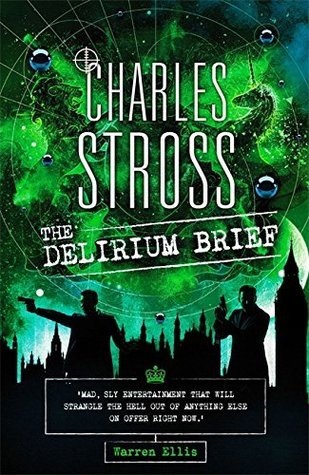
The Delirium Brief

Laundry Files #8

by Charles Stross

The Delirium Brief by Charles Stross

I’m delighted to report back from the world of Bob Howard and Mo O’Brien that all is not well – indeed, all is going very very badly, verging on world-endingly bad, and it’s pretty much a race to the finish as to which particular variety of soul-sucking creature from a parallel universe is going to do us all in.

In other words, this, the eighth in the Laundry Files sequence from Charles Stross, is another cracking read. Although they’re all set in the same world and are more or less sequential, they are all sufficiently independent that I suspect you could pick this one up cold, and still get a great deal of enjoyment from it. I would still recommend reading the others, though, because (a) they’re very good, and (b) you’ll get a little bit more out of this one, as (for example) you’ll known Bob’s history with PHANGs – the in-series designation for what might otherwise be known as vampires.

The world of the Laundry files is the world of modern 21st century England, with a twist: there is a branch of the civil service responsible for dealing with the occult. Up to about book 6 of the series, this was a very secret organisation. Underfunded, drowning in bureaucracy, and with endless reports to fill in, but still very secret.

However, in the preceding book, The Nightmare Stacks there was a full-scale invasion of Yorkshire by undisguisably occult creatures, with some very serious consequences. So now the dreary world of bad coffee, broken IT, and crippling paperwork which Bob used to inhabit has been brought into the harsh light of day, and is being picked over by the mass media in an entirely believable way (an early chapter deals with Bob’s quizzing by Jeremy Paxman on national TV…). At the same time, the organisation is under external threat from not just the usual occult beings, but the more immediate danger of self-serving politicians, all seeking to cover their arses in the aftermath of what happened in Yorkshire. And then a private jet lands at an airport in England, bringing an entirely new kind of threat…

It’s a great book, with a twisty plot, plenty of wry asides, and some new characters, as well as the return of many old ones. I loved it!

Categories
Book review

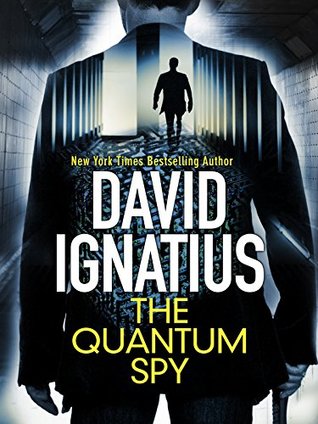
The Quantum Spy

by David Ignatius

The Quantum Spy by David Ignatius

So very disappointed in this novel, I’m sorry to say. It’s set in the present day, with China as the baddie for our intrepid CIA spies, and it has a bit of a techie theme, with the plot loosely set around the search for real life quantum computing. I had high hopes – quantum stuff, spies, high-tech thriller potential, what’s not to love?

Well, what’s not to love is cardboard characters straight from central casting (the hard-as-nails CIA deputy director, the geeky CEO of a tech company, the conflicted American-Chinese), the wildly telegraphed plot line, the simple straight-line narrative thread, written so you didn’t have to worry about losing the thread when you got up from the sunbed where you were reading this to buy an icecream (or a margarita, as you choose).

Some bits weren’t bad – there were some nice snippets of “tradecraft”, and the tech stuff about quantum computers was actually very well done, from a techie POV. And the scenes were set in some interesting places, generally very credibly described. But still not enough to get past the disappointment.

Categories
Book review

Dungeon Born

by Dakota Krout

45712252. sy475

This is a book in the “LitRPG” genre, which for those of us who spent their adolescence with a bunch of other social misfits, surrounded by character charts, multi-sided dice, and rule books for various role-playing games (RPGs), will seem somewhat familiar. In this case, it’s the story of a dungeon, and how it grows up. For it turns out that dungeons, in this world at least, grow from small crystal cores, which slowly gain more abilities to shape the earth and stone around them, and to imbue with life increasingly powerful creatures (rarely friendly) to populate their underworld passages. Add in some adventurers (including one by the name of Dale, who sort-of accidentally owns the land on which this dungeon is growing), and an interesting set of physical laws for the universe, based on the accretion of various “essences” into your soul to increase your powers, and off you go!

I hadn’t met this literary genre until I picked up this book, and it was quite fun, I must say. The plot was straightforward, driven by the dungeon slowly levelling up, and Dale also levelling up and learning about the world of adventuring. The writing was straightforward, if not very nuanced, with some of the moral lessons necessary for Dale to mature being imparted to Dale in very much a “tell, not show” kind of a way. So if I were to be snobby, I’d say this wasn’t a sophisticated book, but all in all, it was entirely enjoyable, and kept me engaged throughout. I probably won’t be reading the follow-on books simply because this isn’t perhaps my favoured style of book, and I have only a limited number of books I can fit in, but but that’s just a personal thing, and others will love this, I know.

Categories
Book review

The Poppy War

by R.F.Kuang

37906566. sy475

The Poppy War is a fantasy novel with a difference. Most such novels are set in a sort-of Lord of The Rings lineage of countries, which all look a lot like medieval England (with greater or lesser degrees of grittiness, but with wizards, and of course lots of men with mighty thews and huge swords.

Instead, here we are in a country like medieval China, with shamans who are linked to sixty-four fantastical god-like creatures, and women with wicked martial arts skills – oh, plus a few mighty-thew’d warriors to round out the numbers. This does give the whole thing a very different flavour, which I have to say I enjoyed. The exploration of this culture, and the way the empires have grown (and are falling), was well done throughout, and definitely deserving of praise.

Better still for me was the main character, Ren, and the portrayal of her inner conflict between duty and vengeance, as she grows from fighting to survive, to fighting for her country, to fighting for her friends. It’s a great piece of character development. We see her start as a young war orphan in a shop in a rural village, then through sheer force of will and determination, we watch her pass the tough exams to attend the prestigious war college – her only way out of this life other than through an arranged marriage to a man 20+ years her senior. From there, we follow her through the college, and into the real war that breaks out before she’s had time to even graduate. It’s then, in many ways, that the really interesting action starts. I did feel a times though that this was a longer book than it might have needed to be, and perhaps some of the build up to this might have been judiciously edited down.

It’s worth warning that some of the writing in the battle scenes in the final third of the book is very dark. One of the themes of the book is about how when we cease to see the “other side” in a war has human, that (a) makes the war easier to fight for the soldiers, and (b) produces extraordinary brutality. You are treated to this in full. I think of myself as mentally quite robust, and am entirely used to high levels of gore in movies, etc, but this gave me some quite unpleasant dreams. Enough said.

So, overall I’m giving this 3-1/2 stars, rounded up to 4 stars. The novelty of the setting and the characters, plus the higher-level themes, elevated this above your normal fantasy novel. Just not for the faint of heart!

Categories
Book review

The Fifth Season

The Broken Earth #1

by N.K.Jemisin

25194939

Sometimes you read a book, and you’ve no idea what’s going on for the first third of the book, but then you put together a few threads through the middle third and you enjoy how it’s going, and by the final third you absolutely love it and are upset when it ends. This was such a book, and I loved it. Some of the rest of this review might need to be shrouded in spoilers, so you can have the same experience, but it’s clear very early on that we’re in a strange world here, with lots of history, and – it turns out – lots of earthquakes. Not all of which are triggered in the usual way. Turns out, there are some people in this world that can trigger earthquakes. Turns out there are those who can feel and control (to some extent) magma flows, the slippage of plates in the crust, the crumbling of rock, and other geological things whose names I didn’t know until I read this book. Really great world building – I can’t think I’ve read anything like this before. I can see why it won the 2016 Hugo Award!

Also, by the way, great storytelling throughout. The story unfolds from multiple points of view – a woman in deep distress, a second-person narrative, a strange creature born from the stone itself, and others. How they come together is the reveal of the middle section of the book. It’s a neat approach, and very well used, but not abused. No annoying super-powers wielded by super-humans, deus ex machina-style, but rather very human characters with flaws and strengths, struggling to come to terms with the world in which they find themselves.

SO, some great characters in here, a brilliant world setting for them, and an intriguing plot. It also has enough of a wrap-up at the end of the book for you to feel satisfied – you aren’t left poised on a cliff edge. Definitely want to see more from this world, though, and there is plenty enough left unfinished to justify reading the next book(s). A well-deserved five stars.


View all my reviews

Categories
Book review

Dangerous To Know

by K.T.Davies

I’m sorry to say I gave up on this after a couple of chapters. I could see that another day (and certainly to other readers) this might be an entertaining read, but I ended up getting annoyed by the fantasy swords-and-sorcery tropes, foreshadowing, and not terrifically well done dry humour.

I hate being mean about someone’s writing, because heaven knows it’s still better than I could manage, but I couple of years ago I realized that I only had a certain number of books I could read before I shuffle off this mortal coil, so I’d better make sure I didn’t waste my time. So I leave this to others, who, based on the consensus of the other GoodReads reviews, will enjoy it more.


Categories
Book review

Silence

by Erling Kagge

This was a short, interesting, exploration of the way we can find quiet in our lives, and the value of doing so. It takes the form of 33 very brief chapters, each only a few pages long, looking at silence from a different perspective. Nicely done, and the physical book itself is a beautiful publication, complete with beautiful photography and art of wild empty spaces. Three and a half stars, rounded down to three as I couldn’t feel it warranted four.

Categories
Book review

The Rook

The Checquy Files, #1

by Daniel O’Malley

The Rook by Daniel O'Malley

What a cracking book! I loved this supernatural/sci-fi combo, with the clever twist that the main character starts the book having completely lost her memory, finding herself standing in the dark in the rain, surrounded by several dead bodies, all of whom are wearing latex gloves. Through the excellent plot device of a series of notes that she’s left herself, she realises who she was and what her life was all about, and quite how much danger she is in.

Myfanwy, the lyrically named heroine, would love to find out what’s going on and how she came to lose her memory, but before she has time, she’s launched into a series of adventures with supernatural forces. For it becomes apparent that Myfanwy is a high-ranking member – a Rook – in a secret organisation called the Chequy, set up to battle the supernatural forces that threaten Britain.

There are some great characters in here, and some intriguing, and quite non-human, forces at play. To avoid spoilers, I won’t reveal too much, but it’s a great read. For me it had something of the vibe of Charles Stross’s Laundry Files series – supernatural creatures and goings on, which are hidden from us by a hidden quasi-governmental organisation. Written with humour and verve, and just a delight to read – hard to put down even late at night, leading to complaints from my better half that the backlighting on the kindle was keeping her awake…

I’ll definitely be picking up the next one in the series.

Categories
Book review

Neuromancer

by William Gibson

I haven’t re-read this for a number of years, but something made me take down my battered 1986 edition of this classic (first published in 1984 in the UK) and read it again.

It’s still a jewel of a book. To be fair, the style isn’t what you’d expect today, but honestly, that’s a bit like saying the paint job on the Night Watch needs a good going over to bring it up to modern standards (or that you prefer the style of “Game of Thrones” to “Lord Of The Rings”). Even today, this is still an extraordinarily impressive book, with deeply textured writing. You can pretty much open it at random and be captured by the intricate style – here’s what caught my eye as I flipped to page 154, for example:

A burst of French from a nearby table caught his attention: the golden children he’d seen gliding above river mist the evening before. Now he saw that their tans were uneven, a stencil effect produced by selective melanin boosting, multiple shades overlapping in rectilinear patters, outlining and highlighting musculature

It’s all very beautiful stuff, and it has influenced so much of what we read and see today. Here is where the word “cyberspace” first appeared, and herein are the first references to that consensual world inside our computers as “the matrix”. The first twenty years of the world-wide web, especially all the 3D graphics, was a conscious attempt by thousands of programmers and hackers to build the cyberspace described in the book. Here’s what we get when Case, the hero, plugs in:

And flowed, flowered for him, fluid neon origami trick, the unfolding of his distanceless home, his country, transparent 3D chessboard extending to infinity. Inner eye opening to the stepped scarlet pyramid of the Eastern Seaboard Fission Authority burning beyond the green cubes of Mitsubishi Bank of America, and high and very far away he saw the spiral arms of military systems, forever beyond his reach.

The world outside cyberspace is similar in many ways to that of Bladerunner, a sort of noir Japanese/American underworld blend, dark and noir. Apparently William Gibson saw a clip from the film when he’d written the first third of the book, and was worried people would think him derivative. He isn’t, of course: he is rather that very rare bird, out in front of the flock, exploring and indeed creating the new frontiers (his earlier short story Burning Chrome predates Bladerunner and is set in the same world as Neuromancer).

The plot is as fractal as the writing, revolving around a hacker, an augmented mercenary, and an AI, in a world ruled by corporations, with genetic engineering, exotic drugs, and (of course) cyberspace, but I won’t try to summarise it, other than to say you need to keep your wits about you to follow it, but there is a plot there, saying something interesting – it’s worth it.

One thing I did notice with this re-read, is quite how short the book is, compared to much modern science fiction. It’s a little over 300 pages in my compact paperback, versus the 500-odd you might commonly find today. And I think it’s all the better for it. It was written on a typewriter – a Hermes 2000, apparently, described by Gibson in an interview for Playboy as “a very Ernest Hemingway sort of war-correspondent-for-the-Spanish-Civil-War machine, from my wife’s step-grandfather who was a journalist”. I think it’s all the better for that. The capability pretty much any author has now to write a hundred thousand words and hit publish does, I think, all too often lead to too much fat. This book is what you’d get after a full-on keto diet: lean, wiry, and so sharp you almost cut yourself reading it. It’s almost science fiction as poetry, in the old style of Samuel R. Delany’s Dhalgren, or Philip K. Dick (who of course wrote Do Androids Dream of Electric Sheep?, which Bladerunner is based on, although the Japanese/American noir blend of the film isn’t in the book at all).

Thirty-plus years after my first read, I am still captivated. A brilliant five stars.