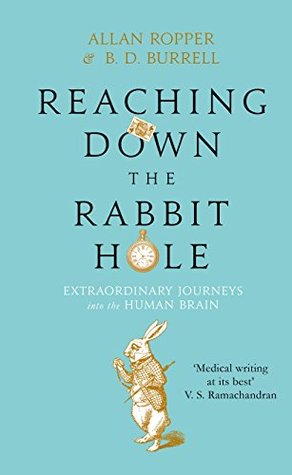
This is a fascinating behind the scenes peek into the neurology unit at Harvard Medical School, and the work there of Dr. Allan Ropper. It’s about real lives, and it’s all the more poignant for that – from people diagnosed with ALS, to minute brain injuries that cause bizarre behaviours, any number of the extremes that we could each fall into, that are ultimately caused by mis-wirings, mis-firings, or damage to our brains.
At ever turn, Dr. Ropper appears knowledgeable, intuitive, willing to listen, and empathic. These are real people he’s talking to, not anonymous patients, and his care and attention to detail comes across at every turn.
If you liked “The Man Who Mistook His Wife For a Hat”, there are many more such stories in here. But ultimately, for me, it was the humanity that came across – of both the author, and, ultimately, of his patients. We are all a ticking clock of immense complexity, and if dust bunnies stick a cog or two in all of us, the it’s just luck, not our moral right, that means we can still scrape through.
Really a very enjoyable book from Randall Munroe, which takes the graphical style of his brilliant going-15-years-and-still-funny xkcd web comic series, adds to it the self-imposed restriction of only using the thousand most common words in English, and pits it against various everyday “things” and attempts to explain them.
You get cross-section views of things like a datacentre (“computer buildings”), dishwashers (“box that cleans food holders”), and laptops (“bending computers”), as well as more abstract things like the US Constitution (“laws of the land”) and the periodic table (“the pieces everything is made of”). Munroe clearly had a lot of fun not just picking the things to explain, but coming up with cute names for them (“sky boat with turning wings” for helicopter, and so on). It’s perhaps a bit more fun if you actually know what he’s talking about, so you can work out what the actual concept he’s getting at is, but it’s fun even when I couldn’t quite get it!
Is this a book you could give to (say) a child, and expect them to learn about microwave ovens, or the Mars Rover? Perhaps not without additional guidance, but for grown-up kids (like me) it’s a delight. It’s charmingly done, and makes a much more entertaining coffee table book than many (physically it’s quite big – 23x34cm, although not super thick at about 1cm).
Four stars for flair and execution, and a bunch of fun.
A second excellent book The Invisible Library series, this picks up the story from the first book as Irene becomes Librarian in Residence in the slightly magical, slightly steam-punk, Victorian England, together with Vale, the great detective (think Sherlock Holmes, thinly veiled, as it were), and Kai, her apprentice. Kai – who we discovered in Book 1 is in fact a dragon, a creature of Lawfulness, working in human form – goes missing, taken by the Fae, who represent the side of Chaos.
As a Librarian, Irene is in theory neutral in this Lawful/Chaos struggle that spans many thousands of worlds in many times, but as Kai’s mentor, she feels a responsibility to find out what’s happening. From this, the plot is spun. And it’s a cracker, moving things into a Venice that’s much closer to the Chaotic side of things, where it’s always Carnival, and masks are de riguer. For me it slowed a little in the middle perhaps, as we started in Venice, but that was a momentary pause lasting only a few dozen pages, before things cranked up to full volume for the sparkling finale.
You perhaps don’t have to have read book 1, The Invisible Library first, but honestly I don’t see why you wouldn’t, as that’s a great book, too. Four and a third stars, for me.
On Playboy Bunnies, Princesses, Trainwrecks and Other Man-Made Women
For me this was an insightful and interesting exploration of the role women have played in (largely American) culture since the mid 1800s, seen through the lens of their portrayal in popular media. The author was a TV and then a film critic, and she looks at the roles women have been given to play, from The Philadelphia Story (1940) through The Stepford Wives (1975) to Frozen and beyond. Her take on things is always insightful and witty, and she made her points very well. I’m a late middle-aged, cis-gendered white man, and I was thoroughly enraged by the way in which women have been expected to politely play nicely as either background or suitable companions for the hero throughout the ages.
This sort of segregated role for women seems to be a creation of a post-industrial age. Hunter-gatherer societies will often have had men and women in broadly separate roles, but this didn’t imply any kind of power hierarchy – women in such societies would have openly laughed at the idea that men were “in charge” of anything (see Margaret Mead’s writings, for example). Such a hierarchy was present in the upper echelons of medieval society in the West, however, as women were often seen as useful pawns in the political wars of the time. I think some of the responsibility for this is the view clearly expressed by the Abrahamic religions that women need to be kept separate from men, and increasingly subordinate to them.
Quite how we get out of this, I’m no clearer than the author, but it’s clear that for the sake of everyone involved, we really need to find a better way to be in the world. This book reveals the “patriarchy” as alive and kicking back, and it’s not good for anyone involved.
I found this a thoroughly entertaining account by Max Tegmark of some of the “big questions” of modern physics, with a particular slant towards cosmology – what is our universe composed of, how did it come into being, what might be its ultimate fate, that kind of thing. Initially I wasn’t sure about the very personal style in which it was written, but after a few chapters I began to like it. Tegmark has been at the forefront of a number of these discoveries, and there are lots of semi-autobiographical anecdotes in here: ultimately, the cheerful and enthusiastic style did win me over, and I found it definitely added to my enjoyment of the book.
I realised as I was reading this that I haven’t really read a popular science account of these topics for perhaps 20 years, so I was definitely behind the curve with regard to things like dark matter and dark energy, and their abundance in the universe (making up something like 20% and 70% of all the stuff out there, respectively). This was a great account of all these theories, working through the evidence in particular from the cosmic microwave background, which has yielded two different Nobel physics prizes.
Tegmark moves the reader through all this at the same time as he elucidates his view of how it all comes together with quantum mechanics. I was pleased here to see the increasing acceptance by physicists of Everett’s “many worlds” interpretation of quantum mechanics, and how it’s taken over from the more historically popular Copenhagen interpretation, with its reliance on the horribly ill-defined “observer” causing a collapse of the quantum wave function. To the very limited degree that I’ve ever managed to get my head around quantum mechanics, it’s always seemed a complete fudge to say “these equations describe the universe as we know it to thirteen decimal places, but I don’t really like what they say about the nature of reality, so I’m just going to paper it over with this observer thing and then I’ll feel more comfortable”!
At this point, Tegmark starts to roll out the big guns of his theory. Not only are there multiple physically separate universes (because the initial expansion phase was so fast that light will never be able to travel from one to another), but also these universes will have different starting conditions. This provides an explanation as to why our universe is so “well tuned” for life – there are 30 or so physical constants whose values would only need to vary by a very small amount to have prevented life ever existing. Well that’s straightforward in this view- those other variations are just in other universes (inaccessible to our light cone). And quantum mechanics now says that physical reality also has other places where the alternate paths of quantum interactions are playing out – in some of these parallel worlds, Schrodinger’s famous cat is alive, in others it’s dead, and that’s all ok (unless perhaps you are the cat!)
Ultimately, Tegmark comes to argue that in fact these different worlds may not only have different starting conditions, but also entirely different laws. Not just (for example) different numbers of space or time dimensions, which is weird enough, but different kinds of physical existences. All our physical laws, he argues, are the result of mathematical symmetries – all the different kinds of particles (quarks, photons, etc) are predicted by symmetries in group theory, for example. Thus there will be other universes with other symmetries, based on other groups. An overwhelming number of these will be too simple to do anything very interesting, but some of them will be complex – perhaps complex enough to form other kinds of particles, and indeed other kinds of life, too strange to even imagine!
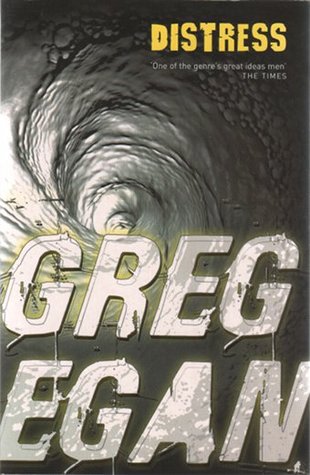
Since I recently read Group Theory and Physics, I was pleasantly surprised by how much I sympathised with Tegmark’s thesis here. It’s even reflected in science fiction in books like Distress, which again I read recently, and which is about how a “theory of everything” might decide which universe (which mathematical symmetries) we really live in. I’m obviously being swept up in a wave of theories and stories all about this – perhaps the cosmos really is trying to tell me something!?
Ultimately, these kinds of questions about the underlying nature of reality are profound, and perhaps even beyond our real knowing, but they’re great fun to think about, and Max Tegmark is exactly the sort of person who you’d want to be sat beside in the pub while you explored it all. This book is as close as I’m ever going to get to that, and I thoroughly enjoyed the opportunity.
Another fun romp into a different version of the present day from Neal Stephenson. This one is about exploring different kinds of “present day”, as well as different possible histories! Our hero is Melisande (Mel) Stokes, a linguist of languages both ancient and modern, who is recruited by Tristan Loyd to translate a number of ancient documents. But first she has to sign the NDA, promising not to tell anyone about any of this, ever. Since she hates her current boss and her job as an overworked, underpaid, untenured lecturer at Harvard, she accepts the offer, and finds she has joined the mysteriously named DODO.
In due course, she finds that DODO are trying to build a machine in which people can once again perform magic – even though magic seems to have disappeared from the world in 1851. Magic, we in due course discover, is done by people who can access other “threads” of the present moment – alternative versions of the world that have split off but are still intertwined with ours. It’s all based on the Many Worlds interpretation of quantum mechanics, which holds that such world-splittings happen literally at every moment. People who can do magic – witches – can manipulate these threads in some way.
So Mel’s job evolves into recruiting a witch, keeping the witch on-side with the programme (witches turn out to be incredibly high maintenance), and working with the expanding crew in DODO to achieve their ultimate aim – using magic to “tweak” the past to the geo-political benefit of the current United States.
The characters are well drawn, perhaps with a little too heavy a hand in one or two places but not bad. And the plot is spun with the characteristic humour and wit of Neal Stephenson. I loved in particular the clashing of the two cultures – one represented by Mel and Tristan and their start-up style organisation, the other the full-press acronym-loaded bureaucracy and hierarchy of the US government, who we soon find out are funding the whole DODO thing. Delightful!
Andrew Worth, a journalist burnt out by his last expose on the abuses of biotech, persuades his boss to let him take over an assignment from another editor about a physics conference on the Theory of Everything. This conference is to take place on a human-created tropical island in the Pacific, which Andrew imagines will be just the tonic he needs. What could possibly go wrong? Other than nearly dying from a synthesized cholera virus, death threats to the Noble Prize winning Violet Mosala (whom Andrew is following through the conference), being held at gunpoint and kidnapped, the paradise itself being attacked, and the potential ending of the entire universe as we know it?
So it’s a busy old time for Andrew, and the plot moves along at pace, with great twists and turns. However, this isn’t just a great techno-thriller: it’s a brilliant exploration of the edges of modern physics, combined with some philosophical probings of what it is to be a separate self, set in a near future where the cults of scientific ignorance that we see today have gained dangerous power, and aren’t embarrassed to use the technologies that science has given them to further their aims. In its time, this was I suppose on the edge of cyberpunk, but there are also shades of Michael Crichton in the detailed use of science and technology as central to the plot, but not overwhelming it.
One of the things that amazed me about this book was just how good these technological predictions are. It’s set in 2055, but it was written in 1995, and it reads astonishingly well today. It could easily have been written in the last couple of years. The technology – gene splicing, virtual reality, machine/brain interfaces, instant worldwide data access – is all spot on for today, as are the concerns around climate change, online cults, and sexual identity. As a trivial example, there are seven identified sexes, with gender-neutral pronouns universally used. Pretty much the only flat note from a tech point of view is the use of infrared as a short-distance communications channel for device-to-device communications.
A solid five stars from me – I’ll be digging out more of Egan’s back catalogue asap!
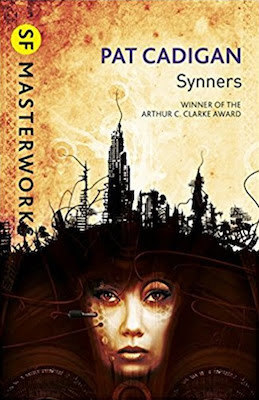
This is another early cyberpunk work – I seem to be having a couple of months where classics like this are appearing in my to-read queue! Pat Cadigan writes beautifully, and she brings more to the individual characters than many of the other early cyberpunk authors. See this insight into the mind of one of the lead characters:
She had the guilts over the coffee even as she couldn’t wait to drink half of it at one gulp. Modern life was making her sick by trying not to make her sick.
The underlying theme is our interactions with our technology – how much do we change for it, as opposed to changing it to work better for us. Gabe, the protagonist, is a “synner” – a synthesizer, who can take images from the brains of artists and spin them into a media package suitable for mass consumption. Here he is, spinning off down this thread when he’s standing in front of a vending machine, and someone says he looked like he might need a few coins for it:
‘Ah. I thought you looked like you needed, um, change for the machines.’ Gabe shrugged self-consciously; he could feel the entire common room watching. The man’s smile was unexpectedly broad and sunny. ‘That’s a good way to put it. How did you know?’ Gabe had the sensation of going over a mental speed bump. ‘Excuse me?’ ‘My whole life has been, “Okay, change for the machines.” Every time they bring in a new machine, more change.’
In this future, a new technology – called sockets – is emerging, which allows people to plug themselves directly into the “dataline” – what we might call the Web. Synners who can do this become vastly more capable, and more commercially valuable. But is it dangerous? – what if there are monsters out there?
Neurons start firing in patterns over and over, and if they’re bad patterns, well, that’s too bad. You people got no shields. You put in sockets, but you forgot about the watchdogs and the alarm systems and the antivirals and the vaccines.
Reality isn’t out there, it turns out, it’s in our heads. The line for Gabe and his friends becomes increasingly blurred, and the action increasingly frenetic. Great stuff, from one of the founders of cyberpunk.
This is a true gem of a book – it sparkles in the light and when viewed from some angles it is beautiful indeed, but there are some sharp pointy bits, and it’s quite hard. I first read it more than 30 years ago, borrowing a copy from the local library. It stayed with me ever since, and it’s recent return to fame (being liberally quoted by Sam Harris) has caused me to re-read it.
If it seems like I took the whole “gem” metaphor too literally there, then that’s what this book does, with its own metaphor of we ourselves having no head, using it to drive home some very deep points.
From where we look out to the world, Douglas Harding points out that we quite literally can’t see our own head. There’s this vague pink cloud which on other people seems to form a nose, but from where we look, it’s translucent and appears either on the left or the right, depending on which way we’re looking, so that doesn’t seem to be like other people’s noses. If we see our head in a reflection, we aren’t seeing our head itself, we are seeing a reflection – often distorted, in water, at an angle on glass, in a shiny door knob or the back of our spoon. Which of these is the real shape of our head? We are indeed unreliable witnesses:
If I fail to see what I am (and especially what I am not) it’s because I’m too busily imaginative, too “spiritual”, too adult and knowing, too credulous, to intimidated by society and language, too frightened of the obvious to accept the situation exactly as I find it at this moment.
Which is the start of the deep points that are being made. We seem, if we look from this point of view, to be directly connected to the whole world. The whole world is where we used to imagine our head was, and we are deeply, intimately, as one with that world:
There are no obstructions here, no inside or outside, no room or lack of room, no hiding place or shelter: I can find no home here to live in or to be locked out of, and not an inch of ground to build it on.
Douglas Harding had these revelations on his own, and his pursuit of others who might at least understand what he was talking about led him eventually to Zen Buddhism. This short book, then, is really about the Zen experience from an intensely first-hand point of view. Harding found that the Heart Sutra, daily recited in Zen (and other Buddhist) monasteries, declares that the body is just emptiness: “Form is emptiness, emptiness is form”, it famously declares. This is the profound experience of Zen. Hardin quotes the 16th-century Zen master Han-shan:
“I took a walk. Suddenly I stood still, filled with the realization that I had no body or mind. All I could see was one great illuminating Whole – omnipresent, perfect, lucid, and serene. It was like an all-embracing mirror from which the mountains and rivers of the earth were projected… I felt clear and transparent”
This is the direct experiencing of non-duality, of Advaita, as the Buddhists call it, the Zen experience of Satori It’s not a Zen or a Buddhist concept alone, either – you see it in Christian mystics, in the writings of Hindu and Muslims as well. Even Shakespeare knew of it, when in Measure for Measure he has Isabella say, in a much-quoted speech:
…man, proud man, Drest in a little brief authority, Most ignorant of what he’s most assured, His glassy essence, like an angry ape
This is indeed a short, but profound, book, directly confronting our inner angry ape. Harding ends with a sketch of a path, of experiences and exercises, that might help us along our way to finding this truth at the heart of reality. He achieved the “direct path” to this insight, and I toil along the lower slope of the mountain daily, with rare glimpses of the glorious peaks when the clouds break. But Werner Erhard, self-help guru and founder of the est movement, at least had it right with this line:
This is it. There are no hidden meanings. All that mystical stuff is just what’s so.
In this book Professor Sternberg of Harvard University takes a fairly detailed look at the deep links between mathematical group theory and the underpinnings of much of modern physics. It’s heavy going in many parts, requiring at least an undergraduate degree in mathematics (one containing lots of group theory) to even vaguely follow it. If you can at least follow along (and I was very much reduced to skimming the deeper technical material), then you’ll find beauty, and deep truth. Eugene Wigner talked about the “unreasonable effectiveness” of mathematics in explaining the physical world, and that’s what you will find herein.
In Chapter 1, Prof. Sternberg introduces key ideas like the action of a group on a set, and uses them to classify the finite subgroups of O(3), the orthogonal group of order 3 (i.e. the group of ways in which you can transform things in three dimensions such that distances between things are preserved). There is an immediate physical application in crystallography, and Prof. Sternberg takes us through this, introducing me at least to some marvelously-named crystals and compounds (iodosuccinimide, diaboleite, or wulfenite, anyone?)
Chapter 2 introduces representation theory for finite groups, which is a way of representing abstract objects as matrices, with the operations on those objects as equivalent to things like matrix multiplication. Using these techniques, you can produce character tables, which are a simple two-dimensional table that can capture much of the deep structure of a particular group. This material is set up for use in the following chapters.
Chapter 3 starts to build on this, first with a simple physical model of molecules as point masses connected by springs, and then adding in some quantum mechanics. This allows us to look at the ways in which such model molecules would “resonate” in vibration, which in turn leads to direct physical applications in spectrography. (Appendix F contains an interesting, detailed, and entirely non-technical review of how spectography evolved through the 19th century – one of the highlights of the book, for me.) This leads to a discussion of the symmetries of space-time, and out of this emerges a very natural representation of the fundamental properties of subatomic particles. Finally we come to Wigner’s truly remarkable 1951 paper in which he identifies these subatomic particles “as” the irreducible representations of the group. By doing this, Wigner was able to lay out a model that has directed particle physics for at least the last 60 years – he earned the Nobel Prize for Physics for this in 1963, and subsequent modifications of his work by Gell-Mann and others have lead to further Nobel Prize level discoveries.
It’s worth pausing on this point: here we have a use of the most abstract parts of mathematics, out of which directly flows deep and powerful results about the universe in which we live. It’s not that we can (say) simply model a molecule as a bunch of weights joined by springs: the types and properties of the most fundamental things we know about in the world spring directly from this abstract mathematics. It’s truly a remarkable, and very beautiful, thing.
Chapter 4 continues the journey, moving on to compact groups. From this we get models which apply directly to the hydrogen spectrum, models of atomic nuclei, and the group underlying the periodic table. Again, we see the powerful linkages back to Wigner’s work on the Poincare group.
Chapter 5 moves on to quarks, and the predictions of and subsequent discoveries of the elements of quantum chromodynamics. Because this book was written in the early 1990s, it doesn’t include any discussion of grand unified models or sypersymmetric models like string theory or quantum gravity, which is a shame, as once again we see the mathematical and group theoretical underpinnings.
There is much to like about this book, and I enjoyed the journey. However, I spotted a number of annoying typographical errors, and I very much fear that if I’d been able to follow some of the denser passages, my journey would have been made harder by further typos. The index is also weak, and I was often reduced to paging back and fro to find what a particular notation or definition was. I also felt that since this book set out to link group theory and physics, I was often not at all certain what the point of a particular mathematical section was – a brief up-front discussion of the motivation would have been very helpful to me. The fact that it ends in the mid-1990s also means it doesn’t cover a lot of recent, equally interesting, work in theoretical physics.
Finally, to be honest, a lot of the book was somewhat beyond me: the author says “a course in multivariate calculus and linear algebra, together with an elementary physics course, should suffice”. It’s been a few years since I took my courses in these subjects, but I have very good retention of them, and they in no way adequately prepared me for some of the long technical passages!
Three stars for me – quite possibly more for you, if you’re further along the maths curve than I started.