by Lavie Tidhar


There’s a lot to like in Donald Hoffman’s book. He carefully marshals a number of strands of experimental and mathematical evidence to lend weight to his claim that, ultimately, it is extremely implausible that our experience of reality in any way corresponds to how reality actually is. This is a very bold claim, and I found the thought experiment of thinking this through to be very interesting, even if ultimately I was unconvinced by the core argument.
Hoffman has spent his professional career thinking about this problem, and he’s build a very interesting view based upon it. He doesn’t deny the existence of a shared “consensual” reality – that you see what looks to you like a chair and a table, and I see the same. Instead, he denies that the chair and table exist in anything like the form we think they exist in – as three dimensional medium-sized objects. Indeed, he denies they exist at all when we’re not looking at them. Instead, our perception of them causes them to appear in our “user interface” for the world.
One of his most powerful metaphors is this “interface theory of perception”. This says that our experience of reality is rather like the graphical user interface of a computer: the rectangular object on the screen which we click on to open a file isn’t, actually, anything at all like the file really is in the computer – where it exists as a series of variations in charge or magnetic field on a solid state or spinning disk, and what looks like a file opening on the desktop is actually the cumulative action of millions of transistor state changes.
To convince us that what we think of as the world really is not at all what we think it is, Hoffman brings in a number of pieces of evidence. He spends a fair amount of time on our visual system. Here he brings together a number of visual illusions to show quite the depth of processing – with a corresponding opportunity for errors – that happens between photons striking our retina, and our perception of a chair, or a colour, or a beautiful person. This is entirely convincing to me: it’s clear that a vast amount of detail of what we might perceive is both hidden from us, and also filled in by informed guesswork by various networks in our brain.
Hoffman also points to modern physics, where quantum mechanics really does tell us some apparently strange things are happening out there. Photons from distant galaxies, millions of years in transit to us, apparently have their entire history affected by actions we take now. I feel there are other stories that we might tell about all this – from Everett’s multi-world hypothesis on upwards. Hoffman doesn’t dwell on these, but instead uses them as another explosion under our foundational belief that the world is what it looks like.
Hoffman also has some mathematics behind all of this. He has a model of consciousness – as a set of Markovian kernels (basically, things that choose amongst outcomes with different probabilities). And he also has what he calls the “Fitness Beats Truth” theorem. In this he pits mathematical creatures which prefer “fitness” against those which prefer “truth”. Given such a construction, in the framework of the game theory he uses, it’s no wonder that the creatures which prefer fitness tend to out-compete those which prefer truth: he defines fitness as the most important thing in his framework, so of course such creatures win. For me, this doesn’t really answer the question of why, in the real world, fitness wouldn’t more or less track truth. Isn’t a creature which depends on features of the landscape as they actually exist – i.e., a creature for whom fitness broadly corresponds to the state of the world – out-evolve a creature whose fitness was ultimately a fantasy? That’s why we haven’t all become addicted to the chemicals in the world which give us the most pleasure – because ultimately, fitness needs to track back to useful features of the world, rather than the ecstasy of a drug.
Despite my reservations, I did enjoy the book, and the arguments I had with it. I’d give it three and a half stars, rounded down to three for fighting too many paper tigers, rather than steel-man arguments against his position.
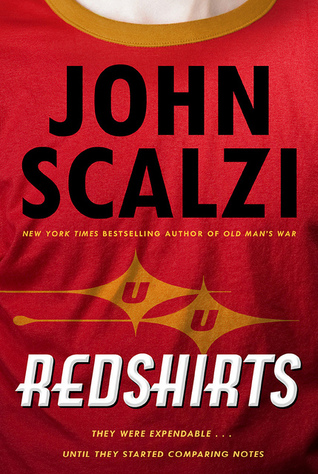
Everyone who has ever watched more than a couple of episodes of the classic Star Trek will have noticed that when you’re beaming down to a new planet, you don’t want to be one of the team in red shirts. Those are the ones who end up shot, eaten, crushed, or otherwise killed by whatever this episode’s planet has in store.
Upon this premise does Scalzi found this charming book. The “red shirts” are real people, too, and in this alternate world, some of them begin to realise their fate.
“Yes, death by away team. Very effective on this ship,” Jenkins said.
Ensign Andrew Dahl has just been assigned to this ship. It’s a prestige posting, but slowly he begins to see that – other than the ship’s captain, its chief science officer, and one or two other charismatic key personnel, everyone else is at risk. As he shares this with a few close colleagues, they realise, too, that there’s no simple way out of this for them:
“In other words, crew deaths are a feature, not a bug,” Cassaway said, dryly.
Andrew and his compadres therefore expend a great deal of energy in not being the one’s selected for the away missions. Until the friends stumble upon a secret, which gives them – just maybe – a truly improbable way out of this all…

A really important and profound book on how we’re a social species, and that although our overall nature is significantly shaped by environment (mostly culture), the set of possible shapes that our nature might take is still profoundly constrained by our genetics. We are not a blank slate at all, despite what some sociologists might claim. Instead, we can:
“hope to decide more judiciously which of the elements of human nature to cultivate and which to subvert, which to take open pleasure with and which to handle with care. We will not, however, eliminate the hard biological substructure until such time, many years from now, when our descendants may learn to change the genes themselves.”
To investigate the limits of genetics, and the flexibility of the human responses to it, Wilson looks at four of the “elemental categories of behavior”: aggression, sex, altruism, and religion.
On aggression, for example, Wilson leaves no doubt that our genetics are those of an aggressive primate, while our culture has striven to remove most of it from our societies.
“Throughout history, warfare, representing only the most organized technique of aggression, has been endemic to every form of society, from hunter-gatherer bands to industrial states … Virtually all societies have invented elaborate sanctions against rape, extortion, and murder, while regulating their daily commerce through complex customs and laws designed to minimize the subtler but inevitable forms of conflict. Most significantly of all, the human forms of aggressive behavior are species-specific: although basically primate in form, they contain features that distinguish them from aggression in all other species.”
In response to those who point to the tiny minority of societies that appear to be pacific, Wilson asks us to look at even their history.
“Among contemporary !Kung San, violence in adults is almost unknown … But as recently as fifty years ago, when these Bushman populations were denser and less rigidly controlled by the central government, their homicide rate per capita equaled that of Detroit and Houston”
None of this is to deny our ability to overcome our genetic tendencies. But first we must recognize that they exist, and the patterns through which they show up in our societies.
“Our brains do appear to be programmed to the following extent: we are inclined to partition other people into friends and aliens … We tend to fear deeply the actions of strangers and to solve conflict by aggression …. (These) learning rules of violent aggression are largely obsolete. We are no longer hunter-gatherer who settle disputes with spears, arrows, and stone axes. But to acknowledge the obsolescence of the rules is not to banish them …. We must consciously undertake those difficult and rarely traveled pathways in psychological development that lead to master over and reduction of the profound human tendency to learn violence.”
This same style of treatment is given to the other topics. For sex, for example, we start with why there are genders at all – and why two of them, versus the thousands of genders in some fungi, or the haplodiploid arrangement of some bees, wasps and ants. From there, we look at what sexual differences seem to genetically exist in humans, and why they might have evolved. His treatment of homosexuality is very sympathetic for the time it was written (1978), and is generally directed towards potential kin-selection benefits of a predisposition to homosexuality, which is perhaps a little dated, but not too far away from my understanding of contemporary views.
Perhaps only in the final chapter, entitled Hope, do I find myself disappointed. Not with Wilson, but with humankind. Wilson’s view is that a correct application of evolutionary theory would uphold three core values: the nobility of the individual (benefiting humankind over their own individual genes), diversity in the gene pool (to allow enough room for human brilliance across any field to emerge), and universal human rights (because power is fluid in our societies in the long term, and any long-term inequity will be visibly dangerous to its temporary beneficiaries). Perhaps he is right, and we’re just not there yet!
Wilson writes all this in 1978; I read a copy of the 25th anniversary edition from the early 2000s, but the subject matter is still just as important today. And very little of it is dated. 4.75 stars, rounded up to 5 for brilliance of exposition.

Excellent follow-up to One Word Kill. You should definitely read that first, although if you’ve forgotten a couple of points from it, Mark Lawrence is good enough to put a very brief summary at the start.
This book picks up the action and carries it forwards with great conviction and style. The characters continue to evolve, and they are just as charming, annoying, or threatening as in the first book. As before, one of the main “characters” is the cancer of the main protagonist:
‘The cancer?’ She came right out with it. Most people hesitate when they say the C-word, just a little, as if they still need to convince themselves you don’t get it just by saying it out loud. Like it was one of those demon lords in D&D that are summoned by name. Say Demogorgon too many times and he was pretty much bound to show up, but cancer . . . not so much.
The science is also very thorough, although since we are talking about time travel, it’s not entirely possible to produce all the convincing details! But it’s well done, and includes several interesting points, such as moving things in time – even just by microseconds – causes them to apparently move in space relative to the Earth, as the planet has moved at least some distance through it’s orbit in that time.
I won’t give away any plot – you’ll have to read it! Now I’m looking forward to #3 in the series…
View all my reviews

The Obelisk Gate was, I’m very sorry to say, a sad disappointment to me. Especially after the brilliance of the first in the trilogy The Fifth Season. This felt to me like about a quarter of a book’s worth of plot, stretched out across a whole book, because it’s a trilogy and so, y’know, it needs three books. The plot did advance – in particular with Nessun, the young daughter we were chasing after in the first book – but not as far as one would’ve hoped. And the same style was there, with the main character being written about in the second person, by a mysterious voice. But it didn’t really add anything substantial to the amazing world that was created in book one, nor were there any particular plot twists to delight the reader.
Quite upset about this all, I have to say. I’m not sure I’ll be able to persuade myself to read the last one, in case that, too, is disappointing.

This was a intriguing book in two ways: first, the subject matter was fascinating, which wasn’t a surprise as that’s why I was reading it, but secondly, I found the prose style delightful. I’ll come back to this later: let’s start with the contents.
It’s all about spatial thinking, and how the way space itself – via gestures, and the metaphors we derive from it – shape the very fundamentals of the way we think. Abstract thinking isn’t “abstract” at all – it’s based on spatial metaphors. We don’t think with words inside our head, we think in (abstract) space in there.
From a personal point of view, this really struck a chord. I was a mathematician and then a computer programmer, and still play with both, and in these worlds I almost always find myself thinking spatially about problems, imagining I’m moving this variable or data structure from here to there, or twisting it in some way to change its form or use. Spatial thinking, Barbara Tversky contends, enables us to draw meaning from our bodies and their actions in the world.
One of the excellent things about this book is that it’s all based in experiment. Hundreds of different experiments underpin the picture that is painted herein, with practical applications everywhere from things that are obviously spatial – how to draw better assembly instructions or navigation instructions – through the physically laid out – comic strips – to the abstract – how to come up with a larger variety of original designs.
As I said, I also came to love the prose style of Barbara Tversky. It beautifully combines short sentences, long sentences, simple words, technical jargon, sentence fragments, lists, the whole gamut, in such an elegant and rhythmic way. Here’s a random example, where she’s talking about tree diagrams:
“The enormity of the influence of tree diagrams on the accumulation and dissemination f knowledge has not been fully recognized. Trees, knowledge, brain. By now their uses are uncountable and their visualizations myriad. The Big Bang, phylogenetic trees, corporate trees, occupational trees, decision trees, diagnostic trees, linguistic trees, knowledge trees, probability trees, family trees, the list goes on. And on.”
All in all, a great book. Four and a half stars.

This is the first book in the “Wild Cards” franchise, which I’d not come across before, despite it now containing (according to the Wikipedia article) 27 books across four different publishers. It’s a set of short stories by various excellently-credentialled science fiction authors, all set in the Wild Cards alternate history, and edited by George R.R. Martin and Melinda Snodgrass.
The set-up to this alternate history is simple: just after World War II, an alien spaceship crashes in the US, and the – very human-like – alien inside demands to meet the President, to mobilise the entire American military to search for another crashed spaceship, which this first alien claims to have been chasing. For inside this other ship is a deadly bioweapon, which if released will have potentially terrible consequences for humans.
And, of course, it does get released: the first of the short stories deals with these events themselves. The bioweapon turns out to be a gas which reacts with human DNA: only 10% of people are affected, and most of them are killed outright. A few, however, have their DNA mutated and acquire either crippling, or superhuman, abilities. Those deformed by the virus become known as Jokers, while those given superhuman abilities are known as Aces.
I was pleasantly surprised by the high overall standard of these stories. Too often I’ve read compilations that were a bit of a curate’s egg – good in parts. These were overall pretty consistently good, with several really hitting home at a very strong level.
The stories are set across the decades from the end of the war to the early 1970s, and contemporary history plays a big role. Initially the Aces are genuine superheros, and we meet a team of four who work at arms-length for the US government to help them with various foreign policy “interventions” in Argentina, China, Cambodia and elsewhere. But all is not always sunny: a couple of the stories dealt with the McCarthy era, where the House Un-American Activities Committee turns its spiteful gaze upon the Aces, and decides they’re not “American” enough, and have possible communist leanings (hey, they worked in China didn’t they?). It’s quite gritty, real-world stuff, and the short story “Witness”, by Walter Jon Williams, was one of my favourite.
I also liked “Transfigurations”, by Victor Milán, which is set in “summer of love”, and wraps around things like the Kent State Shootings, aka the May 4 Massacre, in 1970. These were nicely written stories that did a great job of taking real-life events and using them as a point of leverage for their plot, whilst not diminishing the tremendous impact of the historical events themselves.
Some stories just use the Aces/Joker storyline to come up with interesting characters. “The Sleeper”, by Roger Zelazny, and “Shell Games”, by George R.R. Martin are representative of this, and both showcase great authors doing something a bit different from their normal fare, and doing it very well.
I’ll definitely be looking out for more of these collections in the future. Some of the Aces/Jokers are I’m sure going to make further appearances – the final story, “Comes a Hunter”, by John J Miller, is surely just a teaser for a future visit by The Predator, while the alien visitor himself – Dr Tachyon – is here for the long haul, I’m sure.
The book was first published in 1986, but despite this, it’s aged extremely well. Overall, I’m giving this four stars – very enjoyable.
(Possible trigger warning: some strong sexual content in a couple of the stories. Yes, people had sex even back in the 1980s 🙂 )

This is a dark book, written from a place of nightmares that so many visit, and from which the fortunate might return. In it, William Styron, an author of some considerable skill, writes grippingly of his personal experience with depression. It’s a remarkable book, made all the more remarkable by the skill of the author – for the man can write. Here he is, near the start of this slim volume, in the car on the way to collect an prestigious literary award at a ceremony in Paris:
…it was past four o’clock and my brain had begun to endure its familiar siege: panic and dislocation, and a sense that my thought processes were being engulfed by a toxic and unnameable tide that obliterated any enjoyable response to the living world. This is to say more specifically that instead of pleasure – certainly instead of the pleasure I should be having in this sumptuous showcase of bright genius – I was feeling in my mind a sensation close to, but indescribably different from, actual pain.
This is a book from a place I have never been. Reading it was as much of an immersion in a different world for me as Margaret Mead’s Coming of Age in Samoa: A Psychological Study of Primitive Youth for Western Civilisation. I have no personal experience of depression – I am about as annoyingly chipper as it’s possible to be (on the Big Five personality traits, I am at the first percentile on the neuroticism score – through no moral virtue on my part, I assure you, just luck in both genetics and lack of childhood trauma).
However, I read a second-hand copy of this book, and throughout it, a previous reader had marked certain passages with bright red crosses and underlines. This previous reader was my Margaret Mead: here was my guide to these difficult experiences, of which we still know so little. We don’t know how it starts, we rarely known why – and whether – it ends. Styron says:
I shall never learn what “caused” my depression, as no one will ever learn about their own. To be able to do so will likely forever prove to be an impossibility, so complex are the intermingled factors of abnormal chemistry, behaviour and genetics. Plainly, multiple components are involved – perhaps three or four, most probably more, in fathomless permutations.
As the author’s depression grows, his world folds in on itself and becomes darker still. He reads obsessively about the disease:
It has been established with reasonable certainty (after strong resistance from many psychiatrists, and not all that long ago) that such madness is chemically induced amid the neurotransmitters of the brain, probably as the result of systemic stress, which for unknown reasons causes a depletion of the chemicals norepinephrine and serotonin, and the increase of a hormone, cortisol. Will all this upheaval in the brain tissues, the alternate drenching and deprivation, it is no wonder that the mind begins to feel aggrieve, stricken, and the muddied thought processes register the distress of an organ in convulsion.
Many people find relief with various pharmacological treatments, but the author discovers that his particular version of the disease is resistant to the standard drugs, and even, somewhat alarmingly, finds eventually that the one he has been prescribed to help with his sleep is strongly contra-indicated for men of his age.
Eventually, in this hellscape, Styron’s thoughts become blacker still.
What I had begun to discover is that, mysteriously and in ways that are totally remote from normal experience, the fray drizzle of horror induced by depression takes on the quality of physical pain. But it is not an immediately identifiable pain, like that of a broken limb. It may be more accurate to say that despair, owing to some evil trick played upon the sick brain by the inhabiting psyche, comes to resemble the diabolic discomfort of being imprisoned in a fiercely overheated room. And because no breeze stirs this cauldron, because there is no escape from this smothering confinement, it is entirely natural that the victim begins to think ceaselessly of oblivion.
Styron becomes suicidal, and the margins of my copy gain further red crossings – this passage had two such notations:
The pain is unrelenting, and what makes the condition intolerable is the foreknowledge that no remedy will come – not in a day, an hour, a month, or a minute. If there is mild relief, one knows that it is only temporary; more pain will follow. It is hopelessness even more than pain that crushes the soul.
Curiously, it is Styron’s own skill as a writer that saves him in the end. He sets out to write a suicide note one night in December, his loving and supportive wife asleep upstairs, but finds the words will not come. He cannot write to his own satisfaction, tears up the note, and in the middle of the night, wrapped in a blanket (the furnace is out), puts on a tape of a movie. In it, he hears a soaring contralto voice singing Brahms’ Alto Rhapsody. He is seized by the music, and the memories it brings of happier times
All this I realized was more than I could ever abandon, even as what I had set out so deliberately to do was more than I could inflict on those memories, and upon those, so close to me, with whom the memories were bound. And just as powerfully I realized I could not commit this desecration on myself. I drew some last gleam of sanity to perceive the terrifying dimensions of the mortal predicament I had fallen into. I woke up my wife and soon telephone calls were made. The next day I was admitted to the hospital.
Slowly, but surely, Styron does recover. He knows he may have remissions, but he also knows that with the right help, the illness will again run its course. And my anonymous guide, of the red markings? I saw, with some relieve, their mark beside the final lines:
There, whoever has been restored to health has almost always been restored to the capacity for serenity and joy, and this may be indemnity enough for having endured the despair beyond despair.
I give this book five stars.

My headline for this book would be “Somewhat bloody, and completely bloody brilliant”. Five stars, very well earned.
I marvel, yet again, at how absolutely amazing some books can be at immersing you in their umwelt. This one combines great world-building, complex characters, and – most of all – some amazing prose that rises to the level of poetry at times. Because the plot is so stuffed full of surprises, I’m barely going to mention it. There’s great fight scenes (some are quite gory, if that might concern you), there are many hints of underlying glorious ages gone before (leaving, for example, the “focus moon” – which is a marvellous plot device), there is a fleshed-out background philosophy/spiritual side, and of course are heroes to root for and even the villains are multi-faceted. Perhaps the closest book I can think of is how I felt when I read The Blade Itself and found Joe Abercrombie.
In the end, you don’t read books like this for the plot, you read them because of the prose, and the world that envelopes you as you read. And Mark Lawrence does just a fabulous job with this. I haven’t read any of his others, but for sure I will be doing so. I’m not even going to give you any more of the storyline- I’ll just say that you have to read it, because it’s marvellous.
Here are some random snippets, to keep you going. He waxes philosophical at times – let’s look at time itself:
“All the world and more has rushed eternity’s length to reach this beat of your heart, screaming down the years. And if you let it, the universe, without drawing breath, will press itself through this fractured second and race to the next, on into a new eternity. Everything that is, the echoes of everything that ever was, the roots of all that will ever be, must pass through this moment that you own. Your only task is to give it pause – to make it notice.”
Or
“Your death has not been waiting for your arrival at the appointed hour: it has, for all the years of your life, been racing towards you with the fierce velocity of time’s arrow. It cannot be evaded, it cannot be bargained with, deflected or placated. All that is given to you is the choice: meet it with open eyes and peace in your heart, go gentle to your reward. Or burn bright, take up arms, and fight the bitch.”
The book, you initially guess, and then find confirmed, is about a young girl who ends up in the care of some nuns – people who might, in other worlds, be spiritual and charitable and kind, but who in this world are spiritual and cunning and combat-trained.
“You may be called upon to enforce the authority and the will of the church. It would be better if you did so in a manner that allows the transgressor to see the error of their ways rather than the contents of their body.”
Fight is what they do, and they are very, very, good at it:
“It is important, when killing a nun, to ensure that you bring an army of sufficient size. For Sister Thorn of the Sweet Mercy Convent Lano Tacsis brought two hundred men.”
But sometimes, the prose is just plain philosophical:
“‘It’s hard out there.’ Nona gazed towards the windows. ‘Running’s all right, but when you stop there’s the freezing and the starving and the dying.'”
or
“Children are like cats, only less useful and less furry.”
Enough, or I’ll quote the whole book. And although it’s complete in itself, it’s the first of a trilogy, which I was so thrilled to discover that I just went ahead and bought the others, sight unseen.