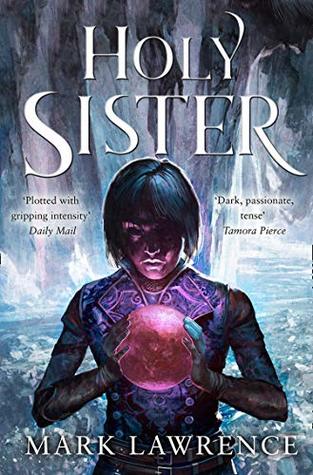
Fab conclusion to the Book of the Ancestor trilogy, with more from Nona and her friends – more action, more chases, more revelations. I loved it. As ever, Mark Lawrence can turn a sentence that makes the hair stand up on the back of your neck:
‘“Every child of the Ancestor wore red on that day when the Scithrowl arrayed their number before the Convent of Wise Contemplation. They ran short of habits for Red Sisters and instead painted the newest novices with the blood of captured heretics”.’
The channel of ice on the planet continues to close in, pushing people into more and more desperate actions:
Murder, murder, and more murder. What else could they expect when the ice kept closing? All of mankind reduced to wild animals in an ever-shrinking cage.
What matters now is who controls the ancient artifacts known as the ship hearts, and quite what the ship hearts can do when all four are brought together. Nona has managed to capture one, but others have been stolen, and the action culminates into a huge battle for possession, and for power.
Along side all this we find out more about “thread-work”, which Nona and the other Sisters are taught to navigate. I liked the hints of an underlying theory of physics as well as the mystical in here, something like Quantum Buddhism (which I sure is a thing out there, even though I just made that up).
when watching the thread-scape you learned how artificial ideas of individual objects, or even people were, since each was infinitely connected and interwoven with the world around them.
Ultimately, it’s about people, both friends and enemies:
She thought of the riddle of her life and the fact that even Abbess Glass’s best advice on the subject had been that people are complicated, especially from the inside.
Not quite the utter brilliance of the first in the trilogy, but still a cracking good read, nicely on the boundary of science fiction and fantasy, and a very sound 4 stars.
There’s an awful lot to like about this book, but it’s not a straightforward read. Hollis seems to relish obscure words and his text isn’t always easy to parse: as Benjamin Disraeli once said of William Gladstone, he seems at times almost “inebriated with the exuberance of his own verbosity”. Having said which, it’s a style thing, and it perhaps made me slow down my reading and forced me to engage more with the meaning, which was all to the good, as there’s a lot to engage with here.
When I started reading, I knew nothing of Hollis, nor of his other books, so I didn’t realise that he was by trade a distinguished psychoanalyst in the Jungian tradition. This soon becomes evident, as a lot of the book centres around the kinds of myths by which we live our lives, and the potential to transform ourselves (or at least our view of ourselves) by engaging with those myths:
“We are all exiles, whether we know it or not, for who among us feels truly, vitally linked to the four great orders of mystery: the cosmos, nature, the tribe, and self?”
I was new to a lot of this, and really enjoyed the discussion. It’s about how you confront the world:
“The dragon shows up every day, no worse for the wear, and ready to scare you back into a corner of your life, to swallow you, and to annihilate the life energy you are supposed to incarnate in this world.”
That’s our challenge, then. We must continue to show up, to face our difficulties, our boredom, our anxieties, and to live so our “daily discipline becomes: That Life Not Be Governed by Fear”. Scattered throughout the book are anecdotes taken from Hollis’s clients, which speak to these deep concerns and to the undercurrents of our lives:
Angela walks away from her marriage of twenty years. Safe, secure, valued by all, including her husband, she walks away. Why? When asked, she mumbles, “I wanted to know that I wasn’t dead yet.”
It’s about understanding our anxieties and our neurosis. Our daily lives tend to become “anxiety management systems”, but are to deeply buried that we don’t even know that this is what we’re doing, nor quite the extent to which we’re doing it. None of which is easy. In fact, in many ways it wasn’t meant to be easy – and anyone who tells you different is selling somehting:
“Why do we have psychologists in the media who conveniently fail to verify the contradictions with which we all daily live, the necessary suffering that is a by-product of real life, rather than suggest that three easy steps will bring us happiness and material affluence
Ultimately, we must become larger people – “step into largeness”, living life by verbs (actions we take), not nouns (things we own, or static truths). Or we can choose not to do that, and live instead on the scraps from the tables of other lives, which we falsely imagine somehow to be more meaningful than our own:
“The world is full of people droning on, sitting before the telly or the Internet, waiting to die, living only for small sensations of scandal or vicarious catastrophe that they can witness from afar.”
It’s our choice, though. Growth, or security – you can’t have both. It’s clear which Hollis is striving for, and although he offers us no “ten steps” or “twelve rules”, no map at all, he perhaps is offering us a compass that will give us our heading, as we cross whatever terrain our lives hold.
This is an thorough and well-argued review from Daniel Dennett of the ways in which religions might have emerged as natural phenomena in early humans, and how the pressures of evolution on this new set of social constructs might have then produced many of the traits we see in today’s religions.
His argument adds important elements to a pure psychological view of religion, although it certainly starts there. In the early chapters, Dennett argues that humans have what he calls an “intentional stance”: that in order to best predict the world, we tend to think of things in the world as rational agents, and figure out the desires, and thus the actions, of that agent. This works brilliantly for other humans, and it works pretty well for the animals that early humans might need to hunt or escape. Thus it’s easy for us to see how we might extend the same logic to other things – the weather, diseases, and so forth. From this, we can see how we might have grown to attribute apparently random changes in (say) the weather to an unseen entity behind the weather itself, and to then see the changes in the weather as reflecting true intentions of that entity. If you want to get it to rain, therefore, it makes perfect sense to try and communicate with the entity behind it, and to get the entity to cause it to rain. We attribute “agency” to the weather, and it makes sense then to try and bargain with the agent.
(As I write this, we’re in lockdown due to the COVID-19 epidemic, and this desire to treat the disease as an entity with intentions, capricious or malignant though they might be, is very visible in the way many people talk about it.)
From here, Dennett grows the argument. Everything we value, or are fearful of, we value or fear for reasons. This view of the world gives us challenges in everyday living, which early folk religions enabled us to handle, psychologically. Once in the culture, these folk religions were susceptible to the same evolutionary pressures – this time at the level of “memes” that thrive or die out – as humans themselves, only many many times faster that physical evolution. Only the best variants of these beliefs will propagate – and “best” means most successful in meeting our deep psychological and physical needs.
As human societies grew, specialised intercessors to these agents emerged (“shamans”, he calls them for convenience). Dennett goes on to suggest that these shamans, and others, had time to become more reflective, and so from these early folk religions, organized religions began to emerge. Sometimes, the simple beliefs in the folk religions were bolstered or even entirely replaced by carefully crafted reasoning. At this point, it might have become necessary to put some of these religious views out of the reach of “gnawing skepticism”, as Dennett puts it. This leads to an interesting way of splitting the world:
“This winnowing has the effect of sequestering a special subset of cultural items behind the veil of systematic invulnerability to disproof – a pattern found just about everywhere in human societies. As many have urged, this division into the propositions that are designed to be immune to disconfirmation and all the rest looks like a hypothetical joint at which we could well carve nature. Right here, they suggest, is where (proto-)science and (proto-)religion part company”
Dennett rightly spends a fair while on this point. Is it right that we treat religion, by definition, as “systematically immune to confirmation or disconfirmation? … No religion lacks these effects, and anything that lacks them is not really a religion, however much it is like a religion in other regards.” Dennett rightly points out that this view wasn’t shared by the shamans themselves: if they saw they were losing their flock to the shaman down the road, they were quite prepared to take on new approaches and ideas – to evolve. So one of the important features that emerged as folk religion merged and became organized religions was this secrecy and systematic invulnerability to disconfirmation.
Now we see Dennett broaden the view out from the leaders to the groups who also believed. He sees this as in many cases an entirely rational decision to join on the part of individuals, who would see benefits from being part of a group regardless of possible supernatural benefits from the gods themselves. There are also many possible psychological benefits in belief, but there is a darker side as well – tribalism in humans is very often reinforced by conflict, and the tendency of religions to spark conflicts and wars from prehistory to the modern day is terrifying. Of course it could be argued that they were being co-opted by pre-existing power structures, but none the less the features of very many religions do seem to be shaped, and often thrive, on conflict.
At this point, Dennett spends a while talking about “belief in belief”. This, he argues, is a very powerful force, in religions and elsewhere, and can completely transform them. For example, he points out that many feel it’s important to maintain the belief in democracy, regardless of its flaws. So we tend to play down the flaws and play up the benefits, and in doing so lose track of the logic which may (or may not) support the arguments for its value. Similarly with science – we may believe in science, we may believe that “e=mc2”, without knowing (or caring) how it is so. None the less, we believe! And, he argues, the same is true of religions. Even very devout followers may not share identical views on details of doctrine, and many lay believers will turn out to have quite different interpretations of major points. But it doesn’t matter – what matters is that they all share the belief in the importance of their beliefs.
Finally, Dennett looks at religions today. He starts to talk about whether religion is, all things considered, a good thing. Is religion good for people, he asks? There is definitely evidence that belonging to religious organisations can improve the morale, and hence the health, of participants. Believers would also argue that the meaning it gives their lives is immeasurably valuable. More specific experiments, for example on the benefits of “intercessory prayer”, give mixed results, and include at least one notorious case of academic fraud. Finally, almost all religious people see their religion as the foundation of their morality. On this point, Dennett comments
“I have uncovered no evidence to support the claim that people, religious or not, who don’t believe in reward in heaven and/or punishment in hell are more likely to kill, rape, rob, or break their promises than people who do. The prison population in the United States shows Catholics, Protestants, Jews, Muslims, and others – including those with no religious affiliation – represented about as they are in the general population … Indeed, the evidence to date support the hypothesis that atheists have the lowest divorce rates in the United States, and born-again Christians the highest.”
There is a lot I really liked about this book. The arguments are thorough, carefully constructed, and evidence is sought wherever possible. Some technical material is present in appedices, a couple of which I found useful I am, I should point out, not a religious believer of any creed, although I do think that there is a deep human need (which I feel) for the spiritual, and so I can’t comment on how a theist would have felt. I hope they would have been able to read the arguments through to the end, and Dennett I feel does a good job of presenting the best arguments on both sides.
There were a few irritations, for me at least. The very first chapter or two nearly caused me to give up, as Dennett spends an entirely unnecessary (for me) amount of time justifying the whole enterprise. He’s also very fond of italics to emphasise key words in his paragraphs, and sometimes this is perhaps too heavy handed. But it’s a forgiveable style. Four and a half stars, rounded up to five on final consideration.
This is a book that I can imagine some people really aren’t going to like at the start: the protagonist, Jorg Ancrath, seems to be more than usually disturbed young man – sociopathic is the word that sprang to my mind.
But as you read on, and as the complexity of his background is uncovered, his behaviour becomes explicable, and one begins to understand more. Eventually, one can perhaps begin to move from understanding to empathy. You learn what he has seen and how he felt – the death, the brutality, the guilt. Together with the environment he grew up in, how else could he have survived? And indeed, in due course, the layers of the true motivation of his actions begin to appear.
Jorg is still a bit of a sociopath, though. Here he is on the game of life:
“You can only win the game when you understand that it is a game. Let a man play chess, and tell him that every pawn is his friend. Let him think both bishops holy. Let him remember happy days in the shadows of his castles. Let him love his queen. Watch him lose them all.”
In this view of life as a game without rules, and a game to be won, you find the key to his character:
“Anything that you cannot sacrifice pins you. Makes you predictable, makes you weak.”
Which gives you Jorg’s philosophy on how to play – you push, you cheat, you stab them in the back, but you never, ever, stop:
“In the end it’s about staying power. They should put that on headstones, ‘Got tired’, maybe not tired of life, but at least too tired to hold on to it.”
The world in which the book is set is also an important element here. Jorg is – or at least was – the heir to the throne of one of many competing kingdoms. War is everywhere, and has always been. Again, expectations are confounded, and we gradually learn more about the history of the world, just as we do about Jorg’s personal history. It’s a world like our own medieval times, with some limited magic thrown in. Although, like Jorg, there’s a backstory which you slowly learn, and which tells you more.
Finally, we see hints of a strange politics in this world. Jorg’s ambition is to regain his throne and end the hundred years of war. But is that his ambition, or is he a pawn in a larger and more sophisticated game? Lots for me to look forward to in the rest of the trilogy!
Four stars here. Excellent writing, intriguing world building, and a nuanced main character.
Some useful advice, buried under many layers of mysticism. So yes, the principles of the Four Agreements are sound psychological advice. They are: Be Impeccable With Your Word, Don’t Take Anything Personally, Don’t Make Assumptions, and Always Do Your Best, and all four are indeed excellent advice in general terms.
But no, the trappings in which it was wrapped did not work for me. Although it’s possible that the wisdom of the Toltec culture survives, the reality is they were a mesoamerican culture that died out nearly a thousand years ago and left no written records, although they certainly left some impressively large stepped pyramids. My conclusion: directionally interesting, but the terrain over which one traveled wasn’t helpful. Two stars, regardless of how much Opra loves it, because it’s recycled and wrapped in too much mystic claptrap.
The plot of this science fiction novel has a lot of potential: a group of elite pilots are training in the latest star fighters, to do battle with an implacable enemy, and they slowly begin to think that all is not quite what it seems in the ongoing war.
Sadly, I found the writing style quite weak. For me, it was clunky with little flow to it, and too much dependence on telling a number of details, rather than letting me intuit it. It also has a whiff of thesaurus about it at times:
“Simon took a look at his bedside clock. The illuminated green numbers informed him that it was just past four thirty”.
Really, the numbers informed him, did they? So no points for style, a couple of points for a reasonable plot.
I wanted to like this book, I really did, and I hate writing a review like this for a number of reasons. But I also know I would want to be able to read reviews like this for books I might be about to buy. So, sorry, but only two stars here.
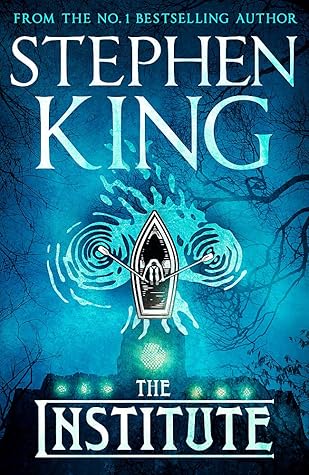
Much to like about this Stephen King, I thought. The first forty or so pages set up the story of Tim Jamieson, an ex-cop who decides on the spur of the moment not to fly from Tampa to New York, but instead to hitchhike. He wends his way along, and ends up at the town of DuPray, North Carolina, where he spots an ad for a “night knocker” – someone to work as an adjunct to the local sherrif’s department, walking the streets at night. Again, he decides more or less on the spur of the moment to pause his cross-country journey, and takes up the job.
Then the story suddenly shifts to Luke Ellis, a genius-level twelve year old boy in Minneapolis. He appears to have a small telekinetic ability – when he’s excited, small objects might unexpectedly rattle about or fall over. He has loving parents, and a great deal to look forward to – MIT have offered him a scholarship already.
Then, suddenly, he is kidnapped, and his parents are murdered, by a well-trained and ruthless team. He wakes up in a room that appears similar, but not quite identical, to his own bedroom. And now he’s inside The Institute, in rural Maine, with a handful of other children who also have psychic gifts – some are”TK”, telekinetic like Luke, others are “TP” and can read surface thoughts. He soon learns that after a few weeks of tests, the children disappear into the Back Half of the Institute, and are never seen again.
The tests they undergo range from the mild to the brutal, but it’s the adults in charge that are in many ways most horrifying. That’s at the heart of the book for me: the moral corruption of the adults who run the Institute, inured to what they are doing to the children for “the greater good”. The children are just children – some compliant, one or two defiant, all scared and trying to hide it. The adults are the horrors. There are several references to Nazi experiments on prisoners, and many of these adults are cast in the same light: some believe in some absolute “truth” that justifies whatever they need to do, while others are by nature, or perhaps simply through long exposure, sadistic and brutal.
Uncomfortable reading at times, but largely well done by Mr King. For me the very last chapter was superfluous – the story could have ended 10 pages earlier, and would have been better for it, so I knock a third of a star off for that. But the preceding 500+ pages were good to great – the second half in particular really gripped me and I found it hard to put down. Three and two thirds of a star, rounded up to four.
I stumbled across this online, where it is referred to as the first Bobiverse book – so called because the main character, Bob Johansson, appears in it in many guises…
…And thus the plot is set. Robert J. is a successful software entrepreneur, who has just sold his software company for multiple millions as we meet him. He decides to spend some of his newly-gotten wealth on a contract that will, in the case of his death, see that his head is preserved, frozen in liquid nitrogen, until such time as it is possible to revive him. As is the way, we soon seen this eventuality arise: Bob is killed in a car accident, and his head is frozen.
When Bob wakes up, more than a hundred years later, he finds that he is now owned by the state, and he is conscripted into an organisation that wants to put him into an interstellar space probe as the controlling system. Not just any probe, but a Von Neumann probe – one that can replicate itself as it finds new stellar systems. Since the state that now owns him is a fundamentalist Christian derivative of the USA, and is on the brink of war with one or the other of the few other superpowers across the globe, this seems like a good option, versus remaining on Earth with a global war potentially about to kick off.
Thus the story is set: Bob launches off onto his adventures as a space ship, with the ability to “clone” himself (although his clones turn out to be more like fraternal twins that identical copies). Of course, things do not go smoothly: at least one of the other superpowers has also launched a probe like his, and they are considerably more aggressive than Bob.
This is a great setup for a very open ended plot, and the whole book is well thought through. The fact that Bob comes from the early 21st century (i.e., now) means that his cultural references are the same as those of the reader. The narration is largely in the first person, and Bob’s ironic-slash-sarcastic voice was nicely done. It’s a science geeky book, too, with puzzles to be worked out and solved using semi-realistic technologies. The overall tone in this reminded me of The Martian in many ways, and I enjoyed it very much. Overall the style was quite bare-bones, without a lot of description of the setting, but lots of science and nerdery, all of which worked very well with the voice of the narrator.
Four stars for me – great fun, and because it wasn’t pretending to be anything it wasn’t. I’ll read the others in due course, I think.
Wherever you are in life, all you have control over is your choices. Did you make the right choices yesterday? Last year? With your first serious partner? That’s what this book cleverly explores. In our youth, all this lies ahead:
“It’s the beautiful thing about youth. There’s a weightlessness that permeates everything because no damning choices have been made, no paths committed to, and the road forking out ahead is pure, unlimited potential.”
Jason Dessen, the hero, is confronted by a masked abductor who asks him “Are you happy in your life?”, forces him to drive to an abandoned warehouse on the outskirts of the city, and knocks him unconscious. When he awakes, he’s strapped to a gurney, surrounded by strangers in hazmat suits. Or at least, they’re strangers to him – but he doesn’t seem to be a stranger to them – they know him, and greet him as a friend.
The Jason who is knocked out is married to a gifted artist, Daniela, whom he married fifteen years before when he found out she was unexpectedly pregnant with his child. Jason gave up his research into quantum mechanics, and took a job as a college physics professor at a quiet university. But in the world he wakes up in, he isn’t married to Daniela, he has no son. In this world, he’s a celebrated genius, who has achieved something truly remarkable, and held in awe by those around him.
I found the premise for the book dragged me right into it. The choices we make define us, but are there other versions of “us” who made different choices? How did those turn out? Better, or worse? The book picks this theme and runs with it flat out, leading to a thoughtful, complex, thriller, which explores the topics brilliantly. It’s also a great exploration of quantum mechanics, and some of the implications thereof. QM is weird – very, very, weird:
“We all live day to day completely oblivious to the fact that we’re a part of a much larger and stranger reality than we can possibly imagine.”
But somehow we cope with this. Is that a flaw in the theories of QM, which make predictions that – quite literally – are accurate to thirteen decimal places? Or is something else going on:
What if we actually inhabit the multiverse, but our brains have evolved in such a way as to equip us with a firewall that limits what we perceive to a single universe? One worldline. The one we choose, moment to moment.
The pace never lets up, and the conclusion is brilliant, and entirely logical. Four stars, well deserved.
The second of Mark Lawrence’s Book of the Ancestor trilogy was another great read for me. Nona, our hero from the first book, is now two years further in to her training at the Convent of Sweet Mercy. In this volume, though, we get to see more of the world in which the Convent is set, and more of the politics that plays itself out through the empire which surrounds it. In particular, there’s more politics in this book – in a good way.
Every law of church or state seeks to separate you from your anger. Every rule is there to tame you – to take from your hands that which you should own. Every stricture aims to place the vengeance that is yours in the grasp of courts, juries, justice and judges. Books of law look to replace what you know to be right with lines of ink. Prisons and executioners stand only to keep your hands from the blood of those who have wronged you. Every part of it exists to put time and distance between deed and consequence. To lift us from our animal nature, to cage and tame the beast.
The physical world itself is a masterful creation by the author, and a great backdrop in the series. In this volume, it comes into the foreground, too. Huge mountains of ice press in on a narrow corridor around the equator, kept clear only by the nightly heat from the focus moon. We see a few more hints of how people came to be on this world, and we get to see some more of the world itself.
We find out more about some of the characters who were introduced in the first book, such as Zole, the “Chosen One”. I really enjoyed her mask of frostiness, from behind which the odd glimpse of humour would sometimes sneak:
‘How did you follow me without my noticing?’ ‘Carefully.’ Zole looked up, pocketing a few coins. ‘Do not feel too bad about it. I am the Chosen One, after all.’ Although there was no hint of a smile Nona suspected that she might have witnessed Zole’s first joke.
Nona herself is still key to the action, and she’s joined by her friends as she has to fight assassins, intrigue, and her own demons to survive. Friendship is a constant theme – the bonds formed by it, and their value. And there’s plenty of action, too: the last third of the book is one long relentless chase, and the twists and turns certainly kept me reading into the night.
Nona let Keot take her tongue, her voice becoming a snarl, something alien. ‘I hunger for their deaths. I want their blood to spill. I’ve been trapped, boxed, poisoned, abused, and now it’s my turn. I don’t fear destruction. It’s the desire to survive that slows you, girl. I—’ Nona wrested control back from Keot, coughed and added in her normal voice, ‘if that’s all right with you?’ Clera, pale now, backed against the tunnel wall, her eyebrows raised, and offered her palms in the ‘be my guest’ gesture.
Overall, four and a half stars, rounded up to five for the action in the final chapters. Great stuff, and I can’t wait to read the last one!