Categories
Book review

Neuromancer

by William Gibson

I haven’t re-read this for a number of years, but something made me take down my battered 1986 edition of this classic (first published in 1984 in the UK) and read it again.

It’s still a jewel of a book. To be fair, the style isn’t what you’d expect today, but honestly, that’s a bit like saying the paint job on the Night Watch needs a good going over to bring it up to modern standards (or that you prefer the style of “Game of Thrones” to “Lord Of The Rings”). Even today, this is still an extraordinarily impressive book, with deeply textured writing. You can pretty much open it at random and be captured by the intricate style – here’s what caught my eye as I flipped to page 154, for example:

A burst of French from a nearby table caught his attention: the golden children he’d seen gliding above river mist the evening before. Now he saw that their tans were uneven, a stencil effect produced by selective melanin boosting, multiple shades overlapping in rectilinear patters, outlining and highlighting musculature

It’s all very beautiful stuff, and it has influenced so much of what we read and see today. Here is where the word “cyberspace” first appeared, and herein are the first references to that consensual world inside our computers as “the matrix”. The first twenty years of the world-wide web, especially all the 3D graphics, was a conscious attempt by thousands of programmers and hackers to build the cyberspace described in the book. Here’s what we get when Case, the hero, plugs in:

And flowed, flowered for him, fluid neon origami trick, the unfolding of his distanceless home, his country, transparent 3D chessboard extending to infinity. Inner eye opening to the stepped scarlet pyramid of the Eastern Seaboard Fission Authority burning beyond the green cubes of Mitsubishi Bank of America, and high and very far away he saw the spiral arms of military systems, forever beyond his reach.

The world outside cyberspace is similar in many ways to that of Bladerunner, a sort of noir Japanese/American underworld blend, dark and noir. Apparently William Gibson saw a clip from the film when he’d written the first third of the book, and was worried people would think him derivative. He isn’t, of course: he is rather that very rare bird, out in front of the flock, exploring and indeed creating the new frontiers (his earlier short story Burning Chrome predates Bladerunner and is set in the same world as Neuromancer).

The plot is as fractal as the writing, revolving around a hacker, an augmented mercenary, and an AI, in a world ruled by corporations, with genetic engineering, exotic drugs, and (of course) cyberspace, but I won’t try to summarise it, other than to say you need to keep your wits about you to follow it, but there is a plot there, saying something interesting – it’s worth it.

One thing I did notice with this re-read, is quite how short the book is, compared to much modern science fiction. It’s a little over 300 pages in my compact paperback, versus the 500-odd you might commonly find today. And I think it’s all the better for it. It was written on a typewriter – a Hermes 2000, apparently, described by Gibson in an interview for Playboy as “a very Ernest Hemingway sort of war-correspondent-for-the-Spanish-Civil-War machine, from my wife’s step-grandfather who was a journalist”. I think it’s all the better for that. The capability pretty much any author has now to write a hundred thousand words and hit publish does, I think, all too often lead to too much fat. This book is what you’d get after a full-on keto diet: lean, wiry, and so sharp you almost cut yourself reading it. It’s almost science fiction as poetry, in the old style of Samuel R. Delany’s Dhalgren, or Philip K. Dick (who of course wrote Do Androids Dream of Electric Sheep?, which Bladerunner is based on, although the Japanese/American noir blend of the film isn’t in the book at all).

Thirty-plus years after my first read, I am still captivated. A brilliant five stars.

Categories
Uncategorised

The Mind Illuminated

by Culadasa (John Yates

This is an extraordinary book. Really, it’s amazing. I mean, I know I bought it because it had just about the highest rating I’d seen for a meditation book on Goodreads, so maybe I shouldn’t have been surprised, but still… it’s superb. So yes, it’s a gold-standard five star book for me too, no question.

What’s so great about it? Basically, The Mind Illuminated (TMI, hereafter) describes in detail a structured, systematic, entirely secular, ten-stage path all the way from your first sit, through to Insights and potential Awakening. Each stage has guidance as to what you should be doing to progress, as well as a description of what you’re likely to be running into trouble with, and how to deal with that. TMI’s path is suitable for the beginning meditator to follow, or for a more experienced meditator to pick up further along.

Now, at this point I should warn the gentle reader: there is a lot of controversy online around John Yates, the person. He has been kicked out of the meditation school he founded, apparently because he spent some of the trust’s funds on women with whom he was having sex. All participants were consenting adults, and not students of the school, but he is married, so to the extent this was harming his wife, behaviour does not align with the way “enlightened” people should act. I’m going to leave all this to one side. My view is that we are all human, all of us have our issues, meditation can make a significant improvement to our lives, and what he does is for him and his wife, who is (at the time of writing) still very much on his side. If it’s anybody’s business, it’s not mine. And none of this speaks to the efficacy of the method he describes, which is 2,500 years old – I didn’t expect it to magically cure all ills, and I don’t put its teachers on pedestals.

Back to the book. The stage descriptions are detailed and specific, with a clear progression and explanations. It uses a small technical vocabulary that is explained up front, and that you’ll easily pick up and be able to understand. The author generally uses English words for this vocabulary, while noting the Pali originals, and uses words that have a specific meaning here – things like Attention, Awareness, Subtle Distractions, and Dullness. This is extremely helpful, I found, and made my own understanding of what was going on much clearer.

The distinction between Attention and Awareness in particular is key, and the explanation here is very clear:

Attention singles out some small part of the context of the field of conscious awareness from the rest in order to analyze and interpret it. On the other hand, peripheral awareness is more holistic, open and inclusive, and provides the overall context for conscious awareness.

This dual aspect of meditation is vital – it’s not all about concentration and attention, it’s also about maintaining awareness of the larger context whilst keeping attention stable on a single object. A difficult balancing act for some of us!

Of course, it would doubtless take most of us a number of years to progress through all ten stages, and indeed many of us (myself included) will probably never make it to the end. This doesn’t matter, though: each step brings additional benefits into your life. You can gain further benefits by undertaking some of the other practices detailed in the appendices – Walking Meditation, Metta or loving-kindness meditation (my favourite!), and Analytical Meditation (for working on specific problems in your work or life).

So that’s it in a nutshell. It’s my new go-to manual, beating out my previous favouriate Mastering the Core Teachings of the Buddha: An Unusually Hardcore Dharma Book. Don’t get me wrong, I love MCTB: if you do get half way up the ten-step ladder, it will brilliantly show you what the view from there on to the top looks like. But even the author of MCTB, Daniel Ingram, recommends this very book – he says of it

Essential reading for anyone interested in meditative development from any tradition … this is the most thorough, straightforward, clear and practical guide to training the mind that I have ever found.

TMI is also better for me than other classics like Mindfulness in Eight Weeks: The revolutionary 8 week plan to clear your mind and calm your life and Mindfulness in Plain English. Both of which are great introductions, and Mindfulness in Eight Weeks is very useful if you’re coming to meditation to help with stress and anxiety, as it integrates meditation with Mindfulness Based Stress Relief (MBSR), a clinically-validated technique to help with anxiety. TMI beats these for me, however, because of the Why? factor.

What do I mean by the Why? factor? I mean that The Mind Illuminated explains why you are doing the various things at each step. Why am I counting the breaths? To focus attention. Why am I doing a bodyscan in this way? To build peripheral awareness. Why do thoughts keep popping into my head? Because of subminds.

And what’s a submind when it’s at home? That’s the other thing I very much liked about TMI: in a series of interludes between the chapters on the ten stages, the book lays out a theory of how the mind seems to work. It’s somewhat science-based, in that it is in line with some of the most current theories in neuroscience. The model presented is of the mind as a group of many smaller subminds or “agents”, each with a specific purpose, which compete for attention. (If you want more on this, the best popular explanation I know of is Marvin Minsky’s The Society of Mind .)

Finally, if you do get into this book, there is a wealth of other material around TMI out there – of particular note is the subreddit, and various YouTube guided meditations or dharma talks by the author, Culadasa.

And really, yes, it’s a great book.

Categories
Book review

The Power Of Now: A Guide To Spiritual Enlightenment

by Eckhart Tolle

855029

When I was a child, I always admired tightrope walkers on television and in movies. I used to walk along the kerbstones beside roads, upgrading in due course to branches in trees, to build my skills. I fell off a lot. Had I persevered, I would I’m sure I’d have improved. However, I doubt I would ever have reached the levels necessary to walk a rope between tall buildings, perhaps stopping at a carefully balanced chair to sit down, or juggling fruit as I went.

I feel a bit like this about meditation. I’ve meditated, on and off, for most of my life. But I am still very far from the levels that Eckhart Tolle describes in this marvelous book. I fall off a lot.

His level of equanimity comes, by his account in this book, not from years of meditation, but rather from one extraordinarily challenging experience that happened to him as a young man – a true dark night of the soul – from which he emerged fully formed. Perhaps this is my problem: rather than trying to sidle up to enlightenment, it perhaps needs to come upon one suddenly, with full sturm und drang. Regardless, it’s an extraordinary achievement, and resonates with the accounts that many others have of similar states. His account is lucid, with some metaphorical language that won’t gell with all readers (“higher vibrational energies”, etc), but by and large it is simple, direct, and compelling, and very readable. This is definitely somewhere that many of us would want to get to, and he describes some of the obstacles holding us back, and ways we might get around them, as well as what it’s like when you get there.

I don’t think one can doubt the sincerity of his description of his state, either. He lives simply, by all accounts, and has devoted much of his life to teaching others and sharing with them his approach. Not for him the clutter of fame or endless material possessions. To watch him speak on his many online videos is a joy: he is a smiling Yoda-Buddha figure, full of joy and mischievous fun, replete with wisdom and beautiful long silences. Find some, and watch them, and you will read the book in his accent and pauses, too, which definitely added to my enjoyment.

Again, his approach is that of immediate access to the Now, to enlightenment, to God-hood, to whatever your spirituality calls it. If I were to compare it to a Buddhist meditative approach (the spiritual path with which I’m most familiar), it would be with the Dzogchen approach, where enlightenment can be achieved in a moment – if the mind is ready. His philosophical approach might be loosely described as pan-psychism, wherein everything, every last blade of grass and stone and star, participates in some kind of Consciousness, and that’s what we, too, can find in the Now.

Although I still am mostly falling off, on a good day I can feel at least the edges of the state he’s talking about. This book is an account of that moment, written as a series of questions and answers, with suggestions of how to get closer.

It’s real, I’ve been there, albeit briefly: the Eternal Now, where time is suspended and one’s inner voice is quietened, and one is held like a fly in amber, hyper-aware of everything, senses wide open, in a moment of joy and calm, regardless of the chaos or the pain of surrounding circumstance. I’ve felt it on a busy train, in the quiet of nature, and during chemotherapy. At least until I fall off, 60 seconds later. But I know it’s there, I’ve seen it, and it’s my life’s work to extend those moments, until at last I can walk on the tightrope across the Victoria Falls, stopping now and then to admire the beauty and the thunder and the majesty of the world – and perhaps juggling some fruit. See you there.

Categories
Book review

The Quantum Magician

by Derek Künsken

41140983. sy475

It took me maybe 30 pages to get into The Quantum Magician, but then it got it’s teeth into me, and I loved it. Great storytelling and plotting, brilliant future technologies and enhanced trans-human capabilities, all combined with very credible characters.

Several different new human “species” have been artificially created in the world of The Quantum Magician; our central character, Bel, is a Homo Quantus, capable of transforming part of his brain into a quantum computer. This makes him a subtle, complex, computational machine, capable of handling problems in dozens of dimensions. But while he’s in this state his human side – his soul, as it were – is shut down. If you read books going back as far as the Iliad, you see that human behaviours haven’t evolved for the last two and a half thousand years, regardless of our enhanced technologies, and so there’s no particular reason to expect us to do so in the next two thousand. This book’s main driver is this thesis – the characters, and their new trans-human abilities: how does this ability affect them – how does it affect Bel? You’ll meet several other such puzzle pieces, each with their strengths and weaknesses, some quite grotesque, but all (even the superficially evil) entirely credible.

Bel has left the planet that created him, and has turned his talents to studying that most complex of problems, the behaviours of other people. But he needs money to live and satisfy his expensive hobbies, so he combines all this and has become a galactic-class con man. He’s hired by a small vassal government to help them with a problem worthy of his talents: smuggle a dozen spaceships across one of the most tightly controlled borders in space. To do so he hires a gang of other misfits and experts in various shady arts, and together they set out to pull the con – and to try to make sure they each emerge with as much of the credit or loot as possible.

To say more would risk spoilers. And although this plotline is wrapped up by the end, there are ample opportunities to revisit this world and some of the players, and I look forward to further encounters very much.

Categories
Book review

One Word Kill

by Mark Lawrence

39792427. sy475

How much did I like this? Well, I didn’t enjoy it, I loved this book genuinely, straightforwardly, and, well, just tremendously!

I didn’t read anything in advance that gave me much of a clue as to what to expect, other than it vaguely involved people playing Dungeons & Dragons, at least somewhat, and it was a bit reminiscent of Ready Player One, which was my book of the year, back in the day. All of these were true, to be fair – the heroes in this tale are young adults, they play D&D, and it’s set in the 1980s. But I don’t think that makes it YA fiction, any more than it makes it “Ready Player 0.5” or something – or actually more precisely I don’t care, it was just such straightforward fun!

I’m not going to say much more than this, because SPOILERS. One of the things I really liked was that the style of writing – I found it compelling, dragging you along by the scruff, so that I had no idea what might or could happen. It caused me to read it all in a bit of a charge, and all the better for that I think. At some point I realised this was part 1 of a trilogy, so it’s not a huge book to get through in any case. The 1980’s period detail was excellent, and all the characters were well painted (although I think I ended up with less of a feeling for what was going on in Simon’s head than the others’).

One warning: there is a thing going on with cancer in this book (not really a spoiler, as you find this out in the first couple of pages). Having been through chemo myself eighteen months ago, I found the first 25 pages or so to be tough going in parts, and wildly evocative for me. Very well written, which is what made it tough going. If that’s you, stick with it, because it’s worth the ride.

Here’s what the narrator has to say about this:

To be honest, though, two minutes after being faced with a diagnosis of leukaemia is not the ideal time to have someone establish that when the medical profession says ‘cured’ it means ‘survived five years’.

Mark Lawrence has a great ability to sketch out a character in a line or two – here’s the key to one of the narrator’s friends, with an aside that also points to the witty narrative:

He knew pi to more decimal places than any sane person would want to. I sometimes joked that it was an irrational feat of memory.

Well worth the five stars, and I can’t wait for the next one! 

Categories
Book review

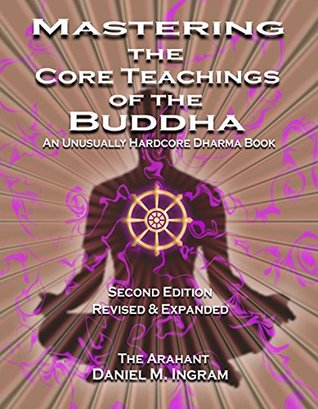
Mastering the Core Teachings of the Buddha: An Unusually Hardcore Dharma Book (Second Edition Revised and Expanded)

by Daniel M. Ingram

38610571. sx318

Wow. What to say about this book? Bottom line, is it provides an extraordinarily detailed and thorough account of how the classical teachings of Buddhist meditation can provide the tools necessary to move progress to full enlightenment (plus, it explains what enlightenment actually means). And we’re not talking about having to go and live in a monastery in Tibet for the rest of your life to do it. Daniel Ingram, the author, seems to have done all this while living a full and busy life, including going through and graduating from medical school.

It’s a mind-blowing book, really. On the one hand, it describes a number of very woo-woo and seemingly mystical things – from seeing your visual field tessellated with multicoloured patterns to understanding the enormous, deep, connection between all living beings (and that’s before he mentions “magick” and the effects that the ancients talk about there). He says at one point

For example, you think there are no magickal (sic) effects possible and suddenly you are seeing chakras and seem to know odd things about people that you couldn’t possibly know

On the other hand, it’s about as practical and down to earth as can be, dismissing any notion of handwaving and woo-woo models of meditative practice, with lines like:

I am no fan of most of these models of awakening. In fact, I consider their creation and perpetuation to be basically evil in the good old “you should burn in hell for perpetuating them” kind of way.

and later in the same section:

A far more practical approach is to accept that we are human, try to be decent in a normal, down-to-earth sort of way rather than in a grandiose, self-conscious, spiritual way … allowing us to be the human beings we are with more balance and less reactivity in the face of that humanity.

And for me, it’s this seeming contradiction that is one of the book’s most compelling features. He talks about all this weird stuff, but he does it in such a hands-on and down to earth way, based clearly on thousands of hours of personal experience, that I emerged more or less convinced of the core argument. Which is that these seemingly exotic states are indeed attainable to normal humans -but that you will have to put in the hours.

You do get a brief introduction to the standard practices of concentration (samatha) meditation, with its focus on the breath, on returning to the breath when you notice you’ve been distracted, and on using this to attain high states of concentration. This is at the core of apps you might have used like Headspace and Calm. This practice can bring a great deal of serenity and even bliss to you in short bursts, and Ingram talks you through the various technical levels of this, known to the Buddhists as the jhanas.

He also explains why you really should be doing this practice: because it gives you the concentration necessary to do vipassana, or insight, meditation. Vipassana meditation is where you focus really really hard on ordinary experience – on the tiny fleeting details of ordinary experience, that we never normally notice. Inside these “vibrations” lie the next levels of understanding. This starts with appreciating that your perception of phenomena is different from the actual phenomena. For example, you hear the blare of a car horn, or the tweeting of a bird, and your mind just knows it’s a car horn or a bird. But actually, in order to do this, you have to hear the sound first, before the mental construct of “car” or “bird” comes to mind. With sufficient attention, you can peel these two things apart.

Eventually, you can begin to truly see what Buddhists call the “three characteristics” of everything: that they are impermanent (they come and go), that they are unsatisfactory (ultimately they don’t fulfill you) and that they don’t cohere into a unified self, in the way that most of us think of being a unified self through time.

All this takes time, practice, and is often very hard to describe in words. Ingram focuses a lot on models of how all this comes together, and the stages one would pass through along the path. I’m not nearly a skillful enough meditator to comment from personal experience on the helpfulness or even the truth of this, but Ingram is very convincing, and he emphasises repeatedly that you don’t need to take any of this on trust, you can just try it yourself.

He is also strong on warning you of the possible dangers that may lie ahead: one of the stages he calls “The Dark Night of The Soul”, which he describes spanning stages of “Dissolution, Fear, Misery, Disgust, Desire for Deliverance, and Re-observation”. He continues to give pragmatic and helpful advice even here:

Allow me to give you two hard-won pieces of advice that I have found make all the difference in the face of these stages. First, make the time to do basic insight practices… The second piece of advice is to have a “no-bleedthrough” policy…it might be expressed by two simple mantras, “Do no harm” and “Keep your shit together”. This is obviously great advice for life in general and it applies doubly here.

Beyond this stage, things return to a more even keel, through Equanimity and on ultimately to Fruition, at which point you will attain “stream entry”, which begins your journey again at a higher, if vastly, level.

All of this is explained in detail, not only with practical instructions but also with references to probably 100 other books you might go and read for more detail about any particular section. I found this especially helpful, myself, and a number of these other books will be showing up in my Goodreads feed in due course!

Ultimately there is the question of why anyone would want to go to this much effort (a question my non-meditating wife asks me repeatedly). There is the Everest-style “because it’s there” answer, and then my usual answer of “because it gives you deep insight into the way the world actually is”. Ingram includes a lot of emphasis on the first of the three Buddhist teachings, those on morality, and he brings this into his final insights. This is about how all of our actions are shaped by our thoughts, and thus the world around us is shaped by our thoughts:

all “internal” intentions, thoughts and mental states mattered, were causal, were spell-casting, were powerful, and molded some part of the causal world. Thus, every single moment of “internal” experience must have ethics applied to it, because it matters, as it is an integral part of this whole space of manifestation. This seemingly obvious insight didn’t sink in all at once but took years to develop.

Or, as the opening lines of the most commonly read of all Buddhist texts, the Dhammapada, puts it:

All actions are led by the mind. Mind is their master. Mind is their maker. Act or speak with a defiled state of mind, and suffering will follow.

So that’s why you should meditate, and why you might want to read this book of nearly 600 pages, where I probably took on average an hour to read and digest any ten pages. It all matters, and if we want to live our life pretending it doesn’t, and leaving our thoughts, feelings and general mental state to run all over the place on its own, then we are just hiding from the (profound, obvious, but rarely realised, disturbing) truth.

Categories
Book review

The Red Queen: Sex and the Evolution of Human Nature

by Matt Ridley

1265734

Today, even more than when the book was written in the early 1990s, this subject area is extremely fraught. Many seek to deny that gender differences are anything other than cultural programming, and in this work the author goes to great lengths to explain the substantial evidence pointing to (a) their existence, and (b) their evolutionary origins, as opposed to cultural origins.

I was a little worried that the 25 years or so since this book had been published would have produced new evidence that contradicted this thesis. Coincidentally, within a couple of hours of finishing the book, I came across well-reasearched current papers supporting the core points of the book: https://digest.bps.org.uk/2019/03/13/

We can see through these arguments that women are driven by evolution to want different things in their partners than men: on the whole, women are genetically programmed to seek to mate with men of status, so their genes get a leg up the power hierarchy, as higher-status men generally have higher-status children, and generally more of them. Meanwhile, men are programmed to seek younger women, as they may father more children by them.

But as the book points out repeatedly, we have the significant capability to rise above our “programming”: murder is entirely natural, but it doesn’t mean we want it ruling our current society. So the question can still legitimately be asked as to whether we want to be like this: if so, how do we wish to set up our culture, and then, how might we judge those who fail to meet our new (culturally created) standards.

Categories
Book review

La Belle Sauvage

La Belle Sauvage (The Book of Dust, #1)
Read date: Feb 2019

La Belle Sauvage by Philip Pullman
My rating: 5 of 5 stars

Philip Pullman is back, and it’s awesome! I read the original Pullman books when they first came out, but not since then, which means my memories of them are vague, and probably influenced by the movie (which was good, but the Armoured Bears and Zepplins of my imagination were way cooler).

La Belle Sauvage fairly rips along – I was gripped from the start, and found myself unable to put it down at various crucial junctures of the storyline. It centres around Malcolm, the young son of the owners of an inn to the north of Oxford, and you also meet some of the other characters from the series, such as Lord Asriel and Mrs Coulter, although they play much smaller parts. I won’t give too many plot details because, spoilers, but I loved it all. It ends at a logical point, but as it’s the first in a trilogy, one is definitely left in anticipation of the next one, if only to enter the magical world once more.

This book is set in the same world as The Amber Spyglass series, but ten years earlier, with Lyra as a little baby. Malcolm is a young adult, and the writing in this book is straightforward and accessible. I’m sure this book would be enjoyed by younger people – my kids at that age would have loved it – but as with the other books in the sequence, it’s by no means YA fiction, with some complex themes opened up, and Pullman’s characteristically dark views of the established church firmly on display.

View all my reviews

Categories
Book review

Don’t Shoot the Dog!: The New Art of Teaching and Training

Don't Shoot the Dog! by Karen Pryor
Read date: Jan 2019

5 stars!

I cannot find fault with this book as an overview of the use of conditioning in training. Karen Pryor’s experiences with training aquatic mammals in the 1960s lead her to a deep understanding of the nuances of what works. She found that positive reinforcement not only works well, but it works much, much better than anything else: it is faster, longer-lasting, and can elicit a greater range of behaviours. And, not insignificantly, it deepens the bond between trainer and trainee.

So if you want to reinforce (or extinguish) particular behaviours from your dog, your horse, your pet porpoise, or even your housemate, this book will show you how. There is a chapter at the end specifically about clicker training, which is now very widely used for dogs, but read the rest, too, as it explains how all this works, and how it works best.

Categories
Book review

Mindfulness: A Practical Guide to Awakening

Mindfulness: A Practical Guide to Awakening
Read date: Jan 2019

Mindfulness: A Practical Guide to Awakening by Joseph Goldstein
My rating: 5 of 5 stars

One of the longest-running programmes on radio in the UK is a thing called Desert Island Discs, where the guest picks eight records (remember them?) that would be the eight they’d be happy to be stuck on a desert island with. In addition to the vinyl, you get to pick a book to be your companion on the island with for your years of solitude – The Bible and The Complete Works of Shakespeare are already there, to save you the bother (perhaps left by a previous inhabitant?).

Well, now I know. This is my Desert Island Book. It is an astonishing work, which works through a deceptively simple Buddhist text (the Satipatthana Sutta), using its discourse on the four foundations of mindfulness as a map to many many teachings and approaches to meditation. The depth and wisdom is extraordinary, and although it’s not necessarily going to be easy for a beginner, it has pretty much everything in there.

Think of it as a kit: all the parts are there, all clearly labelled. You just have to do the work of putting them together, finding which bit is going to solve the problem you’re currently facing, and applying it in the right way. There is broad guidance, but basically everyone is going to need to find their own path, because in all honesty we are all going to hit different sets of problems in different orders. But it’s all in there.

Don’t pick this up as your introduction to meditation – but if you want to take your practice further than the app you bought yourself on January 1st last year and stopped using regularly by about March, and if you’re prepared to do the work, then this is a truly profound guide for you. I cannot recommend it highly enough.

View all my reviews