Categories
Book review

Darkness Visible

A Memoir of Madness

by William Styron

Darkness Visible by William Styron

This is a dark book, written from a place of nightmares that so many visit, and from which the fortunate might return. In it, William Styron, an author of some considerable skill, writes grippingly of his personal experience with depression. It’s a remarkable book, made all the more remarkable by the skill of the author – for the man can write. Here he is, near the start of this slim volume, in the car on the way to collect an prestigious literary award at a ceremony in Paris:

…it was past four o’clock and my brain had begun to endure its familiar siege: panic and dislocation, and a sense that my thought processes were being engulfed by a toxic and unnameable tide that obliterated any enjoyable response to the living world. This is to say more specifically that instead of pleasure – certainly instead of the pleasure I should be having in this sumptuous showcase of bright genius – I was feeling in my mind a sensation close to, but indescribably different from, actual pain.

This is a book from a place I have never been. Reading it was as much of an immersion in a different world for me as Margaret Mead’s Coming of Age in Samoa: A Psychological Study of Primitive Youth for Western Civilisation. I have no personal experience of depression – I am about as annoyingly chipper as it’s possible to be (on the Big Five personality traits, I am at the first percentile on the neuroticism score – through no moral virtue on my part, I assure you, just luck in both genetics and lack of childhood trauma).

However, I read a second-hand copy of this book, and throughout it, a previous reader had marked certain passages with bright red crosses and underlines. This previous reader was my Margaret Mead: here was my guide to these difficult experiences, of which we still know so little. We don’t know how it starts, we rarely known why – and whether – it ends. Styron says:

I shall never learn what “caused” my depression, as no one will ever learn about their own. To be able to do so will likely forever prove to be an impossibility, so complex are the intermingled factors of abnormal chemistry, behaviour and genetics. Plainly, multiple components are involved – perhaps three or four, most probably more, in fathomless permutations.

As the author’s depression grows, his world folds in on itself and becomes darker still. He reads obsessively about the disease:

It has been established with reasonable certainty (after strong resistance from many psychiatrists, and not all that long ago) that such madness is chemically induced amid the neurotransmitters of the brain, probably as the result of systemic stress, which for unknown reasons causes a depletion of the chemicals norepinephrine and serotonin, and the increase of a hormone, cortisol. Will all this upheaval in the brain tissues, the alternate drenching and deprivation, it is no wonder that the mind begins to feel aggrieve, stricken, and the muddied thought processes register the distress of an organ in convulsion.

Many people find relief with various pharmacological treatments, but the author discovers that his particular version of the disease is resistant to the standard drugs, and even, somewhat alarmingly, finds eventually that the one he has been prescribed to help with his sleep is strongly contra-indicated for men of his age.

Eventually, in this hellscape, Styron’s thoughts become blacker still.

What I had begun to discover is that, mysteriously and in ways that are totally remote from normal experience, the fray drizzle of horror induced by depression takes on the quality of physical pain. But it is not an immediately identifiable pain, like that of a broken limb. It may be more accurate to say that despair, owing to some evil trick played upon the sick brain by the inhabiting psyche, comes to resemble the diabolic discomfort of being imprisoned in a fiercely overheated room. And because no breeze stirs this cauldron, because there is no escape from this smothering confinement, it is entirely natural that the victim begins to think ceaselessly of oblivion.

Styron becomes suicidal, and the margins of my copy gain further red crossings – this passage had two such notations:

The pain is unrelenting, and what makes the condition intolerable is the foreknowledge that no remedy will come – not in a day, an hour, a month, or a minute. If there is mild relief, one knows that it is only temporary; more pain will follow. It is hopelessness even more than pain that crushes the soul.

Curiously, it is Styron’s own skill as a writer that saves him in the end. He sets out to write a suicide note one night in December, his loving and supportive wife asleep upstairs, but finds the words will not come. He cannot write to his own satisfaction, tears up the note, and in the middle of the night, wrapped in a blanket (the furnace is out), puts on a tape of a movie. In it, he hears a soaring contralto voice singing Brahms’ Alto Rhapsody. He is seized by the music, and the memories it brings of happier times

All this I realized was more than I could ever abandon, even as what I had set out so deliberately to do was more than I could inflict on those memories, and upon those, so close to me, with whom the memories were bound. And just as powerfully I realized I could not commit this desecration on myself. I drew some last gleam of sanity to perceive the terrifying dimensions of the mortal predicament I had fallen into. I woke up my wife and soon telephone calls were made. The next day I was admitted to the hospital.

Slowly, but surely, Styron does recover. He knows he may have remissions, but he also knows that with the right help, the illness will again run its course. And my anonymous guide, of the red markings? I saw, with some relieve, their mark beside the final lines:

There, whoever has been restored to health has almost always been restored to the capacity for serenity and joy, and this may be indemnity enough for having endured the despair beyond despair.
I give this book five stars.

Categories
Book review

Red Sister

by Mark Lawrence

Red Sister by Mark  Lawrence

My headline for this book would be “Somewhat bloody, and completely bloody brilliant”. Five stars, very well earned.

I marvel, yet again, at how absolutely amazing some books can be at immersing you in their umwelt. This one combines great world-building, complex characters, and – most of all – some amazing prose that rises to the level of poetry at times. Because the plot is so stuffed full of surprises, I’m barely going to mention it. There’s great fight scenes (some are quite gory, if that might concern you), there are many hints of underlying glorious ages gone before (leaving, for example, the “focus moon” – which is a marvellous plot device), there is a fleshed-out background philosophy/spiritual side, and of course are heroes to root for and even the villains are multi-faceted. Perhaps the closest book I can think of is how I felt when I read The Blade Itself and found Joe Abercrombie.

In the end, you don’t read books like this for the plot, you read them because of the prose, and the world that envelopes you as you read. And Mark Lawrence does just a fabulous job with this. I haven’t read any of his others, but for sure I will be doing so. I’m not even going to give you any more of the storyline- I’ll just say that you have to read it, because it’s marvellous.

Here are some random snippets, to keep you going. He waxes philosophical at times – let’s look at time itself:

“All the world and more has rushed eternity’s length to reach this beat of your heart, screaming down the years. And if you let it, the universe, without drawing breath, will press itself through this fractured second and race to the next, on into a new eternity. Everything that is, the echoes of everything that ever was, the roots of all that will ever be, must pass through this moment that you own. Your only task is to give it pause – to make it notice.”

Or

“Your death has not been waiting for your arrival at the appointed hour: it has, for all the years of your life, been racing towards you with the fierce velocity of time’s arrow. It cannot be evaded, it cannot be bargained with, deflected or placated. All that is given to you is the choice: meet it with open eyes and peace in your heart, go gentle to your reward. Or burn bright, take up arms, and fight the bitch.”

The book, you initially guess, and then find confirmed, is about a young girl who ends up in the care of some nuns – people who might, in other worlds, be spiritual and charitable and kind, but who in this world are spiritual and cunning and combat-trained.

“You may be called upon to enforce the authority and the will of the church. It would be better if you did so in a manner that allows the transgressor to see the error of their ways rather than the contents of their body.”

Fight is what they do, and they are very, very, good at it:

“It is important, when killing a nun, to ensure that you bring an army of sufficient size. For Sister Thorn of the Sweet Mercy Convent Lano Tacsis brought two hundred men.”

But sometimes, the prose is just plain philosophical:

“‘It’s hard out there.’ Nona gazed towards the windows. ‘Running’s all right, but when you stop there’s the freezing and the starving and the dying.'”

or

“Children are like cats, only less useful and less furry.”

Enough, or I’ll quote the whole book. And although it’s complete in itself, it’s the first of a trilogy, which I was so thrilled to discover that I just went ahead and bought the others, sight unseen.

Categories
Book review

Our Mathematical Universe

My Quest for the Ultimate Nature of Reality

by Max Tegmark

I found this a thoroughly entertaining account by Max Tegmark of some of the “big questions” of modern physics, with a particular slant towards cosmology – what is our universe composed of, how did it come into being, what might be its ultimate fate, that kind of thing. Initially I wasn’t sure about the very personal style in which it was written, but after a few chapters I began to like it. Tegmark has been at the forefront of a number of these discoveries, and there are lots of semi-autobiographical anecdotes in here: ultimately, the cheerful and enthusiastic style did win me over, and I found it definitely added to my enjoyment of the book.

I realised as I was reading this that I haven’t really read a popular science account of these topics for perhaps 20 years, so I was definitely behind the curve with regard to things like dark matter and dark energy, and their abundance in the universe (making up something like 20% and 70% of all the stuff out there, respectively). This was a great account of all these theories, working through the evidence in particular from the cosmic microwave background, which has yielded two different Nobel physics prizes.

Tegmark moves the reader through all this at the same time as he elucidates his view of how it all comes together with quantum mechanics. I was pleased here to see the increasing acceptance by physicists of Everett’s “many worlds” interpretation of quantum mechanics, and how it’s taken over from the more historically popular Copenhagen interpretation, with its reliance on the horribly ill-defined “observer” causing a collapse of the quantum wave function. To the very limited degree that I’ve ever managed to get my head around quantum mechanics, it’s always seemed a complete fudge to say “these equations describe the universe as we know it to thirteen decimal places, but I don’t really like what they say about the nature of reality, so I’m just going to paper it over with this observer thing and then I’ll feel more comfortable”!

At this point, Tegmark starts to roll out the big guns of his theory. Not only are there multiple physically separate universes (because the initial expansion phase was so fast that light will never be able to travel from one to another), but also these universes will have different starting conditions. This provides an explanation as to why our universe is so “well tuned” for life – there are 30 or so physical constants whose values would only need to vary by a very small amount to have prevented life ever existing. Well that’s straightforward in this view- those other variations are just in other universes (inaccessible to our light cone). And quantum mechanics now says that physical reality also has other places where the alternate paths of quantum interactions are playing out – in some of these parallel worlds, Schrodinger’s famous cat is alive, in others it’s dead, and that’s all ok (unless perhaps you are the cat!)

Ultimately, Tegmark comes to argue that in fact these different worlds may not only have different starting conditions, but also entirely different laws. Not just (for example) different numbers of space or time dimensions, which is weird enough, but different kinds of physical existences. All our physical laws, he argues, are the result of mathematical symmetries – all the different kinds of particles (quarks, photons, etc) are predicted by symmetries in group theory, for example. Thus there will be other universes with other symmetries, based on other groups. An overwhelming number of these will be too simple to do anything very interesting, but some of them will be complex – perhaps complex enough to form other kinds of particles, and indeed other kinds of life, too strange to even imagine!

Since I recently read Group Theory and Physics, I was pleasantly surprised by how much I sympathised with Tegmark’s thesis here. It’s even reflected in science fiction in books like Distress, which again I read recently, and which is about how a “theory of everything” might decide which universe (which mathematical symmetries) we really live in. I’m obviously being swept up in a wave of theories and stories all about this – perhaps the cosmos really is trying to tell me something!?

Ultimately, these kinds of questions about the underlying nature of reality are profound, and perhaps even beyond our real knowing, but they’re great fun to think about, and Max Tegmark is exactly the sort of person who you’d want to be sat beside in the pub while you explored it all. This book is as close as I’m ever going to get to that, and I thoroughly enjoyed the opportunity.

Categories
Book review

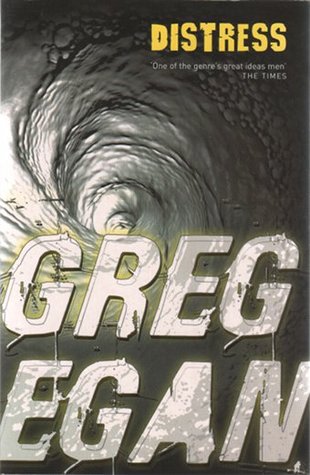
Distress

by Greg Egan

Distress by Greg Egan

Andrew Worth, a journalist burnt out by his last expose on the abuses of biotech, persuades his boss to let him take over an assignment from another editor about a physics conference on the Theory of Everything. This conference is to take place on a human-created tropical island in the Pacific, which Andrew imagines will be just the tonic he needs. What could possibly go wrong? Other than nearly dying from a synthesized cholera virus, death threats to the Noble Prize winning Violet Mosala (whom Andrew is following through the conference), being held at gunpoint and kidnapped, the paradise itself being attacked, and the potential ending of the entire universe as we know it?

So it’s a busy old time for Andrew, and the plot moves along at pace, with great twists and turns. However, this isn’t just a great techno-thriller: it’s a brilliant exploration of the edges of modern physics, combined with some philosophical probings of what it is to be a separate self, set in a near future where the cults of scientific ignorance that we see today have gained dangerous power, and aren’t embarrassed to use the technologies that science has given them to further their aims. In its time, this was I suppose on the edge of cyberpunk, but there are also shades of Michael Crichton in the detailed use of science and technology as central to the plot, but not overwhelming it.

One of the things that amazed me about this book was just how good these technological predictions are. It’s set in 2055, but it was written in 1995, and it reads astonishingly well today. It could easily have been written in the last couple of years. The technology – gene splicing, virtual reality, machine/brain interfaces, instant worldwide data access – is all spot on for today, as are the concerns around climate change, online cults, and sexual identity. As a trivial example, there are seven identified sexes, with gender-neutral pronouns universally used. Pretty much the only flat note from a tech point of view is the use of infrared as a short-distance communications channel for device-to-device communications.

A solid five stars from me – I’ll be digging out more of Egan’s back catalogue asap!

Categories
Book review

On Having No Head

by Douglas E. Harding

On Having No Head by Douglas E. Harding

This is a true gem of a book – it sparkles in the light and when viewed from some angles it is beautiful indeed, but there are some sharp pointy bits, and it’s quite hard. I first read it more than 30 years ago, borrowing a copy from the local library. It stayed with me ever since, and it’s recent return to fame (being liberally quoted by Sam Harris) has caused me to re-read it.

If it seems like I took the whole “gem” metaphor too literally there, then that’s what this book does, with its own metaphor of we ourselves having no head, using it to drive home some very deep points.

From where we look out to the world, Douglas Harding points out that we quite literally can’t see our own head. There’s this vague pink cloud which on other people seems to form a nose, but from where we look, it’s translucent and appears either on the left or the right, depending on which way we’re looking, so that doesn’t seem to be like other people’s noses. If we see our head in a reflection, we aren’t seeing our head itself, we are seeing a reflection – often distorted, in water, at an angle on glass, in a shiny door knob or the back of our spoon. Which of these is the real shape of our head? We are indeed unreliable witnesses:

If I fail to see what I am (and especially what I am not) it’s because I’m too busily imaginative, too “spiritual”, too adult and knowing, too credulous, to intimidated by society and language, too frightened of the obvious to accept the situation exactly as I find it at this moment.

Which is the start of the deep points that are being made. We seem, if we look from this point of view, to be directly connected to the whole world. The whole world is where we used to imagine our head was, and we are deeply, intimately, as one with that world:

There are no obstructions here, no inside or outside, no room or lack of room, no hiding place or shelter: I can find no home here to live in or to be locked out of, and not an inch of ground to build it on.

Douglas Harding had these revelations on his own, and his pursuit of others who might at least understand what he was talking about led him eventually to Zen Buddhism. This short book, then, is really about the Zen experience from an intensely first-hand point of view. Harding found that the Heart Sutra, daily recited in Zen (and other Buddhist) monasteries, declares that the body is just emptiness: “Form is emptiness, emptiness is form”, it famously declares. This is the profound experience of Zen. Hardin quotes the 16th-century Zen master Han-shan:

“I took a walk. Suddenly I stood still, filled with the realization that I had no body or mind. All I could see was one great illuminating Whole – omnipresent, perfect, lucid, and serene. It was like an all-embracing mirror from which the mountains and rivers of the earth were projected… I felt clear and transparent”

This is the direct experiencing of non-duality, of Advaita, as the Buddhists call it, the Zen experience of Satori It’s not a Zen or a Buddhist concept alone, either – you see it in Christian mystics, in the writings of Hindu and Muslims as well. Even Shakespeare knew of it, when in Measure for Measure he has Isabella say, in a much-quoted speech:

…man, proud man,
Drest in a little brief authority,
Most ignorant of what he’s most assured,
His glassy essence, like an angry ape

This is indeed a short, but profound, book, directly confronting our inner angry ape. Harding ends with a sketch of a path, of experiences and exercises, that might help us along our way to finding this truth at the heart of reality. He achieved the “direct path” to this insight, and I toil along the lower slope of the mountain daily, with rare glimpses of the glorious peaks when the clouds break. But Werner Erhard, self-help guru and founder of the est movement, at least had it right with this line:

This is it. There are no hidden meanings. All that mystical stuff is just what’s so.

Categories
Book review

A Christmas Carol

by Charles Dickens

A Christmas Carol by Charles Dickens

From the famous opening line – “Marley was dead, to begin with” – Dickens announces that this isn’t your everyday ho hum Christmas tale; indeed the full title stakes its claim: “A Christmas Carol: Being a Ghost Story of Christmas”.

But it’s more than that, of course. It’s a story that kicked into life the Victorian version of Christmas (apparently turkey sales rocketed at Christmas, while sales of the traditional goose dived correspondingly). It’s another chance for Dickens to talk about the appalling poverty and deprivation which lived on the doorsteps of his middle class readers: the ghost of Christmas yet to come takes the reader to this scene –

The ways were fouls and narrow; the shops and houses wretched; the people half naked, drunken, slipshod, ugly. Alleyways and archways, like so many cesspools, disgorged their offences of smell, and dirt, and life upon the straggling streets; and the whole quarter reeked with crime, with filth and misery.

Dickens was a marvelous writer, and A Christmas Carol contains many great lines, from Scrooge’s “Bah, humbug”, through Marley’s Ghost’s “I wear the chain I forged in life”, to Tiny Tim and somewhat saccharine “A Merry Christmas to us all, my dears! God bless us every one!”. You can read the scenes even now without our modern detachment hiding their power from us. Even the two children clinging to the second Ghost “yellow, meagre, ragged, scowling, wolfish; but prostrate, too, in their humility” still just about land this side of my irony detector.

Ultimately, though, it sets the template for the Christmas tales of redemption. This appears in all our favourite Christmas stories and movies, from “The Grinch” to “Elf” to to “Die Hard”. Like many of these tales the story hangs on the credibility of the transformation of the hero (well, perhaps not with “Die Hard”…). On this re-read, I found Scrooge’s transformation entirely credible. Although only one night has passed in the real world, in the ghostly world Scrooge visits, he spends at least twelve nights in the company of the Ghost of Christmas Present, where the moral is pounded repeatedly into his head:

Much they saw, and far they went, and many homes they visited, but always with a happy end. The Spirit stood beside sick-beds, and they were cheerful; on foreign lands, and they were close at home; by struggling me, and they were patient in their greater hope; by poverty, and it was rich. In almshouse, hospital, and gaol, in misery’s every refuge, where vain man in his little brief authority had not made fast the door, and barred the Spirit out, he left his blessing, and taught Scrooge his precepts.

Perhaps a little over the top to modern ears, but in the renowned psychiatrist Stephen Grosz’s book The Examined Life: How We Lose and Find Ourselves he talked of using A Christmas Carol to show how we really can change – but the motivation needs to be strong enough. By the end of the second ghost’s visit, Scrooge is ready to change, and by the end of the third, he knows he must. He sees what his death may be otherwise, how his cooling body is picked over for change, how the shirt is literally taken from his corpse’s back in exchange for a few pennies from a rag and bone merchant. Buddhists will spend days meditating in charnel grounds to come to terms with their own death and motivate their change in life. One can but hope that humankind in general does not need the lesson so brutally told.

Categories
Book review

The Sentry

by Robert Crais

The Sentry by Robert Crais

I’m not going to review this book, featuring Elvis Cole, a Private Investigator, and his friend, Joe Pike. Cole is cool (he shares his house on the hills above LA with his cat, and he shares his beer with his cat). Pike is beyond cool, and one of my favourite fictional creations (the cat hates him).

Instead, I’m just going to give you a series of quotes from it. If that doesn’t make you buy it, nothing will.

This was why the men down south used him for these jobs and paid him so well. Werewolves caught their prey.

The nature of his life had cost him the woman he loved and the little boy he had grown to love, and left him alone in this house with nothing but an angry cat for company and a pistol that did not need to be put away.

Prisons were filled with convicted murderers who got a drumstick when they wanted a thigh, or who felt dissed when a woman wouldn’t speak to them on a bus, or who decided a bartender was ignoring them. When a man felt frustrated or angry enough, any reason would do.

Pike had focused on a goal and would drive forward like a relentless machine. Back in Cole’s Ranger days, they had called this mission commitment, and Pike’s mission commitment was off the charts.

Pike was a man who showed nothing, projecting a zen-like detachment that Cole sometimes found amusing, but also admired. Cole often wondered what such calm cost his friend, and whether Pike had no other choice but to pay it.

“Yes. Of course, I will call.” “Stay with Artie. Watch his temperature.” “You are a strange man.”

That’s it. Go read it. Or anything with Pike in it, they’re all great.

Categories
Book review

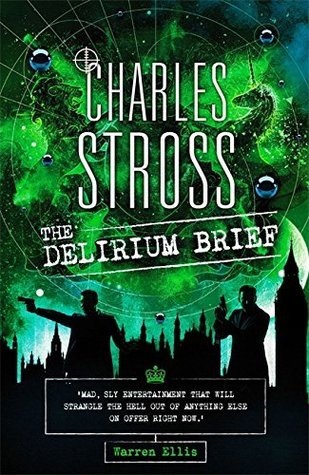
The Delirium Brief

Laundry Files #8

by Charles Stross

The Delirium Brief by Charles Stross

I’m delighted to report back from the world of Bob Howard and Mo O’Brien that all is not well – indeed, all is going very very badly, verging on world-endingly bad, and it’s pretty much a race to the finish as to which particular variety of soul-sucking creature from a parallel universe is going to do us all in.

In other words, this, the eighth in the Laundry Files sequence from Charles Stross, is another cracking read. Although they’re all set in the same world and are more or less sequential, they are all sufficiently independent that I suspect you could pick this one up cold, and still get a great deal of enjoyment from it. I would still recommend reading the others, though, because (a) they’re very good, and (b) you’ll get a little bit more out of this one, as (for example) you’ll known Bob’s history with PHANGs – the in-series designation for what might otherwise be known as vampires.

The world of the Laundry files is the world of modern 21st century England, with a twist: there is a branch of the civil service responsible for dealing with the occult. Up to about book 6 of the series, this was a very secret organisation. Underfunded, drowning in bureaucracy, and with endless reports to fill in, but still very secret.

However, in the preceding book, The Nightmare Stacks there was a full-scale invasion of Yorkshire by undisguisably occult creatures, with some very serious consequences. So now the dreary world of bad coffee, broken IT, and crippling paperwork which Bob used to inhabit has been brought into the harsh light of day, and is being picked over by the mass media in an entirely believable way (an early chapter deals with Bob’s quizzing by Jeremy Paxman on national TV…). At the same time, the organisation is under external threat from not just the usual occult beings, but the more immediate danger of self-serving politicians, all seeking to cover their arses in the aftermath of what happened in Yorkshire. And then a private jet lands at an airport in England, bringing an entirely new kind of threat…

It’s a great book, with a twisty plot, plenty of wry asides, and some new characters, as well as the return of many old ones. I loved it!

Categories
Book review

The Fifth Season

The Broken Earth #1

by N.K.Jemisin

25194939

Sometimes you read a book, and you’ve no idea what’s going on for the first third of the book, but then you put together a few threads through the middle third and you enjoy how it’s going, and by the final third you absolutely love it and are upset when it ends. This was such a book, and I loved it. Some of the rest of this review might need to be shrouded in spoilers, so you can have the same experience, but it’s clear very early on that we’re in a strange world here, with lots of history, and – it turns out – lots of earthquakes. Not all of which are triggered in the usual way. Turns out, there are some people in this world that can trigger earthquakes. Turns out there are those who can feel and control (to some extent) magma flows, the slippage of plates in the crust, the crumbling of rock, and other geological things whose names I didn’t know until I read this book. Really great world building – I can’t think I’ve read anything like this before. I can see why it won the 2016 Hugo Award!

Also, by the way, great storytelling throughout. The story unfolds from multiple points of view – a woman in deep distress, a second-person narrative, a strange creature born from the stone itself, and others. How they come together is the reveal of the middle section of the book. It’s a neat approach, and very well used, but not abused. No annoying super-powers wielded by super-humans, deus ex machina-style, but rather very human characters with flaws and strengths, struggling to come to terms with the world in which they find themselves.

SO, some great characters in here, a brilliant world setting for them, and an intriguing plot. It also has enough of a wrap-up at the end of the book for you to feel satisfied – you aren’t left poised on a cliff edge. Definitely want to see more from this world, though, and there is plenty enough left unfinished to justify reading the next book(s). A well-deserved five stars.


View all my reviews

Categories
Book review

The Rook

The Checquy Files, #1

by Daniel O’Malley

The Rook by Daniel O'Malley

What a cracking book! I loved this supernatural/sci-fi combo, with the clever twist that the main character starts the book having completely lost her memory, finding herself standing in the dark in the rain, surrounded by several dead bodies, all of whom are wearing latex gloves. Through the excellent plot device of a series of notes that she’s left herself, she realises who she was and what her life was all about, and quite how much danger she is in.

Myfanwy, the lyrically named heroine, would love to find out what’s going on and how she came to lose her memory, but before she has time, she’s launched into a series of adventures with supernatural forces. For it becomes apparent that Myfanwy is a high-ranking member – a Rook – in a secret organisation called the Chequy, set up to battle the supernatural forces that threaten Britain.

There are some great characters in here, and some intriguing, and quite non-human, forces at play. To avoid spoilers, I won’t reveal too much, but it’s a great read. For me it had something of the vibe of Charles Stross’s Laundry Files series – supernatural creatures and goings on, which are hidden from us by a hidden quasi-governmental organisation. Written with humour and verve, and just a delight to read – hard to put down even late at night, leading to complaints from my better half that the backlighting on the kindle was keeping her awake…

I’ll definitely be picking up the next one in the series.