Categories
Book review

The Rook

The Checquy Files, #1

by Daniel O’Malley

The Rook by Daniel O'Malley

What a cracking book! I loved this supernatural/sci-fi combo, with the clever twist that the main character starts the book having completely lost her memory, finding herself standing in the dark in the rain, surrounded by several dead bodies, all of whom are wearing latex gloves. Through the excellent plot device of a series of notes that she’s left herself, she realises who she was and what her life was all about, and quite how much danger she is in.

Myfanwy, the lyrically named heroine, would love to find out what’s going on and how she came to lose her memory, but before she has time, she’s launched into a series of adventures with supernatural forces. For it becomes apparent that Myfanwy is a high-ranking member – a Rook – in a secret organisation called the Chequy, set up to battle the supernatural forces that threaten Britain.

There are some great characters in here, and some intriguing, and quite non-human, forces at play. To avoid spoilers, I won’t reveal too much, but it’s a great read. For me it had something of the vibe of Charles Stross’s Laundry Files series – supernatural creatures and goings on, which are hidden from us by a hidden quasi-governmental organisation. Written with humour and verve, and just a delight to read – hard to put down even late at night, leading to complaints from my better half that the backlighting on the kindle was keeping her awake…

I’ll definitely be picking up the next one in the series.

Categories
Book review

Neuromancer

by William Gibson

I haven’t re-read this for a number of years, but something made me take down my battered 1986 edition of this classic (first published in 1984 in the UK) and read it again.

It’s still a jewel of a book. To be fair, the style isn’t what you’d expect today, but honestly, that’s a bit like saying the paint job on the Night Watch needs a good going over to bring it up to modern standards (or that you prefer the style of “Game of Thrones” to “Lord Of The Rings”). Even today, this is still an extraordinarily impressive book, with deeply textured writing. You can pretty much open it at random and be captured by the intricate style – here’s what caught my eye as I flipped to page 154, for example:

A burst of French from a nearby table caught his attention: the golden children he’d seen gliding above river mist the evening before. Now he saw that their tans were uneven, a stencil effect produced by selective melanin boosting, multiple shades overlapping in rectilinear patters, outlining and highlighting musculature

It’s all very beautiful stuff, and it has influenced so much of what we read and see today. Here is where the word “cyberspace” first appeared, and herein are the first references to that consensual world inside our computers as “the matrix”. The first twenty years of the world-wide web, especially all the 3D graphics, was a conscious attempt by thousands of programmers and hackers to build the cyberspace described in the book. Here’s what we get when Case, the hero, plugs in:

And flowed, flowered for him, fluid neon origami trick, the unfolding of his distanceless home, his country, transparent 3D chessboard extending to infinity. Inner eye opening to the stepped scarlet pyramid of the Eastern Seaboard Fission Authority burning beyond the green cubes of Mitsubishi Bank of America, and high and very far away he saw the spiral arms of military systems, forever beyond his reach.

The world outside cyberspace is similar in many ways to that of Bladerunner, a sort of noir Japanese/American underworld blend, dark and noir. Apparently William Gibson saw a clip from the film when he’d written the first third of the book, and was worried people would think him derivative. He isn’t, of course: he is rather that very rare bird, out in front of the flock, exploring and indeed creating the new frontiers (his earlier short story Burning Chrome predates Bladerunner and is set in the same world as Neuromancer).

The plot is as fractal as the writing, revolving around a hacker, an augmented mercenary, and an AI, in a world ruled by corporations, with genetic engineering, exotic drugs, and (of course) cyberspace, but I won’t try to summarise it, other than to say you need to keep your wits about you to follow it, but there is a plot there, saying something interesting – it’s worth it.

One thing I did notice with this re-read, is quite how short the book is, compared to much modern science fiction. It’s a little over 300 pages in my compact paperback, versus the 500-odd you might commonly find today. And I think it’s all the better for it. It was written on a typewriter – a Hermes 2000, apparently, described by Gibson in an interview for Playboy as “a very Ernest Hemingway sort of war-correspondent-for-the-Spanish-Civil-War machine, from my wife’s step-grandfather who was a journalist”. I think it’s all the better for that. The capability pretty much any author has now to write a hundred thousand words and hit publish does, I think, all too often lead to too much fat. This book is what you’d get after a full-on keto diet: lean, wiry, and so sharp you almost cut yourself reading it. It’s almost science fiction as poetry, in the old style of Samuel R. Delany’s Dhalgren, or Philip K. Dick (who of course wrote Do Androids Dream of Electric Sheep?, which Bladerunner is based on, although the Japanese/American noir blend of the film isn’t in the book at all).

Thirty-plus years after my first read, I am still captivated. A brilliant five stars.

Categories
Book review

Zen Wrapped in Karma Dipped in Chocolate

by Brad Warner

Picked this book up at random in a bookshop, based the cover, the title, and my patented method of opening at a random page about 1/3rd of the way through, reading the page, and seeing if I wanted to continue. I did, and, with some mild caveats, I’d recommend it to you, too.

Brad Warner is a teacher of Zen Buddhism. I practice (and to some small extent, teach) a secular version of Tibetan Buddhism, which is rather frowned upon by some of the Zen Buddhists as being a corruption of the original teachings. But Brad (I’m sure he won’t mind me calling him Brad) ain’t that guy. As well as being a Zen teacher, he is a punk rocker from the 1980s (one of the chapters describes him hanging out backstage at Ozzfest – a giant heavy metal festival), still plays with his band, lived in Japan for 11 years, worked for a movie company, has a bit of a crappy relationship with his wife, and so on. He’s a real person, living his real life, just like the rest of us.

This book is a brave attempt to show a true view of a couple of fairly crappy years in Brad’s particular life, and how he coped with them. The subtitle says it all: “A Trip Through Death, Sex, Divorce, and Spiritual Celebrity”. He does this not by “being all Zen” about it, but by being a real, genuine, fully-engaged, human being.

Ultimately, that’s the message of this book: we’re all genuine, complex, brilliant, screwed-up, happy, sad, flawed, self-contradictory, human beings. He’s no different from the rest of us. He’s just perhaps a little bit more aware of it than some – thanks to his 25 years of practice. In the end, this is what Buddhism tries to show you, I think.

I did enjoy this book, and it’s definitely entertaining enough to be worth your time to read. I was hoping, perhaps, for a little more on the Zen stuff, and a little less of the autobiography, so I’d give it three and a half stars, rounded down to three for lack of core content. Still, I’ll look out for others of his – they sound like a blast!

Categories
Book review

Condensed Chaos

by Phil Hine

7735637

I should confess first of all that this book isn’t really about my kind of thing: I’m a maths/science geek, so a book talking about how to perform real magic, with spirit summoning and so forth, isn’t likely to be my cup of tea. But it was on my wishlist (because of a recommendation by an author I rate) and my thoughtful son bought me a copy for my birthday, so I read it with some curiosity.

And it’s fair to say that even from my somewhat doubting point of view, Phil Hine does a great job here. He explains in a really very straightforward way how one might go about doing some of these magical things, if one wants to do so. He’s very clear that you need to actually DO the things, rather than just read about them in books, and that if/when magic starts to work for you, only then will you truly believe.

A lot of what Hine talks about seems plausibly to act on a psychological level, and I can see how much of this might be useful. You’re reminded that the world is in many ways deeply interconnected, in ways that we don’t always see. You’re told about your power to make small changes that may have large effects – again, undoubtedly true, and the foundation for the mathematical “chaos” theory that Hine references.

You’re also given specific instructions for magical acts – for example how to construct a mental “servitor”, and how to project it forth into the world to do your bidding. You’re reminded that you need to be very specific, otherwise you may get exactly what you ask for, not what you wanted. Given the way I do think minds work, together with the vast set of situations one actually encounters every day if you’re paying attention, I can see how this might seem to work for people, setting your mind up for success, and tuning it to look for the early signs.

Hine says he says that he, too, used to think of magic as simply psychological, until early one morning when he awoke to be confronted by a cloudy grey creature sat on his chest, which he eventually dispelled by “projecting” a pentagram at it with his mind. I haven’t had any such experiences, and even if I had I think I would likely attribute them to a particularly vivid dream, or some other bug in the wetware of my brain. So it seems to me there are many explanations of these things that still conform to conventional physics, without having to resort to creatures from another realm materialising in your bedroom. However, I can say is that the author seems entirely sincere, and so I should at least do him the courtesy of adjusting my prior belief in the reality of magic from “extremely unlikely to be the case” to perhaps a tiny fraction more possible.

Three stars, because it was entertaining and well written, and if you were after something like this, then this would seem to me to be a good book for it.

Categories
Book review

Cloud Atlas

by David Mitchell

I genuinely didn’t know what to expect here – I’d previously read one of David Mitchell’s books and greatly enjoyed it, and was a little uncertain what I’d got myself into as I read the first section, a series of diary entries written by someone in 19th century New Zealand.

Then I was even more confused, when just as I was beginning to get the hang of things, and literally in the middle of a sentence, we jumped to the next section, to another continent and perhaps a hundred years later.

And so it continued. In the end, there were half a dozen sections, each lightly connected to the previous one and separated by some number of years. We see different narrative voices, many years apart, threaded cleverly together into a beautiful braid. The plot winds firstly forward through them, and then backwards.

The effect is beautifully done – the writing is entrancing, with great world-building and beautiful scenes created for you, all tangled through with intriguing plotlines. I didn’t engage with some of the characters as successfully as with others, but that’s perhaps always the nature of these things. And perhaps if I were picky, one or two of the plot lines were a bit forced. But overall, I greatly enjoyed it, despite my (snobby) uncertainly created by the “Selected by Richard and Judy book club” on the cover. Shame on me, and four stars for David Mitchell!

Categories
Book review

The Power Of Now: A Guide To Spiritual Enlightenment

by Eckhart Tolle

855029

When I was a child, I always admired tightrope walkers on television and in movies. I used to walk along the kerbstones beside roads, upgrading in due course to branches in trees, to build my skills. I fell off a lot. Had I persevered, I would I’m sure I’d have improved. However, I doubt I would ever have reached the levels necessary to walk a rope between tall buildings, perhaps stopping at a carefully balanced chair to sit down, or juggling fruit as I went.

I feel a bit like this about meditation. I’ve meditated, on and off, for most of my life. But I am still very far from the levels that Eckhart Tolle describes in this marvelous book. I fall off a lot.

His level of equanimity comes, by his account in this book, not from years of meditation, but rather from one extraordinarily challenging experience that happened to him as a young man – a true dark night of the soul – from which he emerged fully formed. Perhaps this is my problem: rather than trying to sidle up to enlightenment, it perhaps needs to come upon one suddenly, with full sturm und drang. Regardless, it’s an extraordinary achievement, and resonates with the accounts that many others have of similar states. His account is lucid, with some metaphorical language that won’t gell with all readers (“higher vibrational energies”, etc), but by and large it is simple, direct, and compelling, and very readable. This is definitely somewhere that many of us would want to get to, and he describes some of the obstacles holding us back, and ways we might get around them, as well as what it’s like when you get there.

I don’t think one can doubt the sincerity of his description of his state, either. He lives simply, by all accounts, and has devoted much of his life to teaching others and sharing with them his approach. Not for him the clutter of fame or endless material possessions. To watch him speak on his many online videos is a joy: he is a smiling Yoda-Buddha figure, full of joy and mischievous fun, replete with wisdom and beautiful long silences. Find some, and watch them, and you will read the book in his accent and pauses, too, which definitely added to my enjoyment.

Again, his approach is that of immediate access to the Now, to enlightenment, to God-hood, to whatever your spirituality calls it. If I were to compare it to a Buddhist meditative approach (the spiritual path with which I’m most familiar), it would be with the Dzogchen approach, where enlightenment can be achieved in a moment – if the mind is ready. His philosophical approach might be loosely described as pan-psychism, wherein everything, every last blade of grass and stone and star, participates in some kind of Consciousness, and that’s what we, too, can find in the Now.

Although I still am mostly falling off, on a good day I can feel at least the edges of the state he’s talking about. This book is an account of that moment, written as a series of questions and answers, with suggestions of how to get closer.

It’s real, I’ve been there, albeit briefly: the Eternal Now, where time is suspended and one’s inner voice is quietened, and one is held like a fly in amber, hyper-aware of everything, senses wide open, in a moment of joy and calm, regardless of the chaos or the pain of surrounding circumstance. I’ve felt it on a busy train, in the quiet of nature, and during chemotherapy. At least until I fall off, 60 seconds later. But I know it’s there, I’ve seen it, and it’s my life’s work to extend those moments, until at last I can walk on the tightrope across the Victoria Falls, stopping now and then to admire the beauty and the thunder and the majesty of the world – and perhaps juggling some fruit. See you there.

Categories
Book review

The Quantum Magician

by Derek Künsken

41140983. sy475

It took me maybe 30 pages to get into The Quantum Magician, but then it got it’s teeth into me, and I loved it. Great storytelling and plotting, brilliant future technologies and enhanced trans-human capabilities, all combined with very credible characters.

Several different new human “species” have been artificially created in the world of The Quantum Magician; our central character, Bel, is a Homo Quantus, capable of transforming part of his brain into a quantum computer. This makes him a subtle, complex, computational machine, capable of handling problems in dozens of dimensions. But while he’s in this state his human side – his soul, as it were – is shut down. If you read books going back as far as the Iliad, you see that human behaviours haven’t evolved for the last two and a half thousand years, regardless of our enhanced technologies, and so there’s no particular reason to expect us to do so in the next two thousand. This book’s main driver is this thesis – the characters, and their new trans-human abilities: how does this ability affect them – how does it affect Bel? You’ll meet several other such puzzle pieces, each with their strengths and weaknesses, some quite grotesque, but all (even the superficially evil) entirely credible.

Bel has left the planet that created him, and has turned his talents to studying that most complex of problems, the behaviours of other people. But he needs money to live and satisfy his expensive hobbies, so he combines all this and has become a galactic-class con man. He’s hired by a small vassal government to help them with a problem worthy of his talents: smuggle a dozen spaceships across one of the most tightly controlled borders in space. To do so he hires a gang of other misfits and experts in various shady arts, and together they set out to pull the con – and to try to make sure they each emerge with as much of the credit or loot as possible.

To say more would risk spoilers. And although this plotline is wrapped up by the end, there are ample opportunities to revisit this world and some of the players, and I look forward to further encounters very much.

Categories
Book review

Norse Mythology

by Neil Gaiman

37756505

I read this shortly after being very disappointed with Stephen Fry’s “Mythos”. Well this, I found, is an entirely better kettle of Viking fish. Great storytelling from Neil Gaiman, both in the stories I knew and in the many that I didn’t. Gaiman’s stories just seem to flow so much better that Stephen Fry ever did for me, and Gaiman has a masterful ability to create a picture in your mind of a god’s temper tantrum or a battle in just a few words.

One thing that’s interesting for me having read the Greek-y myths shortly before the Norse ones is the parallels between many of them – similar scenes, storylines and archetypes appearing in different cultures separated by thousands of miles. But you don’t need to read Mythos first (in fact, I can’t recommend that you do), as you will likely be familiar with the story archetypes in many forms – up to, and including, Disney movies!

Four and half stars, rounded up to five in the hope he writes another one.

Categories
Book review

The Bhagavad Gita: A Walkthrough for Westerners

by Jack Hawley

I very much enjoyed this version of the Bhagavad Gita, I have to say. It was, above all, readable, written as it is in modern English, This meant that (in contrast with some other translations of classics of world literature) I wanted to come back each time and read more. So bonus points to Jack Hawley, PhD, for accessibility.

The Bhagavad Gita is framed as a conversation between Arjuna, a warrior prince, and his charioteer, Krishna, who is the divine made into human form. It is described as

a universal love song sung by God to His friend, man. It can’t be confined by any creed. It is a statement of the truths at the core of what we all already believe

. I’m a secular person, with some experience of Buddhism, plus the benefits of an English school education on the bible, and I could clearly see the parallels with Buddhism, although those with Christianity as it’s usually currently interpreted were less clear. Perhaps with Bishop Berkeley and his more pan-psychism moments. I could take or leave the more Divine moments myself, but it’s entirely possible to read this as about the larger Self, rather than requiring an external divinity. It has a lot to say about how life should be lived, regardless of your beliefts. Clearly, for example, it’s a foundation text for Hinduism, and one can see how it inspired M.K.Gandhi throughout his life.

Although I’ve of course never read the original, Mr Hawley was clearly trying very hard to convey the nuances of the different meanings of the words of the original. He did this in prose which was always clear, and at times also quite beautiful. At a text that’s at least 2,000 years old, perhaps much older, it’s also astonishingly relevant to our modern world. Consider the following:

The downward spiral to one’s ruin consists of the following process: Brooding on worldly attractions develops attachments to them. From attachments to sense objects come selfish desires. Thwarted desires cause anger to erupt. From anger arises delusion. This causes confusion of the mind and makes one forget the lessons of experience.

. That’s more or less stock advice from many self-help books today.

I enjoyed reading this, I’ve highlighted lots of sections, and I’ll dip into it again. A good four stars.

Categories
Book review

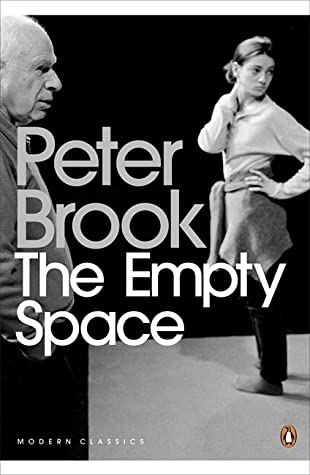
The Empty Space

by Peter Brook

2955838

This slim book sets out to be an analysis of theatre, from one of the most significant directors of the second half of the 20th century. Actually, it’s not about that: it’s about life. Peter Brook analyses theatre performances into four categories, while acknowledging that any performance can flip from one to another category in a few words. It’s completely timeless, by the way – it was written 50 years ago, but could have been written last year.

The first is Deadly Theatre. Theatre as “tradition” and “heritage” and “because that’s just how it’s done”. This was brilliantly caricatured in the third series of the wonderful Blackadder, where two actors try each the befuddled Prince Regent (Hugh Laurie) to improve his public speaking, explaining to him how you need to thrust your groin forward, throw out your arms, and start every declamation with a loud “Aaaaaahhh!!!”. It means theatre as a caricature of itself, acting with an arch view of how acting “ought” to be. In life, I see this all the time: meetings held “because this is when we have this meeting”, corporate decisions guided only by the dead hand of expectation, dismal social conventions because that’s how it was done 20, 30, 50 years ago.

Then there is Holy Theatre. This is when, as Mr Brook puts it:

it could be called The Theatre of the Invisible-Made-Visible: the notion that the stage is a place where the invisible can appear has a deep hold on our thoughts.

It’s when we see theatre performed with beauty and with love (which) fires the spirit and gives them a reminder that daily drabness is not necessarily all. Life as it out to be lived, for the moment, or for the value we bring to others.

Next comes Rough Theatre. Theatre not necessarily performed in traditional venues, but less formal, truer perhaps to the original spirit, more energised by improvisation. It is contrasted with Holy Theatre in that the former tries to look at hidden motives, while the Rough looks at real events and actions that directly affect the viewer.

Finally comes Immediate Theatre. He describes this as theatre that “asserts itself in the present”, which I think means theatre that connects and reflects directly to what’s in our hearts at the moment. He certainly talks more of the interaction with the audience in this chapter, and how much they bring to the experience. Contemporary satirical comedy, with an emphasis on the current political and social climate, and heckling from the audience turning into part of the act, seems to fit in here. More formally, Mr Brooks talks about working with actors to see how the pacing of a speech from Shakespeare might sound in modern prose, and to use that phrasing to connect and convey feeling to the audience. It’s very much about directly engaging with the audience.

Although the boundary between these four isn’t always clear, it does seem to me that if you think of them as four overlapping circles*, rather than four squares with a clear division between them, then it does make a deal of sense. And, I think, this is a very interesting perspective to bring to the world of work, and of our lives. Experiences where advertising seeks to create false “deadly” aspirations, moments in nature that are “holy”, or when we find flow in a “rough” DIY task, or when our interactions with a child are “immediate”.

Four stars for powerful stuff.

(*OK, technically to get each one of four things to overlap with the other three, you need to think of it as four overlapping spheres in a pyramid, but people look at me oddly when I say things like that, and I think you all knew what I meant anyway)