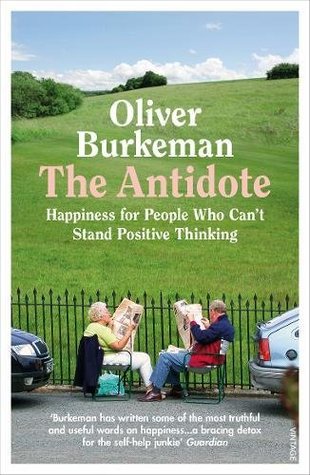
I bought this book as a present for my wife, who would have no shame in admitting that she can’t stand all the “positive thinking” malarkey. She read it, and didn’t really enjoy it, finding that it had many of the same messages for how to be happy but without the “positive” sticker on the front. So I was curious as to what lay within…
And once I’d read it, I could see her point. Many of the conclusions that Mr Burkeman comes to are, indeed, those that you might read elsewhere, but without the same spin: you would read elsewhere of the benefits of mindfulness, of Stoicism, of self-awareness in many websites and books.
The spin here, if there is one, is that you don’t have to do these things with any view that they are designed to be positive affirmations. You can just do them because they seem to work. Plus, you get to poke fun at the wilder elements of the “positivity” crowd, which Mr Burkeman does very effectively in is re-telling tales of huge conference centres with crowds chanting empty slogans about “winning” or whatever it happens to be.
So in the end I rather liked this book. From my personal point of view, I’m becoming increasingly wary of the whole move to Stoicism, as I think it may entrench particular points of view that I don’t subscribe to (in particular I fear it pushes people into accepting a bad status quo, rather than in pushing back against it).
On the other hand, I’m all-in on Mindfulness: there is clearly a bunch going on in our brains that isn’t directly accessible to us, and the identification of ourselves with our stream-of-consciousness self-talk seems like a great candidate for why so many of us are so upset, so much of the time. My cats don’t do that (or at least I don’t think they do…), and they are pretty content.
So anything that tries to break us out of this is a good thing. Plus, the book got me watching Youtube videos of Eckhart Tolle, and the guy is like Yoda, if Yoda were wearing clothes that escaped from the 1970s that his mother had knitted him, sitting and smiling and blinking and not saying much, but when he does saying wise things. How much do I love him!
Three and a half stars, rounded up to four because of the Tolle bits.
I’d heard and read so much about this book, it’s won all sorts of awards, and when I came to it myself it was… underwhelming. There seemed to me to be some rather large plot holes (given the apparent god-like powers available to some of the participants).
To be fair, there was some interesting speculative science in here as well, which I enjoyed. However, I struggled with the characters: for many of the key ones, there actions seemed at best insufficiently motivated, and at worst simply transparent devices to move the story along its determined arc. Again, I did learn some interesting things about the Cultural Revolution in China in the 1960s and beyond, but I’m not sure that was the whole point.
It’s the first of a trilogy, and I’m not sure I can face the others. Too many books with a higher probability of being excellent out there for me to risk my time on another few hundred pages which will likely be as similarly a miss for me. It’s a shame when reading becomes an exercise in Bayesian statistics, but my prior odds on the next in the trilogy being worth my time aren’t looking good right now. Maybe I’ll get enough new information to change my mind!
A moving short story about an ugly old man, a young girl, a snow goose, and the evacuation of the British Expeditionary Forces from Dunkirk in 1939. How does that even fit together in a novel, let alone in a short story?? Well, read it, and you’ll see. It’s a brilliant example of the power of the short story, masterfully painted, emotionally moving without being sentimental.
How much did I like this? Well, I didn’t enjoy it, I loved this book genuinely, straightforwardly, and, well, just tremendously!
I didn’t read anything in advance that gave me much of a clue as to what to expect, other than it vaguely involved people playing Dungeons & Dragons, at least somewhat, and it was a bit reminiscent of Ready Player One, which was my book of the year, back in the day. All of these were true, to be fair – the heroes in this tale are young adults, they play D&D, and it’s set in the 1980s. But I don’t think that makes it YA fiction, any more than it makes it “Ready Player 0.5” or something – or actually more precisely I don’t care, it was just such straightforward fun!
I’m not going to say much more than this, because SPOILERS. One of the things I really liked was that the style of writing – I found it compelling, dragging you along by the scruff, so that I had no idea what might or could happen. It caused me to read it all in a bit of a charge, and all the better for that I think. At some point I realised this was part 1 of a trilogy, so it’s not a huge book to get through in any case. The 1980’s period detail was excellent, and all the characters were well painted (although I think I ended up with less of a feeling for what was going on in Simon’s head than the others’).
One warning: there is a thing going on with cancer in this book (not really a spoiler, as you find this out in the first couple of pages). Having been through chemo myself eighteen months ago, I found the first 25 pages or so to be tough going in parts, and wildly evocative for me. Very well written, which is what made it tough going. If that’s you, stick with it, because it’s worth the ride.
Here’s what the narrator has to say about this:
To be honest, though, two minutes after being faced with a diagnosis of leukaemia is not the ideal time to have someone establish that when the medical profession says ‘cured’ it means ‘survived five years’.
Mark Lawrence has a great ability to sketch out a character in a line or two – here’s the key to one of the narrator’s friends, with an aside that also points to the witty narrative:
He knew pi to more decimal places than any sane person would want to. I sometimes joked that it was an irrational feat of memory.
Well worth the five stars, and I can’t wait for the next one!
Oh Mr. Fry, how I love thee, let me count the ways! Sadly, in the end, this book failed to be one of the ways in which that love could find its expression.
The first third was the setup: a recap of the family tree of the early gods, immortals, Titans, and other supernatural beings. This inevitably has a bit of a tendency to be an old-testament-style recitation of “X begat Y who begat Z”, perhaps spiced up a little as it is more mythic to “X slept with his sister and begat Y who then appeared as a goldfish in a dream with her uncle and thus begat Z”.
The remainder was a retelling of a number of the core stories from the resulting myths. Many I vaguely knew, although they often had surprising endings that I didn’t know (e.g. King Midas and his golden touch). Each one was just, I think, too insubstantial, told only in skeleton form, without much colour – albeit with Stephen Fry’s characteristic twist of humour. Other stories I didn’t know, but just didn’t feel improved by the knowing of.
So Mr Fry saved this as a two star book, and it makes the “it was OK” pile. I’d read more of his fiction any day, just not sure about this one…
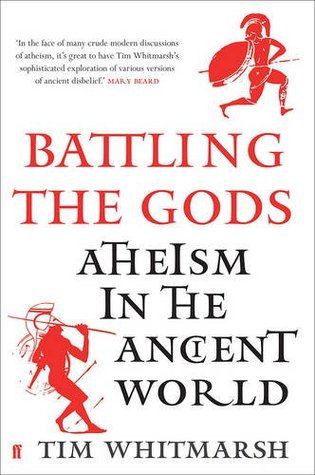
I learned three main things reading this very readable account: first, that there have always been atheists, with writers expressing various philosophical positions and arguments about atheism for all of Greek and Roman ancient history (even early Christianity having a place for it). Atheism was only ever one point on the spectrum of beliefs, but it was always around, and often attracted some high profile proponents.
Second, I found an eminently clear account of the major lines of philosophy running all the way through the ancient world. I hadn’t really seen this laid out like this before, and seeing it set against the historical political background was very helpful.
And finally, I found an interesting slant on the Stoics, which made me rather uncomfortable with the modern geek (not Greek!) revival of Stoicism as a philosophy for living your life today.
The first and the last of these are worth a bit more unpacking. The first is, of course, the main purpose of the book. Tim Whitmarsh gives us a scholarly and yet very readable account of the various threads of (non)belief in the ancient world, and how these were received by their contemporaries. He starts in about the seventh century BC, where the ancient Greek city states were enormously diverse, but didn’t seem to view organised religion in political terms, but rather “for personal communion with the divine”. It provided a vehicle for collective involvement in the community, but differences in belief were personal matters, so long as they didn’t impact the cohesion of the community. This view seems to have continued for hundreds of years – even the trial of Socrates in 399BC for (among other things) “failing to acknowledge the gods the city acknowledges” was about this risk to social cohesion, rather than any atheistic leanings per se.
As we transition into the Roman era, after the Punic Wars and the final sacking of Carthage in 146BC, we still see religion and the gods viewed in the same way: the Roman emperors after Augustus (who died in 14AD) were viewed as gods, but just one amongst many. The ensuing two centuries of Pax Romana didn’t change this: not believing in the gods was acceptable, especially if you were prepared to keep the peace by making the odd minor contribution to the community in other ways. It was only with the emperor Constantine’s conversion to Christianity on his deathbed in 312AD that we would have seen a move towards a much sharper division into “true religio” versus “false superstitio”. With this came the assumption that “all humans are born with a natural sense of the divine but that some people have been led into misunderstanding by false teaching”.
For me, this Christian belief is reflected in Christianity’s much more prosyletizing approach to religion. The Greeks and Romans didn’t really do this, because their polytheism allowed them to incorporate the gods of peoples that they conquered. Indeed, the often produced tables of equivalences, and as long as you knew which of your gods mapped to which of theirs, you could continue to worship whichever you chose (or none at all), and everyone was happy. Not so with Christianity, which was much more all-or-nothing. It’s not until the arrival of the Enlightenment that atheism became a philosophical position that could be held in the Western world (and even then, you were wise to keep quiet about it in many cases!).
All of this is the main thrust of the book, and Mr Whitmarsh provides an excellent and readable account of all of this. Definitely worth the wear on your eyeballs of reading it all.
My other learning, as I said, was a realisation that the modern revival of Stoicism has a rather unpleasant (for me) set of philosophical beliefs embedded within it. I certainly agree that many of the main thrusts of Stoicism are helpful views to hold: be resilient against the slings and arrows of outrageous fortune by anticipating the worst, act according to your beliefs, and confine your actions and your judgement to your own sphere of influence, rather than wasting too much time judging others. All good and helpful, and much lauded today by everyone from Navy SEALs to Tim Ferriss.
But in Mr Whitmarsh’s contrast of Stoicism against the other philosophies that were around at the time I saw a different side: the side that says don’t fight against conventions and the prevailing political system, don’t push back against the hierarchy, just stay in your own small world. All very well if you are already at the top of the hierarchy (as Marcus Aurelius of “Meditations” fame of course was – extraordinarily wealthy, and in due course emperor himself). But not so good for anyone in, say, the bottom half. So I need to do more personal reading here, but for the moment, whilst I will read quotations from modern fans of Stoicism with a more jaundiced eye…
So many good ideas in this book – little ways you can improve your life, each supporting one of Dr Chatterjee’s four pillars of Relax, Eat, Move and Sleep. The author is a GP in the UK National Health Service, as well as an author and occasionally a TV doctor, and one of the nice elements of the book for me was the little stories of how he has used some of these practices to improve the lives of his patients, often without having to resort to additional medication. He is a strong believer in looking at the whole person and their lifestyle, rather than just the set of symptoms, and it’s clear that this is the way forward for health across an aging population serviced by a limited set of resources. So much more effective in the end, and the interventions seem likely to be both longer-lasting and less expensive. It’s great to see a well-researched, practical book with everyday, accessible, changes that can really make a difference to how you live.
My wife read this book first and although we are both fit and eat well, we have already adopted some of his suggestions, and I now I have been through it as well we have solid list of more things that we can try!
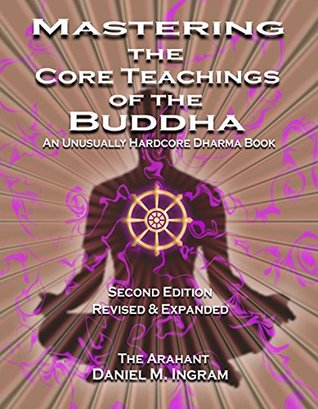
Wow. What to say about this book? Bottom line, is it provides an extraordinarily detailed and thorough account of how the classical teachings of Buddhist meditation can provide the tools necessary to move progress to full enlightenment (plus, it explains what enlightenment actually means). And we’re not talking about having to go and live in a monastery in Tibet for the rest of your life to do it. Daniel Ingram, the author, seems to have done all this while living a full and busy life, including going through and graduating from medical school.
It’s a mind-blowing book, really. On the one hand, it describes a number of very woo-woo and seemingly mystical things – from seeing your visual field tessellated with multicoloured patterns to understanding the enormous, deep, connection between all living beings (and that’s before he mentions “magick” and the effects that the ancients talk about there). He says at one point
For example, you think there are no magickal (sic) effects possible and suddenly you are seeing chakras and seem to know odd things about people that you couldn’t possibly know
On the other hand, it’s about as practical and down to earth as can be, dismissing any notion of handwaving and woo-woo models of meditative practice, with lines like:
I am no fan of most of these models of awakening. In fact, I consider their creation and perpetuation to be basically evil in the good old “you should burn in hell for perpetuating them” kind of way.
and later in the same section:
A far more practical approach is to accept that we are human, try to be decent in a normal, down-to-earth sort of way rather than in a grandiose, self-conscious, spiritual way … allowing us to be the human beings we are with more balance and less reactivity in the face of that humanity.
And for me, it’s this seeming contradiction that is one of the book’s most compelling features. He talks about all this weird stuff, but he does it in such a hands-on and down to earth way, based clearly on thousands of hours of personal experience, that I emerged more or less convinced of the core argument. Which is that these seemingly exotic states are indeed attainable to normal humans -but that you will have to put in the hours.
You do get a brief introduction to the standard practices of concentration (samatha) meditation, with its focus on the breath, on returning to the breath when you notice you’ve been distracted, and on using this to attain high states of concentration. This is at the core of apps you might have used like Headspace and Calm. This practice can bring a great deal of serenity and even bliss to you in short bursts, and Ingram talks you through the various technical levels of this, known to the Buddhists as the jhanas.
He also explains why you really should be doing this practice: because it gives you the concentration necessary to do vipassana, or insight, meditation. Vipassana meditation is where you focus really really hard on ordinary experience – on the tiny fleeting details of ordinary experience, that we never normally notice. Inside these “vibrations” lie the next levels of understanding. This starts with appreciating that your perception of phenomena is different from the actual phenomena. For example, you hear the blare of a car horn, or the tweeting of a bird, and your mind just knows it’s a car horn or a bird. But actually, in order to do this, you have to hear the sound first, before the mental construct of “car” or “bird” comes to mind. With sufficient attention, you can peel these two things apart.
Eventually, you can begin to truly see what Buddhists call the “three characteristics” of everything: that they are impermanent (they come and go), that they are unsatisfactory (ultimately they don’t fulfill you) and that they don’t cohere into a unified self, in the way that most of us think of being a unified self through time.
All this takes time, practice, and is often very hard to describe in words. Ingram focuses a lot on models of how all this comes together, and the stages one would pass through along the path. I’m not nearly a skillful enough meditator to comment from personal experience on the helpfulness or even the truth of this, but Ingram is very convincing, and he emphasises repeatedly that you don’t need to take any of this on trust, you can just try it yourself.
He is also strong on warning you of the possible dangers that may lie ahead: one of the stages he calls “The Dark Night of The Soul”, which he describes spanning stages of “Dissolution, Fear, Misery, Disgust, Desire for Deliverance, and Re-observation”. He continues to give pragmatic and helpful advice even here:
Allow me to give you two hard-won pieces of advice that I have found make all the difference in the face of these stages. First, make the time to do basic insight practices… The second piece of advice is to have a “no-bleedthrough” policy…it might be expressed by two simple mantras, “Do no harm” and “Keep your shit together”. This is obviously great advice for life in general and it applies doubly here.
Beyond this stage, things return to a more even keel, through Equanimity and on ultimately to Fruition, at which point you will attain “stream entry”, which begins your journey again at a higher, if vastly, level.
All of this is explained in detail, not only with practical instructions but also with references to probably 100 other books you might go and read for more detail about any particular section. I found this especially helpful, myself, and a number of these other books will be showing up in my Goodreads feed in due course!
Ultimately there is the question of why anyone would want to go to this much effort (a question my non-meditating wife asks me repeatedly). There is the Everest-style “because it’s there” answer, and then my usual answer of “because it gives you deep insight into the way the world actually is”. Ingram includes a lot of emphasis on the first of the three Buddhist teachings, those on morality, and he brings this into his final insights. This is about how all of our actions are shaped by our thoughts, and thus the world around us is shaped by our thoughts:
all “internal” intentions, thoughts and mental states mattered, were causal, were spell-casting, were powerful, and molded some part of the causal world. Thus, every single moment of “internal” experience must have ethics applied to it, because it matters, as it is an integral part of this whole space of manifestation. This seemingly obvious insight didn’t sink in all at once but took years to develop.
Or, as the opening lines of the most commonly read of all Buddhist texts, the Dhammapada, puts it:
All actions are led by the mind. Mind is their master. Mind is their maker. Act or speak with a defiled state of mind, and suffering will follow.
So that’s why you should meditate, and why you might want to read this book of nearly 600 pages, where I probably took on average an hour to read and digest any ten pages. It all matters, and if we want to live our life pretending it doesn’t, and leaving our thoughts, feelings and general mental state to run all over the place on its own, then we are just hiding from the (profound, obvious, but rarely realised, disturbing) truth.