We live in the 21st century, we don’t have flying cars, so can’t we at least have magic? Maybe it’s that sort of desire that has produced such a wave of “contemporary magic” books in the last decade or two. Or maybe we’ve all read too much Harry Potter, I’m not sure. Either way, this is a nice example of the genre: there’s magic, it’s out there, but it’s been fading for hundreds of years, and now us ordinary people can’t see it – and those who can, like Cordelia “Ves” Vesper, the hero of this book, seem to have a whale of a time with it.
Here, we follow Ves as she works with her new partner, Jay, to discover what’s ailing the troll communities of Britain, many of whom seem to be turning in on themselves in a rather alarming way. We’re in book 1 of a series here, so there is some development of the characters, with Ves receiving most of the spotlight, and Jay less so. I liked the setting, too, with the ancient manor house where their organisation is headquartered also playing a significant role. The writing flowed smoothly, but I did feel a little short-changed when the whole thing wrapped up in about 120 pages, all a little too neatly, and with perhaps not enough time for me to get properly engaged with the world.
Still, lots of enjoy here, so three stars for some engaging writing and interesting segments.
This is the deftly-written conclusion to the excellent Impossible Times trilogy, and I enjoyed it as thoroughly as the first two. This isn’t a book you can read without having read the first two in the trilogy – the plot line is complicated enough as it is, with several different timelines going on in different chapters, and you’re definitely doing well if you don’t need to read the helpful recap at the start of the book.
It’s a book that quite literally begins with a bang – a time-distorted explosion, of course, as it’s a prototype time machine that’s blowing up here.
“The two saving graces of explosions are that from the outside they’re pretty and from the inside they’re quick.”
It’s a book about time travel. Time travel as invented by Nick, the lead character, and the real-world implications of that. (My favourite is still that if you travel through time, you are going to also need to travel through space, otherwise when you reappear in your new time, the Earth’s orbit will have moved it from under your feet!) Time travel is, according to mathematics and the laws of physics, perfectly possible:
“The mathematics of time don’t care about ‘now’, they just ask what value you want to set ‘t’ to. There’s a special connection between consciousness and time. Einstein said, ‘Time is an illusion’, and the great Douglas Adams had even greater doubts about lunchtime.”
That reference to a Douglas Adams line is one of the reasons I loved this book, by the way. I grew up very much in the era in which this book is set, and I love all the references to the culture that Nick grew up with. I also played Dungeons&Dragons enough to get the references there, so this was always going to give this book a +3 in the saving roll against my affections. I also grew up in the early days of the World Wide Web, so references like this make perfect sense to me: I didn’t have time to write any code but the machine linked into the World Wide Web and the Lynx browser enabled me to navigate through literally hundreds of pages of information held on computers all across the planet. Well, mainly in America.
Of course it’s also a book about friendship, and how that changes through time and space. The group of friends we met in the first book are still together – and still playing the same epic D&D campaign that they started in their youth. But they’ve grown up, and grown into their respective characters. One of the nice things is how the tone of the narration has changed very credibly, as we moved from Nick as a teenager in book 1 through to threads of his adult life in the current volume. Although he’s in many ways the same Nick underneath, he’s definitely grown up in this book, and more able to deal with the situations in which he finds himself. Growing up will do that to you:
“Always the child standing there wearing an old man’s clothes, an old skin hanging from old bones, and wondering where the days went, remembering how marvelous it had been to fritter away so many slow and sunny days. And wanting more.”
It’s also a book about enemies: again, the bad guys follow you through time, both forwards and – if you give them a chance – backwards. Miles Guilder is still funding Nick’s research, and he’s still not a nice man. Charles Rust is still very much present as Guilder’s heavy, and he still very much does not like Nick. The interactions with these two drive much of the plot of the book, in ways that are foreshadowed in the earlier volumes, but still reveal in surprising and clever ways in this book.
And Mr Lawrence writes some beautiful lines, here as in all his books, that do such a great job of revealing our shared humanity, even in very tiny ways.
“The stories of our lives don’t behave themselves; they don’t have clear beginnings, and even death isn’t a clear end. We just do what we can, we take what kindness and joy we find along the way, we ride the rapids as best we’re able.”
I loved this book. I perhaps loved the first in the trilogy even more, because it caught me by surprise, but there was so much of that spirit still in here that it’s a solid five stars all the way for me.
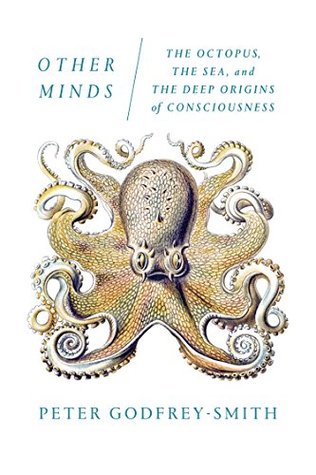
Octopuses have eight legs, we all know that. How many hearts do they have? Turns out they have three. Now, how many brains? Well, it turns out the answer to that is complicated… very complicated. And that has huge implications for how smart we think octopuses might be, along with a few of their close relations like some squids, together known as cephalopods. It also starts to nudge into an even more interesting space: that of whether octopuses are conscious or not. Because if they are, the implications are huge, and that’s what this book mainly sets out to explore:
“Cephalopods are an island of mental complexity in the sea of invertebrate animals. Because our most recent common ancestor was so simple and lies so far back, cephalopods are an independent experiment in the evolution of large brains and complex behavior. If we can make contact with cephalopods as sentient beings, it is not because of a shared history, not because of kinship, but because evolution built minds twice over. This is probably the closest we will come to meeting an intelligent alien.”
It’s a truly fascinating space to think about, and this book did a good job of introducing me to various aspects of it. The early chapters take you through the ancient evolutionary history that lead to both humans and the octopus. We go all the way back to the Ediacaran, from about 635 to about 542 million years ago. Life seems to have been very peaceful then, with creatures grazing on mats of vegetation in the early oceans. All sorts of weird things were out there:
“body forms that have since been entirely abandoned by evolution – three-sided and four-sided designs, some with quilted arrangements of plant-like fronds.”
Then some animal worked out that eating other animals gave you a lot more nutritional value than grazing, and we were in a whole new game. This is the Cambrian era of prehistory:
“During the Cambrian the relations between one animal and another became a more important factor in the lives of each. Behavior became directed on other animals – watching, seizing, and evading. From early in the Cambrian we see fossils that display the machinery of these interactions: eyes, claws, antennae. These animals also have obvious marks of mobility: legs and fins. Legs and fins don’t necessarily show that one animal was interacting with others. Claws, in contrast, have little ambiguity.”
One way to deal with this was to grow a hard shell, and hide within it, or to grow hard body parts and use them to leverage muscles. This was the path our ancestors chose. The other was that of the octopus:
“An octopus has almost no hard parts at all – its eyes and beak are the largest – and as a result it can squeeze through a hole about the size of its eyeball and transform its body shape almost indefinitely. The evolution of cephalopods yielded, in the octopus, a body of pure possibility.”
To use that possibility, the octopus has many more neurons than comparable creatures – about 500 million, close to the range of dogs, and very much larger than all other invertebrates. But these neurons aren’t largely collected in one place, as with vertebrates:
“When vertebrate brains are compared to octopus brains, all bets – or rather, all mappings – are off. There is no part-by-part correspondence between the parts of their brains and ours. Indeed, octopuses have not even collected the majority of their neurons inside their brains; most of the neurons are found in their arms.”
This is where it starts to get weird. The arms have nearly twice as many neurons as the central brain. “Each individual sucker on an octopus’s arms may have 10,000 neurons to handle taste and touch. Even an arm that has been surgically removed can perform various basic motions, like reaching and grasping.”
And still they are very smart – “smart in the sense of being curious and flexible; they are adventurous, opportunistic”. Examples abound:
“When vertebrate brains are compared to octopus brains, all bets – or rather, all mappings – are off. There is no part-by-part correspondence between the parts of their brains and ours. Indeed, octopuses have not even collected the majority of their neurons inside their brains; most of the neurons are found in their arms.”
So how does this all work? The octopus, we discover, is “suffused with nervousness; the body is not a separate thing that is controlled by the brain” – the brain is the body, or perhaps better even to say the body is the brain. If it has a language, it seems to be a language of colour and patterns, for octopuses can also produce a remarkable range of colours and patterns on their body, changing these in a second or less if needed. They do this not only for camouflage, but also, so far as we can tell, to communicate with other octopuses. Our exploration of this has barely begun, as we gather data from octopuses in the wild, but it’s certainly used for mating, and quite likely used for dominance displays.
Finally, we touch on the question of why an octopus might need intelligence like this? Neurons are very expensive things to run, from an energy point of view. Many octopuses only live for two years. Why would such a creature need such a sophisticated capability? We do not yet know.
This is a tantalizing book. The author, based on many hundreds of hours of personal observation in the ocean, and building on decades of work from others, makes a very strong case for octopuses as intelligent creatures, even as conscious creatures – as conscious as your family pet, perhaps. But different, too, with a distributed intelligence of a completely different kind than cats, dogs, and humans. There is much more we can learn about intelligence, about consciousness, about what it is to be human rather than a crab or a cat or a cephalopod, from these eight legged, three hearted, creatures with their distributed intelligence and language of colour.
Let’s be honest here, I bought this book because of the title. Don’t by a book by its cover – well, maybe, but surely you can take the title into account? I did here, and I have zero regrets.
Orhan is a military engineer. He’s never going to rise far through the ranks, despite his evident competence – he’s the wrong race, and regarded as useful, but somewhat out of his depth on a battlefield. By a series of unfortunate accidents, though, Orhan finds himself in a city that is about to be under seige. He is the sort of person who will, somewhat reluctantly, step in when others are thrashing incompetently around him, so he finds himself increasingly in demand, and increasingly in charge of the city defenses.
“as a wise man once said, the difference between luck and a wheelbarrow is, luck doesn’t work if you push it.”
Fortunately, though, he is cunning, smart, and reads a lot.
“According to the books (there’s an extensive literature on the subject) there are fifteen ways to defend a walled city. You can try one of them, and if that doesn’t work— Indeed. But the books were written for generals, kings, emperors; better luck next time, and we have plenty more cities where that one came from. And, to be fair, each of the fifteen ways is practical and sensible, provided you’ve got an adequate garrison, and sufficient supplies and materiel, and a competent staff of trained officers making up a properly constituted chain of command. What the books don’t tell you is, there’s a sixteenth way. You can use it when you’ve got nothing; no stuff, no men and nobody to lead them. Apart from that, it’s got nothing to recommend it whatsoever. Fine, I thought. Let’s give it a go.”
He’s also happy to delegate to people who do appear competent, and resourceful in working out who those might be. Honourable, he is not, but that’s not what the city needs right now. It needs resourceful, and Orhan is that.
Every stupid, bloody desperate little thing I can think of buys us a tiny scrap more time, once he gets here. It’s all ridiculous and pointless, of course, but I’ve got to try.” I looked at him. “Everyone keeps telling me what I can’t do, but they’re wrong. The only thing I can’t do is nothing.”
I liked all the references to various ancient cultures in here, mixed up in a delightful way. The main division in the city, for example, is into the Greens and the Blues – you are just born into one or the other, and they hate each other for reasons lost in the mists of time.
The story is told in the first person, so it’s (delightfully) not always clear when Orhan is being a reliable narrator of his own tale, but that just gives K.J.Parker more license to have some fun with us. I’ll be lining them up now – I loved it!
Why We Justify Foolish Beliefs, Bad Decisions and Hurtful Acts
By Carol Tavris, Elliot Aronson
Many people (but obviously not me) find it difficult to admit to their mistakes. This book explains why (although clearly it doesn’t apply to me, because I’m not like that), illustrating its points with some great examples, and explaining the experimentally-verified underlying psychological tendencies. Most important is the concept of cognitive dissonance: how we (well you lot, anyway, I’m too smart to do it) will resolve the conflict between our view of ourselves as fundamentally honest and right-minded, and any actions we may have taken that aren’t quite as honest or sensible as they might have been:
“Most people, when directly confronted by evidence that they are wrong, do not change their point of view or plan of action but justify it even more tenaciously.”
We are terrifically good at this, too. Over time we will nudge our memories so they align better with how we wish things had gone, we tell half-truths to others that we come to fully believe are justified, and maybe even actually a more realistic version of what happened. And we do all this entirely unconsciously – our minds are just seeking to resolve this cognitive dissonance, and do it all for us without our awareness. For example, talking of the first Gulf war and the invasion of Iraq:
“Before the invasion, about 46 percent of Democrats supported it; by 2006, only 21 percent remembered having done so. Just before the war, 72 percent of Democrats said they thought Iraq had WMDs, but later, only 26 percent remembered having believed this.”
Mostly we do this to make ourselves feel better, but actually it’s about reinforcing whatever our self image is. If you are that way inclined, and you have a negative image of yourself, you will reinforce that view. “Yes, I won the Pulitzer prize, but it was just a fluke, I’ll never write anything half as good again”, these people would tell themselves – quite sincerely believing it.
While we may have noticed this inclination in others, the authors are at pains to point out that we all do it – they give various annecdotes about how they did just this on one occasion or another.
“The brain is designed with blind spots, optical and psychological, and one of its cleverest tricks is to confer on its owner the comforting delusion that he or she does not have any.”
The worst aspect of this isn’t what it may do to our individual lives, but how it can play out on a larger canvas. Several chapters are given over to examples in our courts or in our political system where the implications have included everything from wrongful imprisonment of innocent people of decades, to children taken away from their parents, to corruption, to thousands of deaths in wars or accidents.
Even when we think we are certain we are not doing it this time, we may still be doing it:
“The weakness of the relationship between accuracy and confidence is one of the best-documented phenomena in the 100-year history of eyewitness memory research”
How or why do we do this? One plausible explanation is that we tend to view things that people do as due to either the situation, or due to an innate tendency on their part. When we make mistakes, this is due to the situation – I bumped into you because I was rushing to get somewhere. When others make mistakes, all too often we blame it on their character: they bumped into me because they are just plain rude. This is the so-called “fundamental attribution error”, and again, we may see it in others much more easily than we see it in ourselves.
The final chapter talks a little about how we might get better at spotting these problems in ourselves. If I had one complaint about this book, it’s about how short this section is. The advice is basically “now you know it’s a risk, you can be on the lookout for it, and catch yourself doing it”. True, I’m sure, but how, and what else might we do as well?
I shall give the last word to George Orwell, who the authors quote as putting the whole thing quite magnificently thus:
“We are all capable of believing things which we know to be untrue, and then, when we are finally proved wrong, impudently twisting the facts so as to show that we were right. Intellectually, it is possible to carry on this process for an indefinite time: the only check on it is that sooner or later a false belief bumps up against solid reality, usually on a battlefield.”
Re-read #3 for me on this, I think. It’s such a beautiful little book, only a little over a hundred pages. The prose shines like the highly polished brass of a cannon, gleaming in the sun, catching your eye with its beauty whilst simultaneously capable of blowing your mind into tiny little pieces. I found myself captivated, reading sentences or paragraphs again and again.
It’s about us reading a book:
“The line of words feels for cracks in the firmament. The line of words is heading out past Jupiter this morning. Traveling 150 kilometres a second, it makes no sound. The big yellow planet and its white moons spin. The line of words speeds past Jupiter and its cumbrous, dizzying orbit; it looks neither to the right nor to the left. It will be leaving the solar system soon, single-minded, rapt, rushing heaven like a soul.”
It’s about the process of writing a book:
“I had to discover a method to remind myself that I had water boiling on the stove… so I stuck a clothespin on my finger. It was, as it happened, a strong clothespin, and I had to move it every twenty seconds. This action, and the pain, kept me in the real world until the water actually boiled …. So that is how I wrote those nights, wrote a book about high holy art: moving a clothespin up and down my increasingly reddened little finger. Why people want to be writers I will never know, unless it is that their lives lack a material footing.”
Much of it is of course just the process of being alive – all of our lives.
“What then shall I do this morning? How we spend our days is, of course, how we spend our lives. What we do with this hour, and that one, is what we are doing. A schedule defends from chaos and whim. It is a net for catching days.”
All of it is remarkable, and much of it is also very poignant. The final chapter, on its surface about Dave Rahm, a geologist who also happens to be a world class stunt pilot, makes the hairs on the back of my neck stand up every time I read it. The clouds part, and just for a moment, your imagination conjures up, with the help of these little black shapes on bits of smashed trees and rags, a thing of Platonic beauty.
I love this book – and not least because it’s an old old copy, dating back from my youth, that has followed me across the years, and I’ve read perhaps a dozen times over that time. I feel re-joined somehow with my younger self.
This is not inappropriate for a book about time travel. Here we find Louise, the heroine, reaching back from the far future to our century. Here, her path crosses with Bill Smith. And here, Bill leads a team of air accident investigators who find themselves investigating an appalling mid-air collision between a DC10 and a 747. In which they start to find some very odd things – digital watches running backwards, for example. What exactly is going on!?
The lead characters are great – Bill is nicely written, deeply flawed man: a functional alcoholic with a relentless streak that doesn’t look like it’s going to save his career. Meanwhile Louise is trying to save humanity, one body at a time. And the plot is suitably time-twisty, without any serious impact for being 35 years old, so I’m not going to share any more of it.
Find an old copy somewhere, sit back, and enjoy the ride!
Fab conclusion to the Book of the Ancestor trilogy, with more from Nona and her friends – more action, more chases, more revelations. I loved it. As ever, Mark Lawrence can turn a sentence that makes the hair stand up on the back of your neck:
‘“Every child of the Ancestor wore red on that day when the Scithrowl arrayed their number before the Convent of Wise Contemplation. They ran short of habits for Red Sisters and instead painted the newest novices with the blood of captured heretics”.’
The channel of ice on the planet continues to close in, pushing people into more and more desperate actions:
Murder, murder, and more murder. What else could they expect when the ice kept closing? All of mankind reduced to wild animals in an ever-shrinking cage.
What matters now is who controls the ancient artifacts known as the ship hearts, and quite what the ship hearts can do when all four are brought together. Nona has managed to capture one, but others have been stolen, and the action culminates into a huge battle for possession, and for power.
Along side all this we find out more about “thread-work”, which Nona and the other Sisters are taught to navigate. I liked the hints of an underlying theory of physics as well as the mystical in here, something like Quantum Buddhism (which I sure is a thing out there, even though I just made that up).
when watching the thread-scape you learned how artificial ideas of individual objects, or even people were, since each was infinitely connected and interwoven with the world around them.
Ultimately, it’s about people, both friends and enemies:
She thought of the riddle of her life and the fact that even Abbess Glass’s best advice on the subject had been that people are complicated, especially from the inside.
Not quite the utter brilliance of the first in the trilogy, but still a cracking good read, nicely on the boundary of science fiction and fantasy, and a very sound 4 stars.
There’s an awful lot to like about this book, but it’s not a straightforward read. Hollis seems to relish obscure words and his text isn’t always easy to parse: as Benjamin Disraeli once said of William Gladstone, he seems at times almost “inebriated with the exuberance of his own verbosity”. Having said which, it’s a style thing, and it perhaps made me slow down my reading and forced me to engage more with the meaning, which was all to the good, as there’s a lot to engage with here.
When I started reading, I knew nothing of Hollis, nor of his other books, so I didn’t realise that he was by trade a distinguished psychoanalyst in the Jungian tradition. This soon becomes evident, as a lot of the book centres around the kinds of myths by which we live our lives, and the potential to transform ourselves (or at least our view of ourselves) by engaging with those myths:
“We are all exiles, whether we know it or not, for who among us feels truly, vitally linked to the four great orders of mystery: the cosmos, nature, the tribe, and self?”
I was new to a lot of this, and really enjoyed the discussion. It’s about how you confront the world:
“The dragon shows up every day, no worse for the wear, and ready to scare you back into a corner of your life, to swallow you, and to annihilate the life energy you are supposed to incarnate in this world.”
That’s our challenge, then. We must continue to show up, to face our difficulties, our boredom, our anxieties, and to live so our “daily discipline becomes: That Life Not Be Governed by Fear”. Scattered throughout the book are anecdotes taken from Hollis’s clients, which speak to these deep concerns and to the undercurrents of our lives:
Angela walks away from her marriage of twenty years. Safe, secure, valued by all, including her husband, she walks away. Why? When asked, she mumbles, “I wanted to know that I wasn’t dead yet.”
It’s about understanding our anxieties and our neurosis. Our daily lives tend to become “anxiety management systems”, but are to deeply buried that we don’t even know that this is what we’re doing, nor quite the extent to which we’re doing it. None of which is easy. In fact, in many ways it wasn’t meant to be easy – and anyone who tells you different is selling somehting:
“Why do we have psychologists in the media who conveniently fail to verify the contradictions with which we all daily live, the necessary suffering that is a by-product of real life, rather than suggest that three easy steps will bring us happiness and material affluence
Ultimately, we must become larger people – “step into largeness”, living life by verbs (actions we take), not nouns (things we own, or static truths). Or we can choose not to do that, and live instead on the scraps from the tables of other lives, which we falsely imagine somehow to be more meaningful than our own:
“The world is full of people droning on, sitting before the telly or the Internet, waiting to die, living only for small sensations of scandal or vicarious catastrophe that they can witness from afar.”
It’s our choice, though. Growth, or security – you can’t have both. It’s clear which Hollis is striving for, and although he offers us no “ten steps” or “twelve rules”, no map at all, he perhaps is offering us a compass that will give us our heading, as we cross whatever terrain our lives hold.
This is an thorough and well-argued review from Daniel Dennett of the ways in which religions might have emerged as natural phenomena in early humans, and how the pressures of evolution on this new set of social constructs might have then produced many of the traits we see in today’s religions.
His argument adds important elements to a pure psychological view of religion, although it certainly starts there. In the early chapters, Dennett argues that humans have what he calls an “intentional stance”: that in order to best predict the world, we tend to think of things in the world as rational agents, and figure out the desires, and thus the actions, of that agent. This works brilliantly for other humans, and it works pretty well for the animals that early humans might need to hunt or escape. Thus it’s easy for us to see how we might extend the same logic to other things – the weather, diseases, and so forth. From this, we can see how we might have grown to attribute apparently random changes in (say) the weather to an unseen entity behind the weather itself, and to then see the changes in the weather as reflecting true intentions of that entity. If you want to get it to rain, therefore, it makes perfect sense to try and communicate with the entity behind it, and to get the entity to cause it to rain. We attribute “agency” to the weather, and it makes sense then to try and bargain with the agent.
(As I write this, we’re in lockdown due to the COVID-19 epidemic, and this desire to treat the disease as an entity with intentions, capricious or malignant though they might be, is very visible in the way many people talk about it.)
From here, Dennett grows the argument. Everything we value, or are fearful of, we value or fear for reasons. This view of the world gives us challenges in everyday living, which early folk religions enabled us to handle, psychologically. Once in the culture, these folk religions were susceptible to the same evolutionary pressures – this time at the level of “memes” that thrive or die out – as humans themselves, only many many times faster that physical evolution. Only the best variants of these beliefs will propagate – and “best” means most successful in meeting our deep psychological and physical needs.
As human societies grew, specialised intercessors to these agents emerged (“shamans”, he calls them for convenience). Dennett goes on to suggest that these shamans, and others, had time to become more reflective, and so from these early folk religions, organized religions began to emerge. Sometimes, the simple beliefs in the folk religions were bolstered or even entirely replaced by carefully crafted reasoning. At this point, it might have become necessary to put some of these religious views out of the reach of “gnawing skepticism”, as Dennett puts it. This leads to an interesting way of splitting the world:
“This winnowing has the effect of sequestering a special subset of cultural items behind the veil of systematic invulnerability to disproof – a pattern found just about everywhere in human societies. As many have urged, this division into the propositions that are designed to be immune to disconfirmation and all the rest looks like a hypothetical joint at which we could well carve nature. Right here, they suggest, is where (proto-)science and (proto-)religion part company”
Dennett rightly spends a fair while on this point. Is it right that we treat religion, by definition, as “systematically immune to confirmation or disconfirmation? … No religion lacks these effects, and anything that lacks them is not really a religion, however much it is like a religion in other regards.” Dennett rightly points out that this view wasn’t shared by the shamans themselves: if they saw they were losing their flock to the shaman down the road, they were quite prepared to take on new approaches and ideas – to evolve. So one of the important features that emerged as folk religion merged and became organized religions was this secrecy and systematic invulnerability to disconfirmation.
Now we see Dennett broaden the view out from the leaders to the groups who also believed. He sees this as in many cases an entirely rational decision to join on the part of individuals, who would see benefits from being part of a group regardless of possible supernatural benefits from the gods themselves. There are also many possible psychological benefits in belief, but there is a darker side as well – tribalism in humans is very often reinforced by conflict, and the tendency of religions to spark conflicts and wars from prehistory to the modern day is terrifying. Of course it could be argued that they were being co-opted by pre-existing power structures, but none the less the features of very many religions do seem to be shaped, and often thrive, on conflict.
At this point, Dennett spends a while talking about “belief in belief”. This, he argues, is a very powerful force, in religions and elsewhere, and can completely transform them. For example, he points out that many feel it’s important to maintain the belief in democracy, regardless of its flaws. So we tend to play down the flaws and play up the benefits, and in doing so lose track of the logic which may (or may not) support the arguments for its value. Similarly with science – we may believe in science, we may believe that “e=mc2”, without knowing (or caring) how it is so. None the less, we believe! And, he argues, the same is true of religions. Even very devout followers may not share identical views on details of doctrine, and many lay believers will turn out to have quite different interpretations of major points. But it doesn’t matter – what matters is that they all share the belief in the importance of their beliefs.
Finally, Dennett looks at religions today. He starts to talk about whether religion is, all things considered, a good thing. Is religion good for people, he asks? There is definitely evidence that belonging to religious organisations can improve the morale, and hence the health, of participants. Believers would also argue that the meaning it gives their lives is immeasurably valuable. More specific experiments, for example on the benefits of “intercessory prayer”, give mixed results, and include at least one notorious case of academic fraud. Finally, almost all religious people see their religion as the foundation of their morality. On this point, Dennett comments
“I have uncovered no evidence to support the claim that people, religious or not, who don’t believe in reward in heaven and/or punishment in hell are more likely to kill, rape, rob, or break their promises than people who do. The prison population in the United States shows Catholics, Protestants, Jews, Muslims, and others – including those with no religious affiliation – represented about as they are in the general population … Indeed, the evidence to date support the hypothesis that atheists have the lowest divorce rates in the United States, and born-again Christians the highest.”
There is a lot I really liked about this book. The arguments are thorough, carefully constructed, and evidence is sought wherever possible. Some technical material is present in appedices, a couple of which I found useful I am, I should point out, not a religious believer of any creed, although I do think that there is a deep human need (which I feel) for the spiritual, and so I can’t comment on how a theist would have felt. I hope they would have been able to read the arguments through to the end, and Dennett I feel does a good job of presenting the best arguments on both sides.
There were a few irritations, for me at least. The very first chapter or two nearly caused me to give up, as Dennett spends an entirely unnecessary (for me) amount of time justifying the whole enterprise. He’s also very fond of italics to emphasise key words in his paragraphs, and sometimes this is perhaps too heavy handed. But it’s a forgiveable style. Four and a half stars, rounded up to five on final consideration.