Categories
Book review

The Fifth Season

The Broken Earth #1

by N.K.Jemisin

25194939

Sometimes you read a book, and you’ve no idea what’s going on for the first third of the book, but then you put together a few threads through the middle third and you enjoy how it’s going, and by the final third you absolutely love it and are upset when it ends. This was such a book, and I loved it. Some of the rest of this review might need to be shrouded in spoilers, so you can have the same experience, but it’s clear very early on that we’re in a strange world here, with lots of history, and – it turns out – lots of earthquakes. Not all of which are triggered in the usual way. Turns out, there are some people in this world that can trigger earthquakes. Turns out there are those who can feel and control (to some extent) magma flows, the slippage of plates in the crust, the crumbling of rock, and other geological things whose names I didn’t know until I read this book. Really great world building – I can’t think I’ve read anything like this before. I can see why it won the 2016 Hugo Award!

Also, by the way, great storytelling throughout. The story unfolds from multiple points of view – a woman in deep distress, a second-person narrative, a strange creature born from the stone itself, and others. How they come together is the reveal of the middle section of the book. It’s a neat approach, and very well used, but not abused. No annoying super-powers wielded by super-humans, deus ex machina-style, but rather very human characters with flaws and strengths, struggling to come to terms with the world in which they find themselves.

SO, some great characters in here, a brilliant world setting for them, and an intriguing plot. It also has enough of a wrap-up at the end of the book for you to feel satisfied – you aren’t left poised on a cliff edge. Definitely want to see more from this world, though, and there is plenty enough left unfinished to justify reading the next book(s). A well-deserved five stars.


View all my reviews

Categories
Book review

Neuromancer

by William Gibson

I haven’t re-read this for a number of years, but something made me take down my battered 1986 edition of this classic (first published in 1984 in the UK) and read it again.

It’s still a jewel of a book. To be fair, the style isn’t what you’d expect today, but honestly, that’s a bit like saying the paint job on the Night Watch needs a good going over to bring it up to modern standards (or that you prefer the style of “Game of Thrones” to “Lord Of The Rings”). Even today, this is still an extraordinarily impressive book, with deeply textured writing. You can pretty much open it at random and be captured by the intricate style – here’s what caught my eye as I flipped to page 154, for example:

A burst of French from a nearby table caught his attention: the golden children he’d seen gliding above river mist the evening before. Now he saw that their tans were uneven, a stencil effect produced by selective melanin boosting, multiple shades overlapping in rectilinear patters, outlining and highlighting musculature

It’s all very beautiful stuff, and it has influenced so much of what we read and see today. Here is where the word “cyberspace” first appeared, and herein are the first references to that consensual world inside our computers as “the matrix”. The first twenty years of the world-wide web, especially all the 3D graphics, was a conscious attempt by thousands of programmers and hackers to build the cyberspace described in the book. Here’s what we get when Case, the hero, plugs in:

And flowed, flowered for him, fluid neon origami trick, the unfolding of his distanceless home, his country, transparent 3D chessboard extending to infinity. Inner eye opening to the stepped scarlet pyramid of the Eastern Seaboard Fission Authority burning beyond the green cubes of Mitsubishi Bank of America, and high and very far away he saw the spiral arms of military systems, forever beyond his reach.

The world outside cyberspace is similar in many ways to that of Bladerunner, a sort of noir Japanese/American underworld blend, dark and noir. Apparently William Gibson saw a clip from the film when he’d written the first third of the book, and was worried people would think him derivative. He isn’t, of course: he is rather that very rare bird, out in front of the flock, exploring and indeed creating the new frontiers (his earlier short story Burning Chrome predates Bladerunner and is set in the same world as Neuromancer).

The plot is as fractal as the writing, revolving around a hacker, an augmented mercenary, and an AI, in a world ruled by corporations, with genetic engineering, exotic drugs, and (of course) cyberspace, but I won’t try to summarise it, other than to say you need to keep your wits about you to follow it, but there is a plot there, saying something interesting – it’s worth it.

One thing I did notice with this re-read, is quite how short the book is, compared to much modern science fiction. It’s a little over 300 pages in my compact paperback, versus the 500-odd you might commonly find today. And I think it’s all the better for it. It was written on a typewriter – a Hermes 2000, apparently, described by Gibson in an interview for Playboy as “a very Ernest Hemingway sort of war-correspondent-for-the-Spanish-Civil-War machine, from my wife’s step-grandfather who was a journalist”. I think it’s all the better for that. The capability pretty much any author has now to write a hundred thousand words and hit publish does, I think, all too often lead to too much fat. This book is what you’d get after a full-on keto diet: lean, wiry, and so sharp you almost cut yourself reading it. It’s almost science fiction as poetry, in the old style of Samuel R. Delany’s Dhalgren, or Philip K. Dick (who of course wrote Do Androids Dream of Electric Sheep?, which Bladerunner is based on, although the Japanese/American noir blend of the film isn’t in the book at all).

Thirty-plus years after my first read, I am still captivated. A brilliant five stars.

Categories
Uncategorised

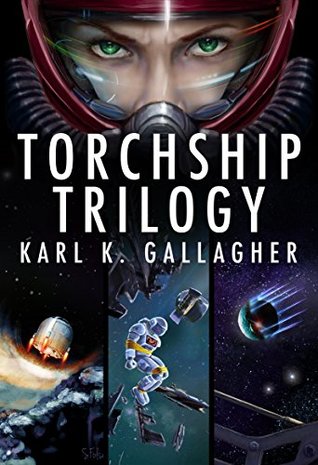
Torchship Trilogy

by Karl K. Gallagher

Torchship Trilogy by Karl K. Gallagher
Categories
Book review

The Quantum Magician

by Derek Künsken

41140983. sy475

It took me maybe 30 pages to get into The Quantum Magician, but then it got it’s teeth into me, and I loved it. Great storytelling and plotting, brilliant future technologies and enhanced trans-human capabilities, all combined with very credible characters.

Several different new human “species” have been artificially created in the world of The Quantum Magician; our central character, Bel, is a Homo Quantus, capable of transforming part of his brain into a quantum computer. This makes him a subtle, complex, computational machine, capable of handling problems in dozens of dimensions. But while he’s in this state his human side – his soul, as it were – is shut down. If you read books going back as far as the Iliad, you see that human behaviours haven’t evolved for the last two and a half thousand years, regardless of our enhanced technologies, and so there’s no particular reason to expect us to do so in the next two thousand. This book’s main driver is this thesis – the characters, and their new trans-human abilities: how does this ability affect them – how does it affect Bel? You’ll meet several other such puzzle pieces, each with their strengths and weaknesses, some quite grotesque, but all (even the superficially evil) entirely credible.

Bel has left the planet that created him, and has turned his talents to studying that most complex of problems, the behaviours of other people. But he needs money to live and satisfy his expensive hobbies, so he combines all this and has become a galactic-class con man. He’s hired by a small vassal government to help them with a problem worthy of his talents: smuggle a dozen spaceships across one of the most tightly controlled borders in space. To do so he hires a gang of other misfits and experts in various shady arts, and together they set out to pull the con – and to try to make sure they each emerge with as much of the credit or loot as possible.

To say more would risk spoilers. And although this plotline is wrapped up by the end, there are ample opportunities to revisit this world and some of the players, and I look forward to further encounters very much.

Categories
Book review

The Three-Body Problem

by Liu Cixin (Author), Ken Liu (Translator)

20518872

I’d heard and read so much about this book, it’s won all sorts of awards, and when I came to it myself it was… underwhelming. There seemed to me to be some rather large plot holes (given the apparent god-like powers available to some of the participants).

To be fair, there was some interesting speculative science in here as well, which I enjoyed. However, I struggled with the characters: for many of the key ones, there actions seemed at best insufficiently motivated, and at worst simply transparent devices to move the story along its determined arc. Again, I did learn some interesting things about the Cultural Revolution in China in the 1960s and beyond, but I’m not sure that was the whole point.

It’s the first of a trilogy, and I’m not sure I can face the others. Too many books with a higher probability of being excellent out there for me to risk my time on another few hundred pages which will likely be as similarly a miss for me. It’s a shame when reading becomes an exercise in Bayesian statistics, but my prior odds on the next in the trilogy being worth my time aren’t looking good right now. Maybe I’ll get enough new information to change my mind!

Categories
Book review

One Word Kill

by Mark Lawrence

39792427. sy475

How much did I like this? Well, I didn’t enjoy it, I loved this book genuinely, straightforwardly, and, well, just tremendously!

I didn’t read anything in advance that gave me much of a clue as to what to expect, other than it vaguely involved people playing Dungeons & Dragons, at least somewhat, and it was a bit reminiscent of Ready Player One, which was my book of the year, back in the day. All of these were true, to be fair – the heroes in this tale are young adults, they play D&D, and it’s set in the 1980s. But I don’t think that makes it YA fiction, any more than it makes it “Ready Player 0.5” or something – or actually more precisely I don’t care, it was just such straightforward fun!

I’m not going to say much more than this, because SPOILERS. One of the things I really liked was that the style of writing – I found it compelling, dragging you along by the scruff, so that I had no idea what might or could happen. It caused me to read it all in a bit of a charge, and all the better for that I think. At some point I realised this was part 1 of a trilogy, so it’s not a huge book to get through in any case. The 1980’s period detail was excellent, and all the characters were well painted (although I think I ended up with less of a feeling for what was going on in Simon’s head than the others’).

One warning: there is a thing going on with cancer in this book (not really a spoiler, as you find this out in the first couple of pages). Having been through chemo myself eighteen months ago, I found the first 25 pages or so to be tough going in parts, and wildly evocative for me. Very well written, which is what made it tough going. If that’s you, stick with it, because it’s worth the ride.

Here’s what the narrator has to say about this:

To be honest, though, two minutes after being faced with a diagnosis of leukaemia is not the ideal time to have someone establish that when the medical profession says ‘cured’ it means ‘survived five years’.

Mark Lawrence has a great ability to sketch out a character in a line or two – here’s the key to one of the narrator’s friends, with an aside that also points to the witty narrative:

He knew pi to more decimal places than any sane person would want to. I sometimes joked that it was an irrational feat of memory.

Well worth the five stars, and I can’t wait for the next one!