A book about words, where they come from, how their use has evolved, and how interconnected they all are. Sounds brilliant? So why only three stars – what’s not to like? Well…. it’s a bit all over the place, albeit by design. Each short section is maybe two or three pages, and covers a few related words, with anecdotes and jokes and origin stories and links to other curiosities.
In the end, it was a bit like being trapped at a party by a very smart person, who was entirely happy to show how smart they were, thirty-two times in a row. Each individual instance was entertaining, just the overall effect did not make a great book. I confess I had to put it beside the loo and read it in brief bursts, to preserve my sanity. Fun, but not quite as much fun as I’d hoped.
How do we know what’s going on in the world? How do people come to take action based on that understanding – be it catching a ball, typing a book review, learning long division, or building a hadron collider (of any size)? Andy Clark sets out a compelling story of how all this has been coming together in neurophysiology over the last few years into a model based on a hierarchy of processing elements, from the raw sensations upwards, with feedback from the higher levels back to the lower ones.
This model is called ‘predictive processing’, and if offers a compelling, unified view of how brains seem to work in the world. Crucially, the hierarchies of processing layers in brains don’t just sit there waiting for input, but rather they are always predicting what they expect to see coming up from the lower level, noticing any errors, and passing those errors up to the next level whilst simultaneously passing back down an updated prediction as to what might be going on. This means we actively build and re-build models as we go and as we act, rather than waiting for a complete model to become available and then deciding how to act.
The story told here is compelling, detailed, and fits with our emerging understanding both of the data from animal (including human) experiments and of computational models such as neural networks. It explains all sorts of things like dreams, saccade movements of our eyes, and some of the mechanics of language processing. It’s a great story, and I suspect the truth as we eventually uncover it will be more or less along these lines.
Having said all of which, I didn’t find this an easy book to read. Andy Clark is a Professor of Logic and Metaphysics at Edinburgh University, and even as a sciency person myself, I found his prose style dry and, well, academic. There were a few typos that I spotted, and a bit of a heavier hand with the editing might have helped. My complaints here vary from his desire to make up new words like “surprisal” where we already have perfectly good ones like “surprise”, to mixing between a description of hierarchies as sometimes going from front to back, and sometimes going from low to high – occasionally using both in the same sentence. It meant I could only read a few pages at a time before I lost the thread – although I would say there were helpful summary sections at the beginning and end of each chapter, which helped me keep my grip on things, more or less.
My favourite chapter summary, by the way, was for Chapter 8, The Lazy Predictive Brain, which opened up talking about a famous 1989 paper on robotics called “Fast, Cheap, and Out of Control”. Which always sounds like a fun Saturday night to me! (or perhaps that’s just my brain hierarchy switching from up-down to front-back…)
The book is dense with footnotes and references, which is great if you’re another person in this field, but less useful if you’re a more general reader. So although this was a very interesting book in many ways, and I suspect really really good if you’re in this field, I’m only going to give it 3 1/2 stars for myself, rounded down to three for prose density.
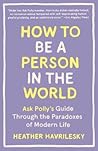
Well, what a marvelous book this is: a collection of long, wise, sweary, ranty, and very very funny responses from the advice columns of Heather Havrilesky. Never afraid to say to her correspondents “oh yes, I also did that enormously stupid thing for five years in my thirties”, she manages also at the same time to dispense sage words, with enormous kindness and empathy to the person on the other end of the letter.
No matter how you are living your life right now – regardless of how badly or how well you are doing in the game we all have to play through to the end – you will learn something from these pages. One to read, re-read, and then read some more until the pages start to fall out.