by Stephen King

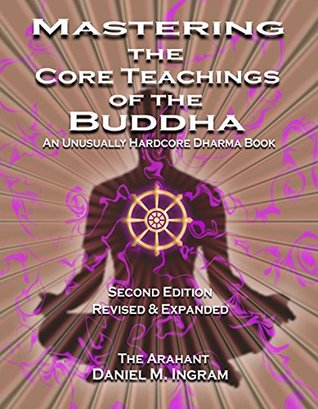
Wow. What to say about this book? Bottom line, is it provides an extraordinarily detailed and thorough account of how the classical teachings of Buddhist meditation can provide the tools necessary to move progress to full enlightenment (plus, it explains what enlightenment actually means). And we’re not talking about having to go and live in a monastery in Tibet for the rest of your life to do it. Daniel Ingram, the author, seems to have done all this while living a full and busy life, including going through and graduating from medical school.
It’s a mind-blowing book, really. On the one hand, it describes a number of very woo-woo and seemingly mystical things – from seeing your visual field tessellated with multicoloured patterns to understanding the enormous, deep, connection between all living beings (and that’s before he mentions “magick” and the effects that the ancients talk about there). He says at one point
For example, you think there are no magickal (sic) effects possible and suddenly you are seeing chakras and seem to know odd things about people that you couldn’t possibly know
On the other hand, it’s about as practical and down to earth as can be, dismissing any notion of handwaving and woo-woo models of meditative practice, with lines like:
I am no fan of most of these models of awakening. In fact, I consider their creation and perpetuation to be basically evil in the good old “you should burn in hell for perpetuating them” kind of way.
and later in the same section:
A far more practical approach is to accept that we are human, try to be decent in a normal, down-to-earth sort of way rather than in a grandiose, self-conscious, spiritual way … allowing us to be the human beings we are with more balance and less reactivity in the face of that humanity.
And for me, it’s this seeming contradiction that is one of the book’s most compelling features. He talks about all this weird stuff, but he does it in such a hands-on and down to earth way, based clearly on thousands of hours of personal experience, that I emerged more or less convinced of the core argument. Which is that these seemingly exotic states are indeed attainable to normal humans -but that you will have to put in the hours.
You do get a brief introduction to the standard practices of concentration (samatha) meditation, with its focus on the breath, on returning to the breath when you notice you’ve been distracted, and on using this to attain high states of concentration. This is at the core of apps you might have used like Headspace and Calm. This practice can bring a great deal of serenity and even bliss to you in short bursts, and Ingram talks you through the various technical levels of this, known to the Buddhists as the jhanas.
He also explains why you really should be doing this practice: because it gives you the concentration necessary to do vipassana, or insight, meditation. Vipassana meditation is where you focus really really hard on ordinary experience – on the tiny fleeting details of ordinary experience, that we never normally notice. Inside these “vibrations” lie the next levels of understanding. This starts with appreciating that your perception of phenomena is different from the actual phenomena. For example, you hear the blare of a car horn, or the tweeting of a bird, and your mind just knows it’s a car horn or a bird. But actually, in order to do this, you have to hear the sound first, before the mental construct of “car” or “bird” comes to mind. With sufficient attention, you can peel these two things apart.
Eventually, you can begin to truly see what Buddhists call the “three characteristics” of everything: that they are impermanent (they come and go), that they are unsatisfactory (ultimately they don’t fulfill you) and that they don’t cohere into a unified self, in the way that most of us think of being a unified self through time.
All this takes time, practice, and is often very hard to describe in words. Ingram focuses a lot on models of how all this comes together, and the stages one would pass through along the path. I’m not nearly a skillful enough meditator to comment from personal experience on the helpfulness or even the truth of this, but Ingram is very convincing, and he emphasises repeatedly that you don’t need to take any of this on trust, you can just try it yourself.
He is also strong on warning you of the possible dangers that may lie ahead: one of the stages he calls “The Dark Night of The Soul”, which he describes spanning stages of “Dissolution, Fear, Misery, Disgust, Desire for Deliverance, and Re-observation”. He continues to give pragmatic and helpful advice even here:
Allow me to give you two hard-won pieces of advice that I have found make all the difference in the face of these stages. First, make the time to do basic insight practices… The second piece of advice is to have a “no-bleedthrough” policy…it might be expressed by two simple mantras, “Do no harm” and “Keep your shit together”. This is obviously great advice for life in general and it applies doubly here.
Beyond this stage, things return to a more even keel, through Equanimity and on ultimately to Fruition, at which point you will attain “stream entry”, which begins your journey again at a higher, if vastly, level.
All of this is explained in detail, not only with practical instructions but also with references to probably 100 other books you might go and read for more detail about any particular section. I found this especially helpful, myself, and a number of these other books will be showing up in my Goodreads feed in due course!
Ultimately there is the question of why anyone would want to go to this much effort (a question my non-meditating wife asks me repeatedly). There is the Everest-style “because it’s there” answer, and then my usual answer of “because it gives you deep insight into the way the world actually is”. Ingram includes a lot of emphasis on the first of the three Buddhist teachings, those on morality, and he brings this into his final insights. This is about how all of our actions are shaped by our thoughts, and thus the world around us is shaped by our thoughts:
all “internal” intentions, thoughts and mental states mattered, were causal, were spell-casting, were powerful, and molded some part of the causal world. Thus, every single moment of “internal” experience must have ethics applied to it, because it matters, as it is an integral part of this whole space of manifestation. This seemingly obvious insight didn’t sink in all at once but took years to develop.
Or, as the opening lines of the most commonly read of all Buddhist texts, the Dhammapada, puts it:
All actions are led by the mind. Mind is their master. Mind is their maker. Act or speak with a defiled state of mind, and suffering will follow.
So that’s why you should meditate, and why you might want to read this book of nearly 600 pages, where I probably took on average an hour to read and digest any ten pages. It all matters, and if we want to live our life pretending it doesn’t, and leaving our thoughts, feelings and general mental state to run all over the place on its own, then we are just hiding from the (profound, obvious, but rarely realised, disturbing) truth.

A detailed and hands-on look at the different patterns of behaviour that make up the Language And Behaviour (LAB) profile. Each pattern is explained, together with some guide questions that will allow you to determine how the participant fits against the profile. The patterns themselves are derived from NLP, and there has been some good work to establish that they are consistent within particular individuals in a particular context, and also that different interviewers will spot the same patterns in a person.
Understanding the patterns is very useful for a number of things. For example, if you’re interviewing for a particular job, you could usefully think about the characteristics of the job – do you need a creative person, or one who follows processes very well, for example? Each of the patterns will help you think about the role, and give you some very useful questions to ask candidates. Or if you’re selling a product face to face or online, thinking through the characteristics of your intended buyer will help you shape the language you use in the sales pitch. And I first came across the LAB profiles at work, where a consultant interviewed my management team and some of the staff and produced a very helpful set of profiles that allowed us to reshape the organisation to be much more effective.
As a particular example, some people are “towards” motivated, while others are “away” motivated. So when you ask someone why they did something in a particular context (e.g. why they took their current job), if they are “towards” motivated they might say “because of all the great opportunities this job offered”, whereas if they were “away” motivated they might say “because my old boss was quite difficult and I didn’t like the commute”. Both are likely true, but people will focus on one or the other depending on their towards/away inclination in the work context. Some jobs require “away” motivation (health and safety), while others are more suited to “towards” (sales).
Overall this is a very useful practical guidebook more than a pop-psychology book. Having said which, it’s hard to read the patterns and not think about where we might fit on them, and if you are reasonably insightful you’ll make a pretty good guess! My only negative comment would be that I read my copy on a kindle, and the formatting was a bit screwy at times – lots of tables and text boxes, which didn’t always come out perfectly. If I were to need to refer to this book a lot, I would likely buy a paper copy.
Full disclosure: I received a free ARC softcopy of this book. My comments and rating are accurately reflective of what I felt reading it.

There’s a lot that I liked about Team Human: the underlying thesis is that we have let technology into many corners of our lives without thought for many of the consequences, and that the motives of those driving the technology adoption are often very poorly aligned with those of the users of the technology. The result is often a significant level of social isolation and repression, and Rushkoff proclaims loudly that the default answer of “add more technology to fix it” is unlikely to improve things. For me, it’s undeniably true, and the author does a great job of assembling a manifesto make his points.
The structure of the book was interesting, too – 100 short sections, varying from a few paragraphs to two or three pages. I did find it frustrating at times, though, as very often you would meet assertions that you disagreed with, and although there are footnotes on each section at the end of the book, I often had to do a reasonable amount of googling to find the supporting evidence. I sometimes didn’t find the evidence very convincing, either – e.g. in #58, where he refers to Penrose and Hameroff’s “Orch OR” theory of quantum consciousness, which is widely regarded as at best somewhat hokey science, and likely to be just flat out wrong.
Also worthy of comment is that the physical book itself is beautifully put together, in a non-traditional way. I almost always buy on Kindle, but I didn’t with this one, because (a) I was able to follow the book’s own thesis of more local, distributed, human activity by buying it from my local small bookshop, and (b) I wanted to own the physical hardback. Definitely worth it (plus you get to Stick It To The Man by doing so…)
The ultimate question is I suppose whether there’s actually anything we can do about any of this. Can we stop the tech juggernauts taking all our data and using vast clouds of Big Data machines and machine learning algorithms to work out how to drive us towards their desired economic behaviours (usually, although interestingly not always, they’re economic)? I don’t know if we can stop it, but I know if we don’t try to at least chisel away a little at that rock face, we’ll very likely regret it.

Today, even more than when the book was written in the early 1990s, this subject area is extremely fraught. Many seek to deny that gender differences are anything other than cultural programming, and in this work the author goes to great lengths to explain the substantial evidence pointing to (a) their existence, and (b) their evolutionary origins, as opposed to cultural origins.
I was a little worried that the 25 years or so since this book had been published would have produced new evidence that contradicted this thesis. Coincidentally, within a couple of hours of finishing the book, I came across well-reasearched current papers supporting the core points of the book: https://digest.bps.org.uk/2019/03/13/…
We can see through these arguments that women are driven by evolution to want different things in their partners than men: on the whole, women are genetically programmed to seek to mate with men of status, so their genes get a leg up the power hierarchy, as higher-status men generally have higher-status children, and generally more of them. Meanwhile, men are programmed to seek younger women, as they may father more children by them.
But as the book points out repeatedly, we have the significant capability to rise above our “programming”: murder is entirely natural, but it doesn’t mean we want it ruling our current society. So the question can still legitimately be asked as to whether we want to be like this: if so, how do we wish to set up our culture, and then, how might we judge those who fail to meet our new (culturally created) standards.

“It’s time to get the band back together.”
Many things to like here, in particular the core idea of the adventurer teams as analogous to rock bands, complete with tours and arenas and individual characters, and many lines quoted from movies about bands that you’ll know – from Blues Brothers to The Princess Bride to Spinal Tap. That worked brilliantly, and lent the book a different and often very funny perspective. The characters were well drawn, too, in particular Clay Cooper, but also some of the more peripheral characters – I would love to see more of Jain and her band, for example.
There are some very funny lines in here, though, even aside from the references to other things:
“Please,” he prayed to whichever of Grandual’s gods was in charge of killing people at random with the corpses of chimeras, “grant me this one… fucking… thing.”
Or we could go with:
“They served the most incredible brunch: poached basilisk eggs and toasted bread with brown butter preserve. No one does a good basilisk egg anymore,” he remarked sadly, and Clay heard Ganelon mutter under his breath: What the fuck is brunch?
For me, although there was a lot to like, the flow of the story didn’t always work, and there was perhaps a little too much “deus ex machina” intervention to keep the plot moving forward. In the end, this was still a very entertaining book, and an excellent first novel. I will read more from Nicholas Eames, for sure. But the original and still the best, for me, of this modern fantasy genre is Joe Abercrombie. Up against such illustrious comparisons very few can hold up, but I can still give Kings of the Wyld a happy four stars.

I was looking forward to this, after the lovelieness from Rachel Joyce that was Harold Fry’s unlikely pilgrimage. It’s a story about music, and love, and how people can fall in love with music they didn’t know they needed to hear. I’ll resist drawing a parallel with the four sections of a symphony, but it’s there if you want it, I’m sure. The incidental characters were I felt in many ways better drawn than the main actors, and the setting of the 1980s small English city was very well done.
In the end, it was a bit of a curate’s egg – good in parts. Loved the beginning, loved the end, I felt a bit lost in the middle. Maybe three and a half stars. And if you aren’t sniffling back the tears at the end, you have no heart.
The Small Big: Small Changes That Spark Big Influence by Steve J. Martin
My rating: 4 of 5 stars
An interesting and generally very practical book: 52 short chapters, each with a specific, straightforward, and tested, suggestion for how you might influence people to get a particular outcome.
– Having problems getting people to attend their appointments for your clinic? Get them to write down the time and date on a slip themselves, or read it back to you over the phone – this improves rates over simply giving them a printed slip with the details.
– Want to improve your own likelihood of going to the gym or remembering to meditate? Visualise the specific details of what you’re going to do as you start the process, in advance of when you want it to happen. Better yet, write these details down in a short note to yourself.
– Want to improve your tips as a server in a restaurant? Put a sweet or a mint on the tray with the bill for each person in the group – and then come back after a minute with another mint or two.
And so on. Each chapter will only take you ten minutes to read, and although you may have come across some of the suggestions before if you’ve read the authors’ other works, there will very likely be some that are new to you. And by the way, the authors are not science journalists, but are among the most widely recognised leaders in this field – Cialdini, for example, is the most referenced author ever in the field of social influencing.
Clear, helpful, actionable: what more could you ask?

4 stars
Three and three quarter stars, really, but rounded it up to four as it has potential for the rest of the series (and minus a quarter star for the cover art – I mean I know sex sells, and it’s fun, but it nearly put my wife off reading it, which would have been a shame as she loves them now!)
Quite a fun fantasy-in-the-modern-world story: you’ve got shapeshifters, werewolves, vampires, and the fae, all hiding in plain sight in the modern world. A slight twist in this world is that the fae – at least the “lesser” fae – have been outed, and their existence is known to us mundanes.
The plot is centred around Mercy Thompson, a shapeshifting car mechanic, and the troubles she gets into with the neighbourhood werewolves. Her next-door neighbour is the alpha of the pack, and tends to do things like leave Mercy’s pet cat on her doorstep with a note saying “please keep your cat off my lawn, or I might eat him”. Things get complicated when Mercy hires a drifter type to help out in the garage, who she quickly realises is a “lone wolf” werewolf, one without a pack.
The story is fun, with quite a lot of scene setting in the first half, but the pace picks up in the back half and I enjoyed the ride. I will definitely pick up the next one if I’m off on holiday and fancy an entertaining read on the beach!
La Belle Sauvage by Philip Pullman
My rating: 5 of 5 stars
Philip Pullman is back, and it’s awesome! I read the original Pullman books when they first came out, but not since then, which means my memories of them are vague, and probably influenced by the movie (which was good, but the Armoured Bears and Zepplins of my imagination were way cooler).
La Belle Sauvage fairly rips along – I was gripped from the start, and found myself unable to put it down at various crucial junctures of the storyline. It centres around Malcolm, the young son of the owners of an inn to the north of Oxford, and you also meet some of the other characters from the series, such as Lord Asriel and Mrs Coulter, although they play much smaller parts. I won’t give too many plot details because, spoilers, but I loved it all. It ends at a logical point, but as it’s the first in a trilogy, one is definitely left in anticipation of the next one, if only to enter the magical world once more.
This book is set in the same world as The Amber Spyglass series, but ten years earlier, with Lyra as a little baby. Malcolm is a young adult, and the writing in this book is straightforward and accessible. I’m sure this book would be enjoyed by younger people – my kids at that age would have loved it – but as with the other books in the sequence, it’s by no means YA fiction, with some complex themes opened up, and Pullman’s characteristically dark views of the established church firmly on display.